
Council considers new MAGIC Fund guidelines
Proposal would create eligibility categories
Trending
MAGIC Fund dollars would go to more defined uses under proposed guideline changes offered by a review committee to the Minot City Council Monday.
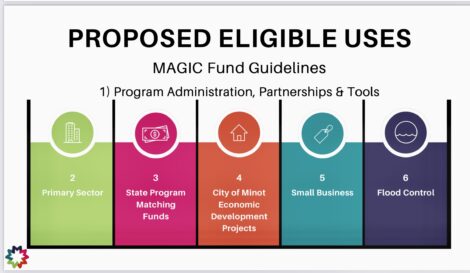
The proposal, which the council is expected to act on at its Dec. 18 meeting, sets aside money for fund administration and creates eligibility categories for primary sector companies, small businesses, matching funds for state programs, City of Minot economic development projects such as downtown facade improvements and wayfinding signage, and flood control.
Council members questioned using MAGIC Fund dollars for flood control.
Brekka Kramer, president of the Minot Area Chamber EDC, said previous guideline revisions already in place made flood control eligible. Flood control is included because it is an allowed use for sales tax, she explained.
"Our goal is, obviously, to put the economic development priorities first," she said.
The proposals also set limits for the amount of money in the MAGIC Fund and in each of its buckets.
The Primary Sector Business Program Fund couldn't exceed $10 million but if it falls below $3 million, the fund would become the priority bucket to receive incoming economic development sales tax dollars to bring it back up.
The maximum for other buckets is: $1 million for state program matching funds; $800,000 for city economic development projects and $300,000 for small businesses. Flood control has no minimum or maximum.
The MAGIC Fund currently has about a $9 million balance, of which a certain share is already allocated. City Manager Harold Stewart said if the proposed guidelines are adopted, based on available money, the MAGIC Fund buckets would start with $5 million for primary sector, $1 million for state matching, $595,211 for city economic development and $300,000 for the small business fund.
The revised guidelines also detail how funds can be moved from one bucket to another upon a supermajority vote of the city council.
Primary sector and small business applicants would be eligible for forgivable or non-forgivable loans, but forgivable loans cannot account for more than 20% of total project financing for a primary sector business without a supermajority vote of the city council.
Funding available for program administration includes appropriations to Task Force 21, Retail Coach, MACEDC and Souris Basin Planning Council.
The proposed guidelines address conflicts of interest that may arise within the City of Minot, MACEDC, MAGIC Fund Screening Committee or city council.
The policy states any "direct and substantial personal or pecuniary interest" in a matter be disclosed in a written letter or email to the corresponding board, committee or city council before that entity takes up the matter. A conflicted member shall not participate in evaluating or debating the merits of a proposal without the consent of a majority of the rest of the body.
"I think the conflict of interest section needs to be tightened up just a touch," council member Stephan Podrygula said. He suggested conflicts of interest be publicly declared and that boards not be allowed to let a conflicted member participate.
"I really don't care if the majority says you can participate in discussion, I think that's wrong," Podrygula said. "If you have a conflict of interest in some things before your organization, I really don't think you should participate in any discussion or any vote - even if the majority thinks that's fine. I don't think that's fine at all."
Council members also brought up concerns from the public about the editing of the document by city staff and MACEDC. Stewart explained the editing was done by the city attorney and others to ensure the draft was legally sound and administratively workable. The review committee then assessed those updates before giving its final recommendation.
Kramer said changes to the document after that point were minor fixes, such as grammar corrections, that did not affect the substance.
Council member Lisa Olson raised a constituent's concern about the approval process for MAGIC Fund applications, which often starts with MACEDC as lead agency and could end there if not advanced.
Stewart said screening of applications needs to occur to ensure applicants meet eligibility, goals and objectives for receiving public dollars. Both MACEDC and the MAGIC Fund Screening Committee serve that purpose, he said.
"We have a stopgap in there to preclude continuing to take it up the chain if it's already been identified as a bad idea," Stewart said. "If we want the council to make the final decision on it, then we need to save everyone's time and not have the screening committees because what are they accomplishing?"
Olson said the concern is projects advance or fail based on the wishes of MACEDC, with no appeal.
"I certainly have no issue with them making sure that it's ready to proceed forward. But, I'll agree with this constituent in saying it would be nice for us to realize that an application had been denied - if that applicant chose to bring it forward," she said of having an appeal option.
Kramer said actions taken by MACEDC on applications are detailed in meeting minutes provided to the council.
"We want to be fiscally responsible and also be the advocates for any kind of development in our community, but we also want to be conscientious of everyone's time, and if an application does not meet the guidelines in any way, you won't see those moving forward," she said.