
Returning to Minot roots
Former resident recalls Japanese-American history in Minot; Downtown cafe was part of community life
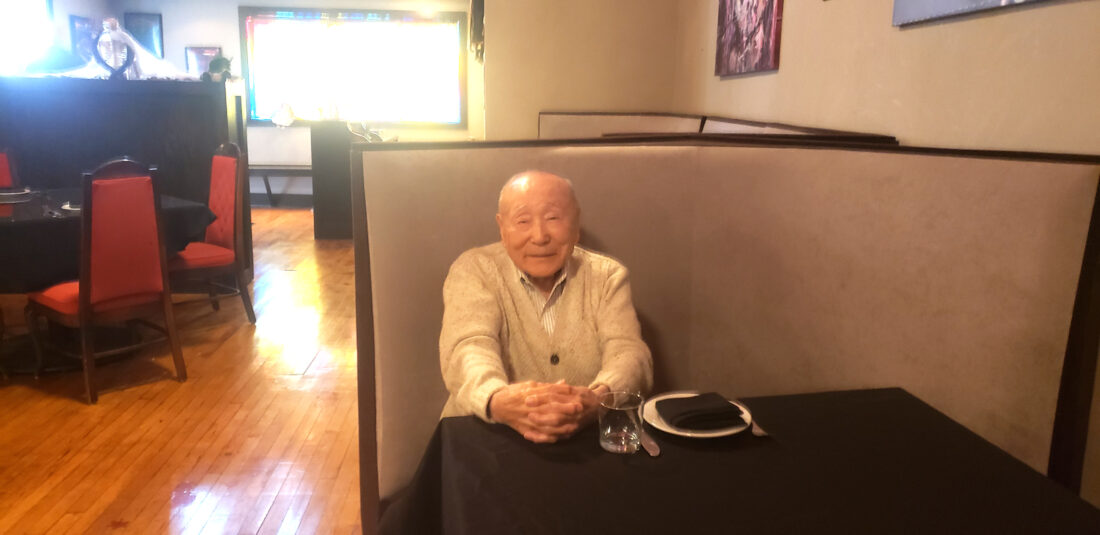
Submitted Photo Roy Toyama sits at the 10 North Main Smokehouse Bar and Grill originally owned by his father as the U.S. Cafe.
Roy Toyama, son of the late Tom Toyama, the original owner of the U.S. Cafe, now 10 North Main Smokehouse Bar and Grill, recently came back to his hometown, Minot, with his wife Kate, and daughter Summer Branum. Toyama, now of Liberty Lake, Washington, worked at the restaurant as a teenager, alongside his brother in the 1930s.
The Toyamas owned the restaurant with a partner, Jack Suto, from about 1918 and developed it into an establishment.
Toyama’s father worked vigorously at the cafe.
“He would leave before we left for school in the morning and get home at around 7:30 p.m. exhausted. We did not see much of him. He sacrificed much all those years,” Toyama said.
Toyama said the cafe was always lively but things got quiet during the Depression. A lot of Minot establishments were going out of business, but he said his father persisted.
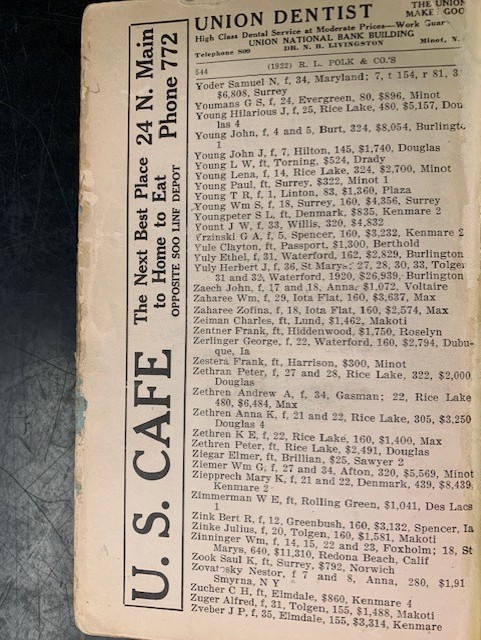
Eloise Ogden/MDN An ad, shown in this photo, for the U.S. Cafe, then owned by the late Tom Toyama, ran in the 1922 Minot-Ward County Directory. During that time the cafe’s address was 24 N. Main.
“Businesses all struggled. There was not a lot of traffic except for Saturday nights,” said Toyama. “My father lost his partner two years after the Depression began and my mother was tied up with raising a family. Sometimes funds got so low he couldn’t afford to pay the salary, but there weren’t any other jobs to go to either.”
Toyama recalls there was an unusually large group of people of Japanese ancestry inhabiting Minot during the era. He estimates there were about 60-75 Japanese Americans living in Minot at the time, making it the largest group between Minneapolis and Spokane and more than in Grand Forks or Fargo.
“They came out here slowly, one by one, and settled in Minot for the Great Northern, the railroad that still runs through here,” Toyama said.
Toyama’s father came in 1912 and wrote back home to tell his family he would like to have a wife.
“He found this woman who was a schoolteacher of Japanese history and a college graduate. Why she came from beautiful Japan to the middle of North Dakota, I will never understand,” Toyama said. “She came to the middle of an isolated, desolate state and had no one to speak Japanese to except her children. She had to teach us how to speak Japanese, and that was my first language.”
The Japanese attack on Pearl Harbor on Sunday, Dec. 7, 1941, cast the U.S. into World War II.
On Dec. 8, the Japanese American residents of Minot placed an advertisement in The Minot Daily News to tell of their loyalty to the United States, titled: “A Statement by the Japanese People of Minot.”
It read: “Japan has made a cowardly attack upon the United States. Her military leaders have plunged Japan into a conflict in which the inevitable end for her is a crushing and deserving defeat. The United States is OUR HOME, OUR COUNTRY. She must and will end this war which was not of her choosing. Eagerly we await the opportunities to prove the sincerity of these words, and our loyalty to America. Count us in, we ask, in the task that lies ahead to forever smash the military machine which stabbed without warning.”
Despite this, the next day, U.S. Treasury Department agents, FBI agents and local police marched into two Japanese-owned restaurants in Minot, asked all customers to leave, and informed them the government was taking their properties.
Tom Toyama was one of these owners. He had his Minot bank account frozen by the Treasury Department and faced a background investigation.
“One night a couple of men came to our house on Third Street. They said we were considered enemy sympathizers and asked us to turn in our cameras, guns, and binoculars. We complied, and they closed the restaurant,” said Toyama.
Ultimately, Toyama was allowed to re-open following a two month shutdown.
The evening before his re-opening, Tom Toyama bought an ad in The Minot Daily News, thanking his customers for their sympathy and patronage.
“Everything I have in the world,” Tom Toyama wrote, “is in Minot.” He was appreciative of the support given during what he called the darkest moment of his life.
Toyama’s father became ill in his 50s and retired.
“It was time for us to take over the restaurant, but my mother, Chiyoko, wouldn’t hear of it,” Toyama said. “She just assumed we were all going to college because she was a college graduate at a time when less than 2% of Japanese women went to university at all.”
Toyama and his three siblings all graduated from Minot High School. He and his brother, Tom, then went into service during World War II.
“We were stationed in Okinawa. Everybody that was 17 or 18 years old in 1941 had to sign up for the draft, so I lost track of what was happening here in Minot. My senior class scattered all over the world,” he said.
Things were totally turned around for 10 or 15 years during World War II.
“I was surprised when I came back 10 years later just to see that the building was still here,” Toyama said.
He lost track of everyone in his class as well.
“Most of my fellow high school graduates are gone. The ones I kept in close contact with have all passed away last year. I’m the last because I was the youngest in my class,” he said.
Toyama mentions Minot was a wonderful place to grow up and the people were always kind to them.
“They were so accepting of the Japanese. I was the only minority in my graduating class of 180. There were no African Americans, Native Americans or Chinese – only me. But everybody was always kind,” he said. “When the war started, on the West Coast there were people who refused to associate with their former school friends because they were Japanese but I never ran into that here except on a few occasions. It was a painful experience to go through in my teens. But other than those few instances, people were always kind.”
The families in Minot did not have to go to internment camps as many Japanese residents in the western states did.
However, after running out of personnel, the government began drafting Japanese Americans on the mainland.
“My older brother and I both got our notices simultaneously. We went together and served together the whole time,” Toyama said.
After being discharged, they both worked for the U.S military in Japan for four and a half years. They came back together and went off to the University of Minnesota.
After graduating from medical school, Toyama did not know what he wanted to do.
“I changed my major five or six times. I ended up practicing family medicine in northern Minnesota for a few years and then I decided to specialize in ophthalmology,” he said.
Including himself, all three of the boys in Toyama’s family went on to become doctors.
-
- Submitted Photo Roy Toyama sits at the 10 North Main Smokehouse Bar and Grill originally owned by his father as the U.S. Cafe.
-
- Eloise Ogden/MDN An ad, shown in this photo, for the U.S. Cafe, then owned by the late Tom Toyama, ran in the 1922 Minot-Ward County Directory. During that time the cafe’s address was 24 N. Main.
Local News
Global Strike Command leader to address symposium
Milestone
Students named to 2026 academic team BISMARCK – Fifteen students from the North Dakota University System’s ...
Grants available to serve at-risk populations
GRAND FORKS – Applications are now being accepted for the Gibbens Memorial Grant, to be used for health, welfare, ...
NDFB photo contest showcases ag
BISMARCK – The North Dakota Farm Bureau Promotion and Education Committee has announced the start of its ...

Surging fertilizer prices fuel farm crisis in ND
Credit union awards $10,000 in local scholarships
Town & Country Credit Union has announced 10 recipients of its 2026 scholarship program, which awarded $1,000 ...