Officials recall Minot’s 2011 flood fight
Officials recall events of 2011
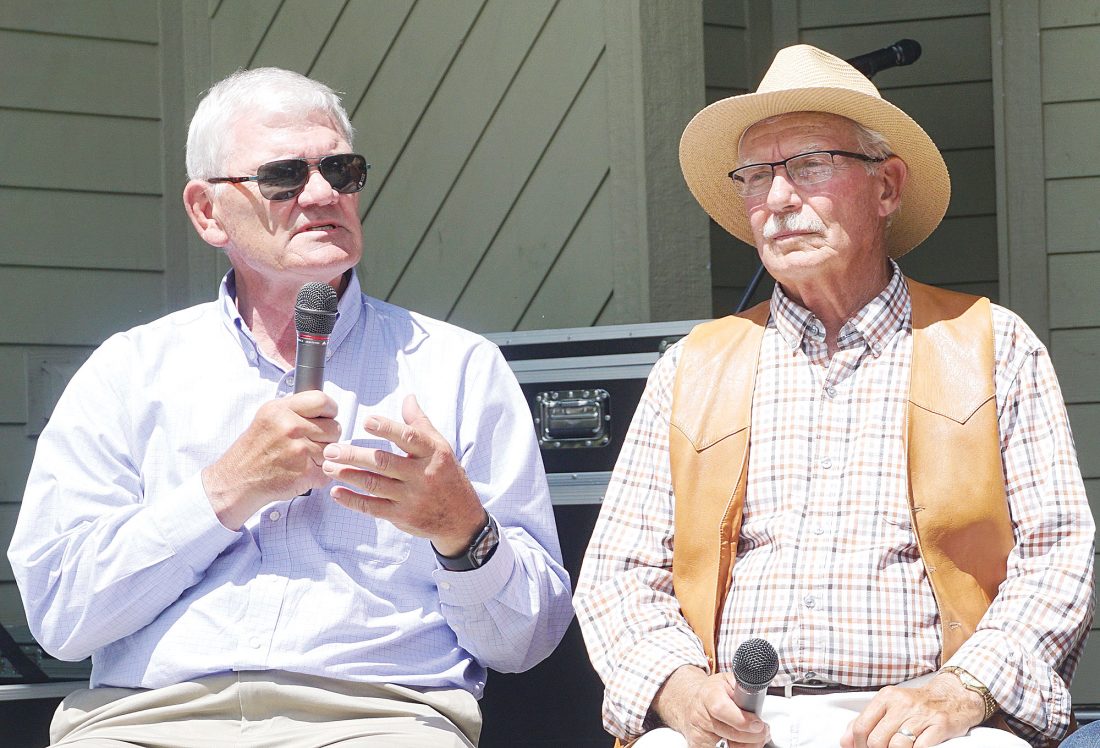
Jill Schramm/MDN Dave Sprynczynatyk, who headed the North Dakota National Guard during the 2011 flood fight, speaks at a Resilient Together panel as Alan Walter, Minot’s Public Works director at the time, listens at right.
The long fight was lost in the end, but officials at the helm of the battle remember the dedication of the people on the front lines.
Minot’s Resilient Together anniversary commemoration Saturday in Oak Park included a panel of several key officials who reminisced about the June 2011 Souris River flood.
“As spring was rolling around, we knew we were going to have flooding events across the state,” said Dave Sprynczynatyk, then adjutant general for the North Dakota National Guard. “As I continued to be briefed daily on what was happening to the north of us, it became obvious that the event here in Minot was going to be much greater than anyone had thought. Even as the flood unfolded, suddenly we had rain on the plains and the snow in Saskatchewan and that just made everything so much worse.”
“We had started fighting water and water issues in the middle of March,” said Alan Walter, who was Minot’s Public Works director at the time. “We had men working around the clock. Double shifts were wearing them out, but as it got closer and closer to the event, it just kept getting worse and worse.”
He recalls how the predicted cubic feet of water per second increased quickly as time went by.
“In three days, we went from saving the city at 11,000 cfs to no way possible to save it with 30,000 cfs coming at us,” he said.
Ten minutes before the region learned 30,000 cfs was coming, Amanda Schooling was promoted from homeland security planner to emergency manager for Ward County.
“You pretty much had to roll with the punches and try to do your best to help the community,” she said. “It was a very, very busy time.”
She said the Emergency Operations Center opened that April and the group guiding the flood fight became like family.
Garrison native Brian Hvinden, an external affairs specialist with the Federal Emergency Management Agency, said because of flooding elsewhere in the state, the agency was already on the ground in North Dakota when the Souris River flood hit. FEMA representatives had been working closely with the state on preparations for a Minot flood.
“But until it happens, you really don’t know how things are going to play out,” he said.
The federal response was long, he added. He didn’t wrap up his work until September 2013, Hvinden said. Even then, FEMA has continued to be engaged with the city through through workshops and assistance in finding resources for the flood protection project, he said.
Ward County Commission Chairman John Fjeldahl, a commissioner at the time, recalled the impact of excessive moisture on the rural area.
“We had lots of roads in the county, both township and county roads, under water, and under water for a long period of time. A lot of the cropland didn’t get planted that year because of the moisture in the system. The soil was saturated,” Fjeldahl said.
Ward County repaired its last flood-damaged road three years ago, he said.
“That’s how long it has taken to finally repair some of the damage, and in some townships, it has never been repaired,” he said.
David Ashley of the Souris River Joint Board, who became the board’s chairman after the 2011 flood, also talked about the impact of the flood outside Minot.
“My hometown is Velva – one of the fortunate ones in the basin, but it wasn’t through lack of significant effort that they were saved. We had the whole town evacuated. It was problematic, and we almost lost it due to hydrology on the east side of the bridge,” he said.
Elly DesLauriers, director of marketing and development at Minot Park District, spoke of the logistics in moving 150 animals from the zoo, and Minot Public Schools Superintendent Mark Vollmer recalled a flyover with Sprynczynatyk that revealed schools sitting in ring-dike bowls of mucky water.
“We flew over Perkett and that was the only green that we could see in the valley,” he said. Although Vollmer questioned whether the National Guard could do it, Guard members ensured Perkett never was lost, bringing in one-ton sand bags that had to be carefully and strategically placed.
“We had nearly a 1,000 soldiers and airmen here at the peak, and they were so driven to do what they could to protect the community,” Sprynczynatyk said. There was a feeling of sadness within the Guard when the flood fight was lost, he said.
“Up to that point, they thought we could save the community. When the sirens blew and we knew we couldn’t do anything more, our Guard members were just heart sunk,” he said.
Vollmer said he gets calls for advice from other school districts around the nation that are going through natural disasters. His message is simple.
“We didn’t do everything right, but we always tried to put people first,” he said. “I think that in the midst of a crisis and natural disaster, whatever it is, if you can focus on people first and foremost, you’re always going to do right. And Minot did that.”
Local News
New detachment coming to Minot AFB

Study aims for good fit between base, community
City shares tall-grass ordinance updates
The City of Minot has released information regarding updates to ordinances directing the response for tall-grass ...
Research Center Precipitation
On Wednesday, June 3, at 8 a.m., 0.21-inch of moisture was recorded at the North Central Research Extension ...
May sets moisture, temp records
The past month of May was the driest May since 2019, according to Austin Kraklau of the North Central Research ...