
Study aims for good fit between base, community
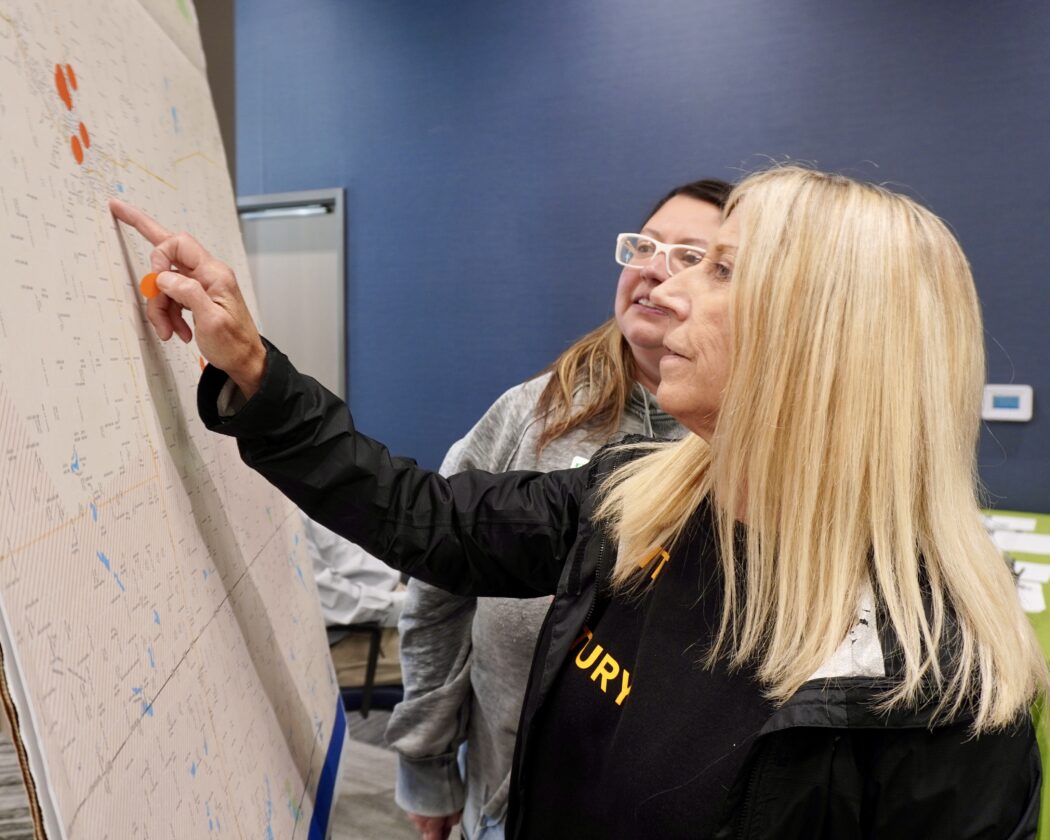
JILL SCHRAMM/MDN Jane Mayer marks a map with her home location as Bonnie Domsteen observes. Attendees at a Minot Air Force Base Compatible Use Study public meeting on Tuesday, June 2, were invited to leave comments and map their locations.
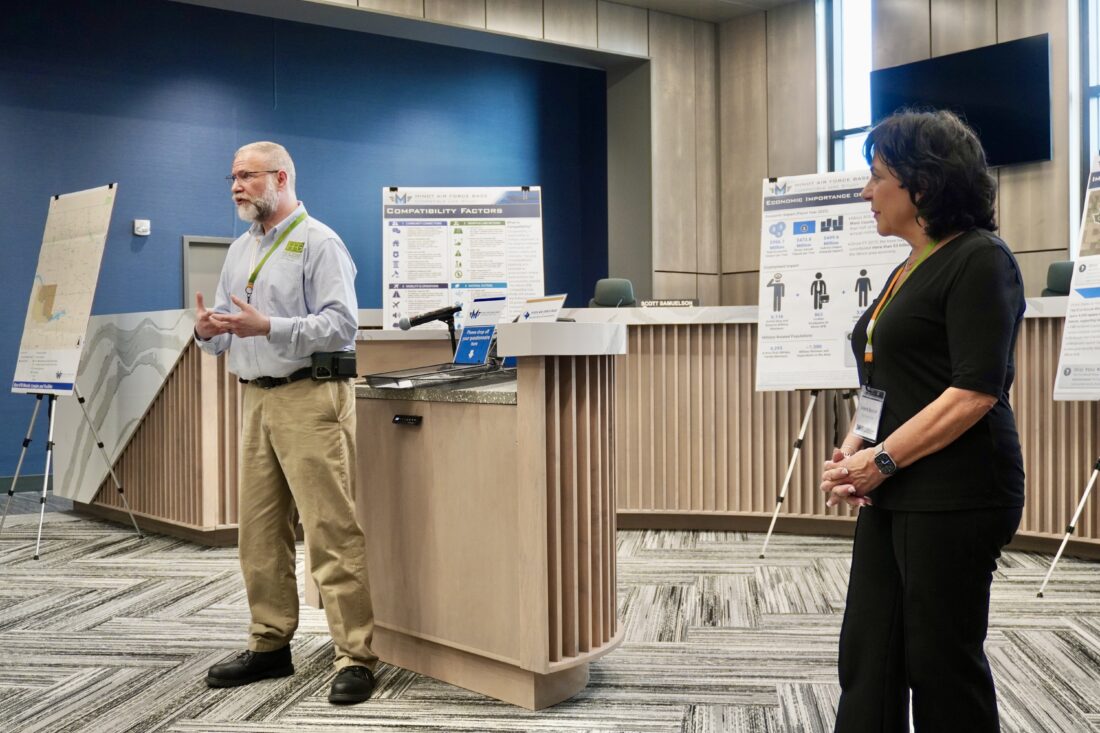
JILL SCHRAMM/MDN Pat Small, project manager, left, provides a background of the Minot Air Force Base Compatible Use Study to public meeting attendees Tuesday, June 2, in Minot City Hall as team member and project director Celeste Boccieri listens at right.

JILL SCHRAMM/MDN Neil Gush studies a display board offering a project overview as he and other participants at a public meeting on Tuesday, June, 2, took the opportunity to learn more about a Minot Air Force Base Compatible Use Study.
JILL SCHRAMM/MDN Jane Mayer marks a map with her home location as Bonnie Domsteen observes. Attendees at a Minot Air Force Base Compatible Use Study public meeting on Tuesday, June 2, were invited to leave comments and map their locations.
JILL SCHRAMM/MDN Pat Small, project manager, left, provides a background of the Minot Air Force Base Compatible Use Study to public meeting attendees Tuesday, June 2, in Minot City Hall as team member and project director Celeste Boccieri listens at right.
JILL SCHRAMM/MDN Neil Gush studies a display board offering a project overview as he and other participants at a public meeting on Tuesday, June, 2, took the opportunity to learn more about a Minot Air Force Base Compatible Use Study.
Trending
A study has identified 26 compatibility factors around which planning will be critical to the successful coexistence of Minot Air Force Base operations and local communities going forward.
Work on the Minot Air Force Base Compatible Use Study has begun, and public input meetings, including one held in Minot Tuesday, June 2, are part of the study team's effort to gather information. A public meeting also was held in Mohall and another is scheduled in New Town June 4.
The study team will be conducting a detailed technical assessment, with the intent to release action recommendations in February 2027.
In the context of military readiness, the project's definition of compatibility refers to balancing the needs and interests of both the community and Minot Air Force Base.
Project Director Celeste Boccieri said much has changed over the years with the presence of wind turbines and, more recently, the introduction of drones, and now the coming of data centers. These changes bring impacts on both the air base and community and have increased the number of study areas since the last plan was developed in 2015, she said.
The 26 identified compatibility factors fall into six categories:
- Community Connections, including communication, housing, public services, cultural resources and legislative initiatives.
- Growth and Land Patterns, such as new roads or utilities, compatible land use, safety and intentional or accidental public trespassing.
- Mobility and Operations, such as roadway capacity and noise.
- Natural Systems, incorporating air quality, sensitive biological species and water quality.
- Technology and Utilities, such as radio spectrum, energy development and artificial lighting or reflective glare.
- Readiness and Resilience, including anti-terrorism protection and ability to prepare for, withstand and recover from disasters.
"We're going to look at every single one of the 26 compatibility factors, and we're going to identify if there are any issues today, and then look to see if there could be issues in the future. If there are issues today, we are going to develop strategies and options to mitigate them," Boccieri said. "If they're not an encroachment issue today, let's develop some strategies and action items to make sure they never will be."
Recommended actions will be organized into time frames of short-term (1-3 years), mid-term (4-10 years) and long-term (11-20 years).
Boccieri said the recommendations will be tailored because a plan that fits Minot might not be appropriate and politically acceptable in a smaller town, township or different county.
"We tailor them to each of the different stakeholders because we want them to be implemented," she said. "If they are not executed, then we failed."
The implementation plan won't be just a list of action items but will identify the stakeholders who can best execute them and suggest potential resources.
"Resources, especially financial resources, are limited everywhere," Boccieri said, noting the need to leverage all partners and seek grants from a variety of federal agencies.
Action items will include tasks and projects that can remain in place once implemented and activities that will require ongoing attention. A major ongoing item is communication and coordination, and many of the recommended actions will relate to formalizing those, Boccieri said.
"Part of the communication is educating," she added. Legislators, local elected officials, developers and neighbors need to understand the compatibility issues and solutions to make appropriate decisions, she said.
She stressed the aim is not to stymie development but to guide the appropriate compatible development.
"We're looking at redundancy of infrastructure, making sure that there's continuity of operations for the community. The community needs to be able to be sustainable and resilient because they support the base, and then that means the base can have continuity of operations," Boccieri said.
Keli Roselli-Sullivan, military liaison with Minot Area Chamber EDC, said MACEDC and the City of Minot saw the need to update the 2015 plan with the coming of the Sentinel missile modernization project.
"Are we prepared for what's coming? Encroachment is a big thing,” she said.
Minot City Manager Tom Joyce said it is important to build relationships before a crisis in the 8,500-square-mile study area, which includes 150 missile sites and eight counties. Preparing responses to potential disasters, whether manmade or natural, can help ensure base operations continue through those times, he said.
Funding for the study is coming from the Office of Local Defense Community Cooperation in the Department of War.
The study continues to accept public feedback at minotcus.com.