
Opportunity called for baseball’s Darin Erstad
Opportunity never had to knock twice for ND’s Erstad
Trending
Darin Erstad believes in grasping opportunities. The former Major League Baseball player credits many of his opportunities to his parents and the people who supported him along the way.
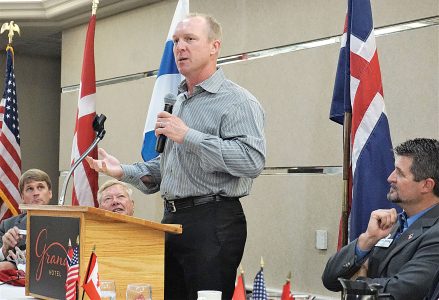
An inductee into this year's Scandinavian Hall of Fame, Erstad spoke Tuesday at the annual joint service clubs meeting in Minot. In a speech touched with heartfelt gratitude and humor, Erstad spoke not of the great ball players he encountered but the people who opened the doors of opportunity for him.
"My whole point is - opportunities. You get opportunities. Thankfully, I was brought up the right way, that I was ready for those opportunities," Erstad said.
Steve Shirley, Minot State University president, introduced Erstad by noting the Jamestown native has had a "tremendous life of philanthropy, service and giving back to his local communities and, simply put, might be the finest athlete ever to come out of North Dakota. We are proud to call him one of our own."
The outfielder and first baseman spent 14 years in the major league, compiling nearly 1,700 hits, 700 runs batted in and 125 home runs. He was a two-time All Star and three-time Gold Glove recipient.
Erstad earned All American status playing baseball for the University of Nebraska and also was a member of the 1994 National Championship Cornhusker football team, for which he was punter. He was inducted last year into the university's Athletics Hall of Fame.
He was the number one draft pick in 1995 and went on to win a World Series title with the Anaheim Angels in 2002. He later coached baseball at the University of Nebraska, retiring this year to spend more time with his wife, Jessica, and their three children.
Erstad was accompanied to Minot by his parents, Chuck and Dorothy, now of Fargo, and sister Heidi of Brookings, South Dakota. He also has a brother in Fargo who was unable to make the trip.
Driving across the state to Minot, Erstad said, his mind drifted back to the many games he played in the different towns. He said he could feel the hairs on his neck stand up when Minot came into view.
"I just had nightmares of Philion skating circles around us, and Blessum smashing me into the boards and losing by about nine goals in hockey. So I have a lot of great memories of here," he joked to the crowd's laughter.
"But I do want to talk about North Dakota being the foundation of who I am and what I've became and what I'm still working on becoming. The one thing I have to tell anybody about North Dakota is it's about the people," he said. "I had the opportunity to have people affect my life in a positive way."
The first influence on his life was his parents, he said. His father was busy in the insurance business, but he never was too busy to spend time with his children, establishing himself as a role model for Erstad with his family.
"What they did for us is they said, 'Have fun. Try it all,'" he recalled of his parents. "Empty the tank with what you are doing. Give your best effort. Find what you love."
He also singled out the baseball enthusiast who performed upkeep on Jamestown's field. He would throw the ball around with Erstad during the day when his parents were at work.
"He made coming to the field fun," Erstad said.
He recalled his first Legion coach, who put him on the mound when he was 14.
"I got to face Minot as a 14-year-old," he said. "We held our own, but it was a great opportunity for me, and I took advantage of it."
He mentioned his Legion coach from Nebraska, who interested the University of Nebraska in looking at this North Dakota kid.
Joining the Angels, the worst organization in baseball in 1995, might not have seemed like an opportunity. But six years later, Erstad helped the Anaheim Angels win the World Series.
Erstad joked that no one retires from baseball.
"The Grim Reaper taps you on the shoulder and says you're not good enough. Stop with the 'I'm retiring. I don't want to play anymore.' Yeah, right. You're not good enough. Just get over it," he quipped.
When it happened to him, he began to look at what he was going to do with the rest of his life.
"Thankfully, Coach (Tom) Osborne was athletic director and he gave me the opportunity to coach at Nebraska in baseball. I had never even thought about coaching," he said. "My passion has always been baseball, but my purpose in life has been to get to the big leagues, win a World Series."
Then his wife told him she'd question his mental capacity if he made his goal anything other than influencing the lives of youth in a positive way.
Serving as head coach at the university for eight years was his opportunity to be that influence, he said. His decision to step down came about as he considered how his parents were always there for him. He realized it was time to show that support to his own children.
"I don't want to miss our kids growing up, and now I'm in a position to affect our own kids' lives in a positive way - to help coach hockey, be there for our daughter's dance, and go to their baseball games," he said. "In fact, this summer. I've watched more baseball games than I have ever watched coaching and recruiting, just watching our kids play. And it was awesome."