No more one-and-one, new foul limits in prep basketball with rule changes

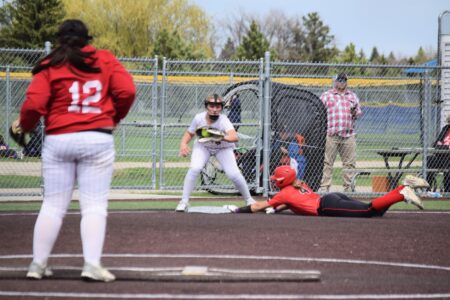
MDN File Photo Breanna Rose, of South Prairie-Max, shoots her second free throw during the Royals’ game against the Parshall Braves on November 30.
High school basketball fans will see changes to how teams shoot free throws this year, as the National Federation of State High School Associations (NFHS) approved changes in April that eliminates the one-and-one scenario and sets new foul limits each quarter for awarding the bonus free throw.
In addition to awarding two foul shots for all common fouls, teams will reach the bonus when their opponent commits five fouls in each quarter and team fouls will reset at the end of each quarter. Previously, teams were awarded the one-and-one bonus when their opponents committed seven fouls in a half and two foul shots when 10 fouls were committed each half.
“The rules committee studied data that showed higher injury rates on rebounding situations and saw this as an opportunity to reduce opportunities for rough play during rebounds,” Lindsey Atkinson, NFHS Director of Sports and liaison to the Basket Rules Committee said at the time. “Additionally, resetting the fouls each quarter will improve game flow and allow teams to adjust their play by not carrying foul totals to quarters two and four.”
Area coaches are adapting to the change, and with games starting, they are experiencing firsthand the impact it is having on the game.
For Des Lacs-Burlington Lakers girls’ basketball head coach Tracy Bonn, her team will need to adapt more than others given the girls’ aggressive style.
“It probably doesn’t help us because we are an aggressive team,” said Bonn. “We did end up with that seventh foul and tenth double-bonus fairly often, so now with that being enacted at five, the girls are really going to adjust.”
According to Bonn, the key for the Lakers is being more aware to how each referee is calling the game and adjusting accordingly with more discipline.
“They have to move their feet instead of their hands,” said Bonn.
Tanner Mosser, the girls’ basketball head coach of the South Prairie-Max Royals sees the new rule as a positive for his team, given their lack of size.
“It does make it a little more physical, and the new foul rule, now you get five fouls a quarter. I don’t mind it because we don’t have the biggest girls, and so I think that will toughen us up a little bit for later on in the year,” said Bonn.
He also cited how free-throw shooting is a strength of the Royals, which creates another advantage for his team.
Cole Edwards, in his first year as the head coach of the Bishop Ryan Lions girls’ program, is more familiar than most about how the new rules impact the game. That’s because before joining the Lions, he previously worked as Director of Basketball Operations for Minot State University, and women’s college basketball already adopted a similar rule in 2015.
“I don’t know if I love it yet,” said Edwards. “I guess it is going to take some getting used to for the players.”
Edwards added that it might remove some of the pressure on players at the line, because they know that even if they miss the first one, they still get another shot.
“That said, I don’t think it changes too much. You still have to make free throws down the stretch,” said Edwards. “You miss the first one, that second one gets a lot more tough.”
Other rule changes include the official placement of a shot clock operator at the scorer’s table for those states that use the shot clock, and players will now be allowed to step out of bounds and return to the court if the player gains no advantage. According to the NFHS, “a player is penalized only if, after returning inbounds the player is the first to touch the ball or avoids a violation.”
Local Sports
Aggies secure Region 6 Championship with 10-0 shutout
Lakers claim Region 3 title, advance to 10th straight state tournament

Majettes win fifth straight WDA Dual Tournament title
Girls Soccer: McKibben nets lone goal in Minot High’s win over Demons
The Minot High girls soccer team peppered Bismarck High goaltender Gabby Bruer to the tune of 22 shots on goal. ...
Youthful Stars return to title game after win over Rugby