
Commission seeks more review of battery storage ordinance
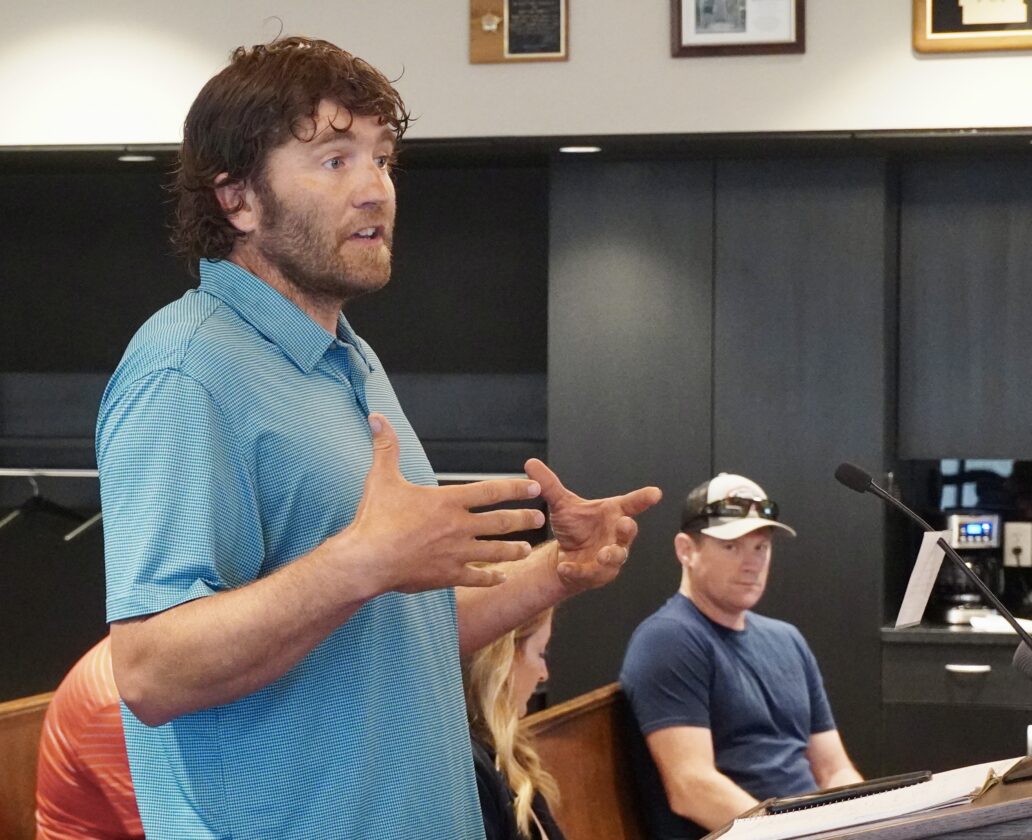
JILL SCHRAMM/MDN Brian Lee speaks to the Ward County Commission on Tuesday, July 7, regarding a proposed ordinance regulating battery storage facilities.

JILL SCHRAMM/MDN Ward County Commissioner Jason Olson addresses battery storage facilities and their regulations during the commission’s Tuesday, July 7, meeting.
JILL SCHRAMM/MDN Brian Lee speaks to the Ward County Commission on Tuesday, July 7, regarding a proposed ordinance regulating battery storage facilities.
JILL SCHRAMM/MDN Ward County Commissioner Jason Olson addresses battery storage facilities and their regulations during the commission’s Tuesday, July 7, meeting.
Trending
After extensive discussion, the Ward County Commission sent a proposed zoning ordinance on battery storage facilities back to the county planning commission for further review on Tuesday, July 7.
Daulton Pearson, representing NextEra Energy Resources, asked the commission to consider changes in the draft, stating that siting a facility would be challenging under the current proposed regulations.
The planning commission's draft establishes the setback at a half mile between a facility and the property line of an occupied dwelling, school or church. Although the planning commission reduced the distance from what initially was a mile, Pearson noted it is well above the industry standard and asked for a change to a quarter of a mile.
The company also is asking that property owners within a setback be able to voluntarily sign a waiver to allow the siting if they believe they are not materially impacted by the project.
County Commissioner Ron Merritt said he is leery of reducing setbacks due to the noise and other impacts of battery storage facilities on residents.
"I would want to hear from some of them before ever thinking about a reduction. I'd probably go the other way," he said.
Brian Lee of Sawyer recommended not reducing the setback.
"You have major corporations that are multi-billion dollar corporations. They're coming into small town North Dakota and they are basically invading the areas and then taking away the rights of the owners - of the people who live there," he said. "What is the necessity of these things? Is it for power companies to make money, or are they actually providing a service to Ward County?
"Nobody's against change and progress, but I think it's important to understand that as we allow these facilities into a community, they take away from the agricultural land. In the last nine to 10 years in the United States, we've lost 23 million acres of farmland," he added. "I think it's very important that, as an agricultural community, that we protect those areas."
He also called for ensuring facilities remain economically viable and aren't eventually left idle or no longer paying taxes. Fallon Adair, fire safety engineer with NextEra explained how battery health is tracked and how batteries can be replaced when necessary.
Noise was another concern of Lee and the commission.
Pearson said the planning commission did a good job of including noise mitigation measures in the proposed ordinance. The ordinance would require an annual study by an acoustical engineer at the battery owner's expense.
"That's a good thing to have, and I think it protects everybody," Pearson said of the mitigation rules.
However, he voiced concern about measuring noise level from the project to the property line of an occupied dwelling rather than to the actual dwelling.
"It's standard and typical with industry that most of the measurements for sound, even at the Public Service Commission level, are measured 100 feet from that property itself, and that goes the same for wind energy facilities," he said.
NextEra also proposed changes to the ordinance section related to fire mitigation and emergency response because battery fires are fought differently from a typical fire.
Lee suggested also requiring a fire safety plan that has been reviewed by a fire agency or county emergency management before a company applies for a permit.
The proposed ordinance requires companies to develop a formal response plan with local fire departments and aid in their training annually.
"We always prioritize safety, and we would absolutely provide any training beforehand, before the project goes operational," Pearson said of NextEra.
Adair added NextEra uses a lithium ion phosphate battery that has less likelihood of thermal runaway than older battery systems that produced more violent fires.
NextEra has not submitted a project application in Ward County, although it has indicated interest. It has received state approval to construct projects in Burke and Emmons counties.
The commission also discussed idled facilities and other long-term issues that could arise with the facilities. The proposed ordinance includes reclamation and financial security requirements, said Beth Pietsch, Ward County Planning and Zoning administrator.
"We're not ready to pass this, in my estimation," said County Commissioner Jason Olson, who moved to return the ordinance draft to the planning commission. The planning commission could consider recommendations from Pietsch based on NextEra's suggestions and county commission discussion.
Commissioner Jim Rostad said the basic ordinance is good but facility siting will be critical.
"The biggest concern of mine is where the location comes down to and does it affect neighbors," Rostad said. "I'm going to be reserved on this until I feel comfortable that the place isn't going to disrupt our residents."
The commission placed a moratorium on battery storage facility applications for three months, or until an ordinance is finalized.