
Governor reflects on ND as most military friendly state
Trending
Since taking office nearly two years ago, Gov. Kelly Armstrong said he and Lt. Gov. Michelle Strinden have been working with state groups and agencies to make North Dakota the most military friendly state in the nation.
He said the North Dakota Military Commission, National Guard, N.D. Legislature and N.D. Department of Veterans Affairs are part of the effort.
"With all due respect to the work we've done, we had a pretty good head start from our Legislature and previous administrations. We take it very seriously," Armstrong said.
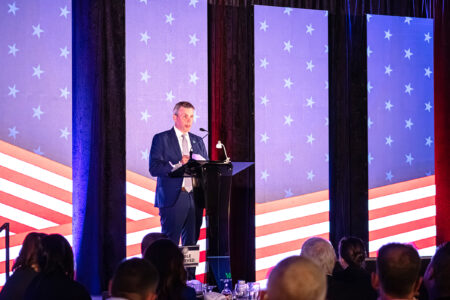
He was among speakers at the 2026 North Dakota Nuclear Triad Symposium held April 28 in Minot.
Locally, he said Brekka Kramer and Pete Hankla from Minot's Task Force 21 have been very active on the N.D. Military Commission, helping to guide its efforts.
Armstrong also said the work has been made much easier due to retired Maj. Gen. Alan Dohrman, chief operating officer for the Governor's Office. He said Dohrman, retired adjutant general of the N.D. National Guard, spent 40 years in the military and understands the issues. Dohrman was scheduled to retire last week.
"We are blessed to live in a state where people do support the military and to have the best National Guard in the nation led by Brig. Gen. Mitch Johnson and his team," Armstrong said.
Noting Minot Air Force Base is the only base with two legs of the nuclear triad, Armstrong said it is one of the most strategically important military installations in the nation.
As for nuclear deterrence, he said the modernized B-52s and the Minuteman III intercontinental ballistic missiles eventually being replaced with the Sentinel program, will continue to play a vital role in keeping this country safe.
"That's why for six years in Congress I worked to support the Sentinel project and continue to support it as governor. It's the largest modernization effort ever undertaken by the Department of War and its impact will be felt far beyond Minot," Armstrong said.
He said the Sentinel project will have an impact on infrastructure, workforce, housing and industries across this state.
“It's a once in a generation opportunity for us, but with that opportunity comes responsibility," he said.
Reflecting on the North Dakota National Guard and its mission, he said its primary focus is to be supplemental for U.S. strategic and military defense but it also has secondary responsibilities when needed for emergencies, including tornadoes, blizzards and floods.
"They continue to perform with excellence," he said.
"We're also really, really proud of the 119th Wing's active role in securing our missile fields and nuclear silos. The work being done by the 219th Security Forces Squadron (at Minot AFB) is a model for the total force concept that mixes active duty, Guard and Reserve components for missions. In fact, they're so good at it that you can't tell the difference anymore between active duty and the 219th personnel, which speaks to their skills and their professionalism," Armstrong said.
In addition to the 219th helping secure the ICBMs and protecting the ground leg of the nuclear triad, Armstrong said an agreement was recently signed that allows the National Guard to contribute to the air leg of the triad. He said the B-52 Operational Classic Association was approved by U.S. Air Force Headquarters last September. He said it's a new detachment that has the Air National Guard's 119th Wing working with the 5th Bomb Wing to augment portions of the B-52 mission at Minot AFB.
"We're excited that Air Force Global Strike Command will develop plans for future expansion of the detachment beyond operations and maintenance. This new detachment really reinforces the role of the military in North Dakota of achieving peace through strength. It recognizes that we are stronger when we work together," Armstrong said.
Armstrong extended his appreciation to the community, the state of North Dakota, the United States of America, the airmen and soldiers, and their families who carry out the mission every day.
"To be the most military friendly state and the most secure nation, we need to collaborate across the local, state and federal levels. That means working in tandem with groups like Task Force 21, the North Dakota Military Commission, base retention groups, our congressional delegation and all the way up to the Pentagon. As I said before, North Dakota has a strong track record of being a military friendly state and the next chapter, with the Sentinel, is a great opportunity and a great responsibility,” he said.
Armstrong also said strategic deterrence is as important as ever in the 21st century.