
County considers alcohol safety at State Fair
Trending
Options for managing alcohol sales and preventing underage drinking during the North Dakota State Fair were examined Tuesday, May 5, by Ward County commissioners, who already have taken steps to ensure more licensing controls.
The Ward County Commission fielded a complaint last August regarding underage consumption, brought by the Ward County Sheriff's Department against M & S Concessions, which holds the liquor license at the fairgrounds. The hearing concluded with a 10-day license suspension but prompted the commission to look more closely at its grounds licensing.
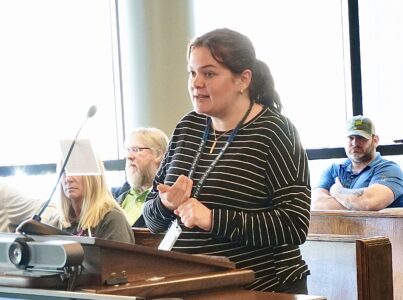
Amy Silverwood-Miranda, alcohol prevention coordinator at First District Health Unit, presented recommendations Tuesday from the district's alcohol prevention coalition. Recommendations included mandatory beverage server training, use of identification card scanners, establishing alcohol-free areas throughout the fairgrounds, conducting screening for alcohol being brought in and installing signs to alert fair-goers to the presence of ID scanners and 21-only service areas. Wristbands, which have limits in terms of underage drinking prevention, can be a tool but don't preclude checking IDs if age is in question, she said.
Commissioner Ron Merritt raised privacy concerns regarding ID scanners, particularly if data is accessed by anyone not authorized.
Silverwood-Miranda said First District has distributed 14 scanners in Minot to establishments using them voluntarily. First District also loans a scanner to organizations for special events. She said the data is kept only by First District, where it is accessible only by two staff members, who report the numbers of detected fake IDs to the state. She added First District has privacy rules that must be followed regarding the data.
"I'm not in favor of us having anything to do with a program like this. We need better safeguards for the data or the data just doesn't get kept. It either says it's real or it's fake and that's the end of it. It doesn't scan the other information," Merritt said. "It's not a problem until something bad happens, which there's stories all across the world and across our country of this kind of stuff happening, where all of a sudden the data gets accessed for the wrong reason. And it could be here."
Jeff Senger, owner and general manager for M & S Concessions, indicated M & S plans to hold information just during the course of the fair before deleting it. M & S does not plan to download or share the data. The scanners are owned by the North Dakota State Fair and leased to M & S.
Silverwood-Miranda said First District can clear the data from its system once required information is obtained, eliminating any further local access, although the scanner company could have access to any downloaded information.
Commissioner Jason Olson said the county shouldn't get involved with mandating scanners. Merritt added he doesn't want the county to encourage scanner use either and suggested the commission ensure no Ward County funds are in First District's budget that can be spent on scanners. Silverwood-Miranda said the scanner program funds come from a federal grant.
Sheriff Robert Roed responded to the commission's concerns about the effectiveness of wristbands as an enforcement tool, calling them more of a deterrent to adult buyers providing alcohol to minors.
"It's not an arrestable offense. It's an infraction," Roed said. "But the citations and the underage drinking - it’s still taking place, and some of it is because they're getting through with fake IDs and things like that."
Another issue is the amount of alcohol being brought onto the fairgrounds by fair-goers, he said.
Commissioner Miranda Schuler suggested having a policy to allow only clear, see-through bags, which Roed said would need to be a decision of the State Fair.
The commission also discussed whether there's a necessity for alcohol-free zones. Roed clarified that alcohol issues tend to be associated with concerts or the alcohol venue Flickertail Gardens.
Silverwood-Miranda said the suggestion for alcohol-free areas came from the commission's previous concerns that areas open to alcohol consumption weren't adequately defined and also concerns about setting cultural and community norms if drinking is allowed around children. She said the goal is to identify ways in which everyone can work together to make the environment safer.
"One thing I want to stress is I think everybody wants our fair to be successful. This ain't a claim that it isn't. I think for the most part, we're doing a good job," Fjeldahl said.
"It's not as bad as we make it sound sometimes," Roed agreed. "We're busy out there. But it's a safe environment. It's definitely a safe environment out there, and we want to increase our presence to make sure that happens."