
Council candidates discuss budget
Trending
Candidates in the June 9 race for Minot City Council shared their varied views on city spending at a forum Tuesday, May 19, while acknowledging the difficult budget work that lies ahead post-election.
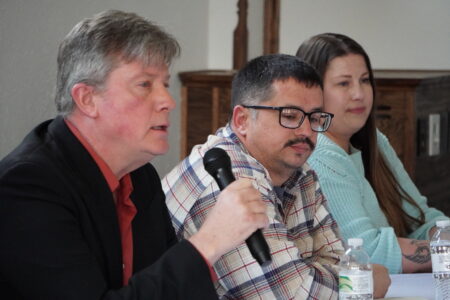
Participating in a forum hosted by the Minot Alliance of Nonprofits in partnership with Minot Area Council of the Arts and Independence, Inc. were Nicole Brasfield, Eric Locken, David Wiley, Isaiah Keller, Joan Hawbaker and Stephan Podrygula. John MacMartin was unable to attend.
Wiley suggested city spending should be reduced by tightening the number of city employees, which he said is at 452 for a city of about 47,000 population.
"I don't believe that we should have a champagne government. I really believe in scaling it back," he said. "It's nothing against the city employees. It's just saying, 'Can we do the required work without all the extras?'"
He said he believes the city can dig deep and find places to trim fat, but he wants to know what residents think.
"It's ultimately not about what I think. It's about what people think. Where do you want to see it be spent? So, I'm open to those kinds of discussions. I want to see the community voice their opinion a lot more," Wiley said.
Hawbaker said the budget should be examined line by line. She mentioned a $1 million sidewalk by Rosehill Memorial Park in a five-year Capital Improvement Plan. The sidewalk would get little use, but the city has proposed it based on ordinance requirements for sidewalks, she said. Her solution would be to change the ordinance, she said.
Brasfield said she went through the budget line by line with the city's finance director and found no easy answers.
"What it really comes down to right now is there is no fat to cut," she said. "It is, 'What service are you willing to cut?"
The city spent more than $100,000 on overtime in response to residents who wanted streets cleared of snow more quickly. It helped those without four-wheel drives get to work, but it is a lot of money, she said.
Brasfield called for efficiency and looking for ways to save money in payroll, but, ultimately, she said, the population has to grow to bring in more revenue.
Keller cited the difficult budget decisions the council will need to make this year, noting the 3% reduction that departments have been asked to make in their budget requests.
"We need to keep asking questions, and I think if city council and the mayor and the community can be comfortable asking questions, I think we can get through it together, because there will be some that suffer, no question. That's just where we're at," Keller said. "I would encourage community members to come to city council meetings and ask those difficult questions."
Personally, he doesn't want to see cuts to fire, police and dispatch.
"That's something that I'm very passionate about, but again as we work through things, whether it's a building that's being built or possibly it can be remodeled, there's things that we can do to become more efficient, and I think everyone's open to that," Keller said.
"We're facing some very unpleasant choices and an unpleasant situation, and there are no really, really great options," Podrygula said. He said the city should gauge its budget on outcomes from the money spent and how well goals are met.
"I would like to see us harness the expertise of city staff more effectively. I don’t think we've utilized their skills enough," he added.
Candidates also indicated they could get behind city financial support to nonprofits in certain instances. However, they also noted the city's budget situation and suggested there may be nonfinancial ways to show support.
Keller said granting agencies put stock in grant requests that have a government body vouching for them.
"A municipal government, tribal governments, they have a ton of credibility when it comes to grants, especially on a federal level but also on a foundational level," he said.
Hawbaker said the city should support nonprofits to a certain extent, such as existing grants to the Minot Commission on Aging. However, the city has so much debt because of the flood control project that helping nonprofits largely should be left up to the citizens, she said.
"The people of Minot are very, very giving," Hawbaker said.
Locken said the city needs to make choices about where it grants dollars and those nonprofits receiving assistance should not be fully financed by the city.
Brasfield said any nonprofit seeking money must have a business plan and other revenue.
"It cannot just be the taxpayers," she said.
Wiley said it comes down to prioritization and determining the resources the city has available to allocate.
"We would love to be able to provide extra services to the people that need it," Wiley said. "But it, unfortunately, will always come down to a financial issue."
Podrygula said there are nonprofits that should be supported as long as there is a detailed rationale for spending the money.
"We have to be very cautious, very careful, because again, these are taxpayer dollars. We have to exercise good stewardship," Podrygula said. "We need to maintain good oversight of these organizations."
Keller agreed if the city is going to fund nonprofits, there must be limits and oversight. He said he would like to see more collaboration like that shown by the Alliance of Nonprofits, particularly on grant writing as a way to bring more money to the community.
"One thing that I realized with my experience in the nonprofit world, working for various nonprofits and also being on the board of directors of multiple nonprofits, is that you can't put a price on a good grant writer," he said.