
Ancestor links generations of Douglas family
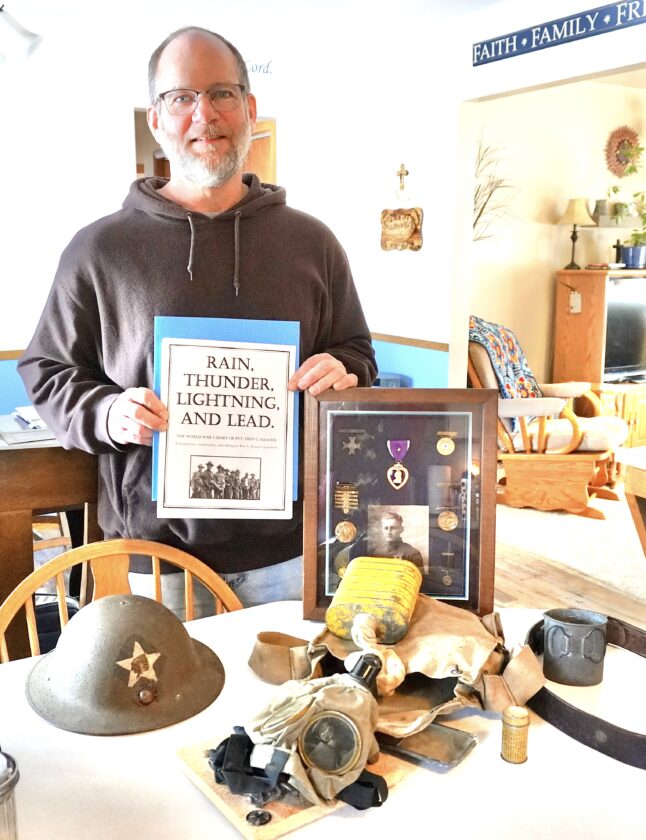
Jill Schramm/MDN Ron Kramer holds a printout Jan. 26 of his story of his grandfather Fred Kramer’s World War I experiences in France, titled “Rain, Thunder, Lightning and Lead.” Also shown are his grandfather’s helmet, gas mask, medals and other items brought back from France.
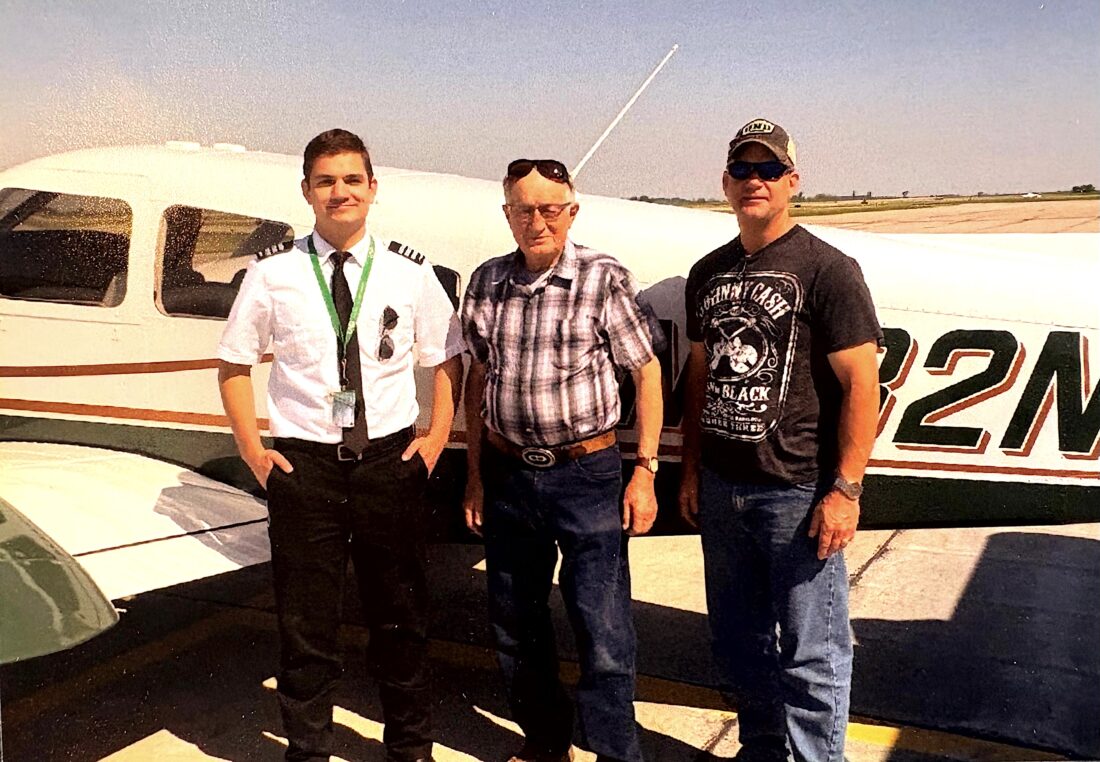
Submitted Photo Casey, David and Ron Kramer, from left to right, stand next to a Piper Archer after Casey, then a Grand Forks flight instructor, gave his Grandpa Dave an opportunity to be at the controls of an airplane again in June 2022.
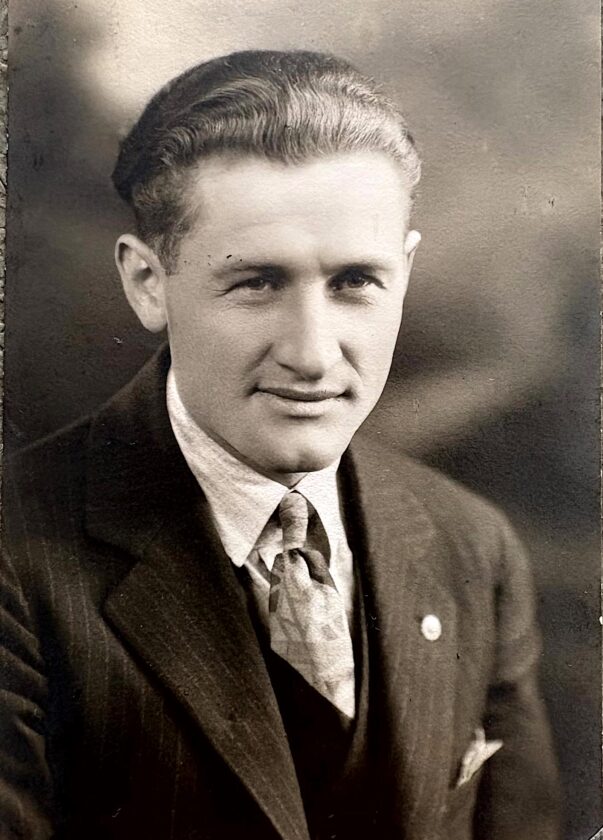
Fred Kramer
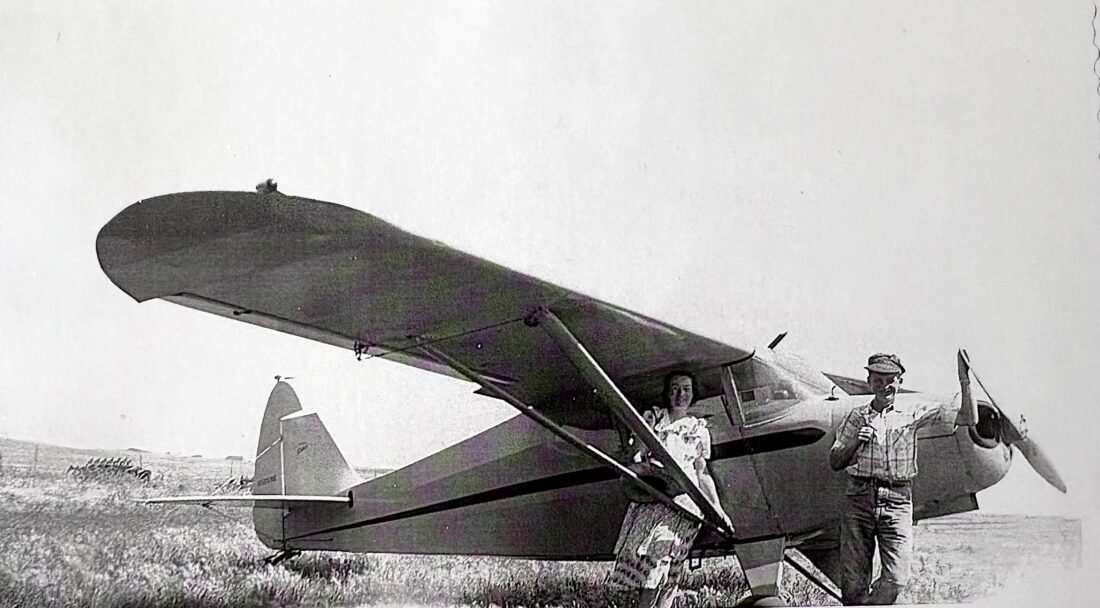
Submitted Photo Fred and his wife, Cecelia, stand next to his first airplane in the 1940s.
Jill Schramm/MDN Ron Kramer holds a printout Jan. 26 of his story of his grandfather Fred Kramer’s World War I experiences in France, titled “Rain, Thunder, Lightning and Lead.” Also shown are his grandfather’s helmet, gas mask, medals and other items brought back from France.
Submitted Photo Casey, David and Ron Kramer, from left to right, stand next to a Piper Archer after Casey, then a Grand Forks flight instructor, gave his Grandpa Dave an opportunity to be at the controls of an airplane again in June 2022.
Fred Kramer
Submitted Photo Fred and his wife, Cecelia, stand next to his first airplane in the 1940s.
Trending
DOUGLAS -- When Fred Kramer returned home to Iowa after World War I and eventually found his way to North Dakota in 1930, he settled into life as a veteran, farmer and hobby pilot.
It was a rather adventurous life, and Fred, 1895-1979, left a generational impact on the Kramer family. His interest in airplanes transferred to his son, David, and then to his great-grandson, Casey, now a commercial airline pilot.
David's son, Ron, operates the third-generation family farm near Douglas that awaits its fourth generation. Ron Kramer also recently completed a written history detailing his grandfather's involvement as an American Marine in World War I.
Kramer recalled when he was growing up, there was a steamer trunk in a basement storage room of his family home that would get opened every now and then. Inside were items his grandfather, Fred, brought home from the war.
"Never really talked about it. It was never really a very big deal," Kramer said.
However, years later while in college, he was visiting with his parents about his late grandfather's war diaries, and it piqued his curiosity.
"I started kind of flipping through them," he said. "It was like 'Wow. There's really a lot in here, and it's something that nobody has really ever even looked into."
The diaries, written in pencil from 1917 to 1919, gave snippets of experiences each day. Kramer said the diaries weren't easy to read, partly due to his grandfather's spelling but also due to the slang of that day.
"At that time, I had no idea what my grandpa had done. The only thing I knew was that Mom had a picture frame with his medals in it, and that was in the steamer trunk, too," Kramer said. "Just to peel back the layers of the onion and go through this thing and find out all the things that he did. He was in almost every major battle that the Marines fought in, in World War I. They crossed the Rhine River towards the end. He was on the front line on the day the armistice was signed, and he wrote a letter home that day, describing what the atmosphere was like over there."
The more he read of the diary, Kramer said, the more he realized how little he knew about the war. Initially, he only transcribed the diary but always wanted to go back and research information for a book to bring his grandfather's story into context with the history of America's involvement in World War I.
Over the years, he began reading books related to World War I and collecting more information. Family members helped by locating books that proved valuable in the research. He also visited the Smithsonian's World War I exhibit and the World War I Memorial in Washington, D.C.
One of his grandfather's brothers produced letters that Fred had sent home from France, and Ron Kramer was able to match them with references in the diaries to get more descriptive information.
Kramer said a few years ago, his uncle gave him his grandfather's photo album, which contained photos from his training at Parris Island in South Carolina and Quantico, Virginia, along with photos depicting Marine activities in France that his grandfather had purchased. Seeing the photos sparked his enthusiasm again for a book project.
Recently, Kramer completed the book and shared it electronically with family members as he considers putting the document into a printed book form.
Kramer, who was only 5 years old when his grandfather died, said the family's only memories of his grandfather really opening up about the war came when Fred's son, Stephen, returned from serving in Vietnam and they swapped war stories.
"That was something Grandpa was proud of his entire life - that he had been a Marine," Kramer said.
Gen. John Pershing, an Army general in charge of the American Expeditionary Forces, didn't initially know what to do with the Marines, he said. For their first several weeks, he had them building railroads and docks, he said.
"He didn't know why they sent him the Marines until they put them in battle. Then, he realized why they sent him the Marines, and they almost never had any rest after that, because once they got in there, they fought to the death. One of Grandpa's first battles that he was in was the Battle of Belleau Wood, and that's where the Germans started calling the Marines the Devil Dogs," Kramer said. "They couldn’t believe how ferociously they fought, especially with their hand to hand combat."
His grandfather suffered a mustard gas attack early on, which almost killed him and put him in the hospital for about nine days, Kramer said. It caused scarring on his vocal cords that left him with a permanent rasp to his voice.
In a later battle, a piece of shrapnel broke through his Doughboy helmet, circled around his head and went through the back side, narrowly sparing his life.
After the war, the Marines set up guard duty between Germany and France. Also, a marksmanship competition was held within the American Expeditionary Forces in Europe. Fred Kramer, an automatic rifleman during the war, competed and won the automatic rifle category of the contest. Pershing shook his hand and presented the medal, which the family still has.
Fred Kramer had been a founding member of the Douglas American Legion post. He also was one of the first area farmers to acquire a tractor with rubber tires and he purchased and learned to fly an airplane.
"I think he just loved the feel of flying," Ron Kramer said. "He bought a two-seater plane and just really liked it. Then a couple of years later, he bought a brand new four-seater plane, and that was the one they had for a long time, and that's the one my dad learned how to fly in."
David Kramer, now of Minot, said he and his father took lessons at Douglas from a former World War II pilot who would fly in. Kramer, who still has his log book, also took lessons from Virgil Nordstrom in Minot and soloed for the first time at age 16, receiving his private pilot's license in the mid-1950s.
He gave up flying because he needed to put his finances into farming at the time.
"I always was going to go back and it never worked out for me. I did love to fly. I didn't really want to give it up," he said.
The 1949 plane had been sold, but the family tracked it down about 30 years ago in Wisconsin, where it had been restored and still contained the Kramer flight log. The plane's history in the Douglas area included being loaned out to another pilot for use in making food lifts to local residents snowed in during the major winter storms of 1949-50.
As an avid aviation buff, David Kramer exposed his grandchildren to Northern Neighbors Day at Minot Air Force Base and to the air museum in Minot, which has been one of his favorite places.
It made an impression on Ron's son, Casey Kramer of Douglas, who received his aviation degree from the University of North Dakota and now is a captain piloting the 76-seat Embraer 175 for SkyWest, having been with the company since 2022.
Casey Kramer said his aviation interest certainly was influenced by his Grandpa Dave.
"Once I was able to finish up with my training at UND, or at least get it enough of the way through it, I was able to take my grandpa out. The first flight I did with him was right after I got my private pilot license in 2017 and I rented a plane from Minot, and we flew down to Garrison and did the Garrison Fly-In Breakfast. So, it was a pretty neat experience," he said. "He hadn’t been in a plane like that for quite some time."
Casey Kramer later took his grandparents on a flight over Lake Sakakwea and Garrison Dam in a Piper Cherokee. As a certified flight instructor in Grand Forks, he took his Grandpa Dave on Piper Archer and gave him the controls briefly so he could leave an instructor's note in his grandfather's old log.
"These planes were much more technically advanced than the ones that he had flown. It was kind of neat being able to show him all the different things - have him take control for a little bit," Casey Kramer said.
As the family prepares for the 100th anniversary of the farm in 2030, it offers another opportunity to remember the ancestor who started it all. Ron Kramer said seeing the contributions his grandfather made to both his country and his family made his own work in preserving his grandfather's story enjoyable but rewarding. Yet, there's still one more thing he would love to do, and that is to visit the sites mentioned in his grandfather's diary.
"That's always been kind of on my bucket list as I would love to go over to France," he said. "Since I have the names of all these cities and places where Grandpa went, I thought it would be really cool to go over and retrace his steps."