
Kindred spirits: Doctors forge their own paths
Trending
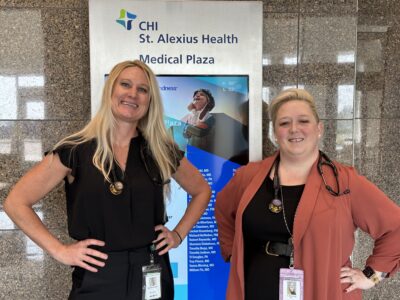
Marisa Albertson and Vanna Binning took similar paths on the road to becoming medical professionals. Both are Minot natives, graduates of Minot State University, and completed their residencies at the UND Center for Family Medicine after medical school. Albertson attended the University of North Dakota School of Medicine and Binning attended a medical school in Florida. Eventually, they became colleagues at Trinity Health, sharing not only patients but also a healthy respect for the other's standards and abilities.
"The first day she walked into Trinity, we're talking about rooms or something, and I could tell she was no BS and that was it. I just loved her immediately and we got along immediately," Albertson said of Binning, who now works with Albertson in practicing family medicine at the CHI St. Alexius Minot Medical Plaza in northwest Minot.
A graduate of Bishop Ryan, Albertson attended the University of Mary in Bismarck, where she also played basketball, before eventually returning to Minot to finish a biology degree. She spent time teaching science at Bishop Ryan and coaching gymnastics at Minot High.
"I just didn't think I was focused enough. After I had my son, I just thought, 'You know what, I can do this and I can make people feel more comfortable," Albertson said.
After her residency, Albertson cut her teeth in practicing primary care at Trinity Health. Described by Albertson as "the general contractors" of the medical field, primary care physicians must be a "jack of all trades" but still must be a master of some.
"We come in and do our best to fix absolutely everything. You got to know a little bit about everything going on, and you really got to know the person. That's what drew me into it. I get the people here. They're honest. They're North Dakota tough. But you also get heavily involved," Albertson said.
Albertson transitioned out of primary care to work in Trinity Health's walk-in clinic, establishing herself there shortly before the beginning of the COVID-19 pandemic. Albertson was the medical director at FirstCare, which proved to be ground zero in the fight against the virus in Ward County in the early days of the pandemic. Her leadership during the crisis did not go unnoticed, earning her the moniker of "Dr. Covid" among her peers.
"I had amazing staff, and we were the ones in town doing the testing. That's kind of what happened for the next two years. I did some other stuff and was a medical director at nursing homes in Iowa and Minnesota because I didn't know what I wanted to do," Albertson said. "Medicine after COVID was pretty tough."
While she said her experiences in the trenches during the pandemic did come at a cost, Albertson hesitated from calling it burnout.
"I've done a lot of research on this. You read articles saying, 'physicians burned out,' and that is a term that makes us seem like there's a weakness or something," Albertson said. "It's not burnout. It's moral distress. You're not going to burn us out unless you continue to demand things that alter the moral compass essentially. You get too many businesspeople telling doctors how to do medicine. You feel like you can't do what's right, because you're being asked to do something by someone who has never done it. And that's where Binning comes in."
Binning also had been questioning remaining in the healthcare profession and had been interviewing for academic positions before being encouraged by family members to give it another shot. She had been set up at the Minot Medical Plaza for a couple years since her bout with doubt and had been persistently bugging Albertson to join her, as she found the new approach by administrators there to be cultivating a much different dynamic between administrators, providers and the patients they serve.
"I waited until I had a big enough carrot to dangle, and when I did, I used it," quipped Binning. "I've never seen a clinic like this in my life."
Binning credited St. A's current ownership, Common Spirit, for facilitating longevity in doctor-patient relationships saying, "It's allowing me to do what I've always wanted to do for the community, to give them continuity and quality. This is my hometown. I'm not going anywhere. I'm not going to leave a job just because it doesn't make me happy. I have a commitment to the people here that I care for. I still see children I delivered eight years ago."
Operating under a didactic system, in which each doctor works with their own administrator and team of advanced practice providers and nursing staff, Binning and Albertson say they are more empowered to give more time to their patients on an individual level, but also are encouraged to utilize their own expertise rather than referring to outside specialists for matters they can diagnose themselves. Binning believes this allows their operation to avoid unnecessary referrals, which exacerbates issues created by a lack of certain specialists.
"We have to protect our specialists and be good stewards of our resources," Binning said. "We all have come to agree on certain practice standards. We're practicing evidence-based medicine as a group. We are all very connected to each other and share tips and tricks. It's very collaborative. I've never had a place that I've worked that not only respected everybody I worked with, but I like them.
"Every choice they've made so far has been for the betterment of the patient but also the providers," she added.
Another innovation brought to her family practice is the use of scribes, who are remote professionals who aid the doctors in completing their notes and transcribing the appointment. A luxury typically reserved for specialists, Albertson and Binning both credit their scribes for allowing them to be as present as possible.
"We're excited about medicine again. I remember about two weeks into this when (Albertson's) schedule really started to pick up, and I walked in to check in at the end of the day. She said, 'I love medicine again,' and that hit me to my core," said Binning.
Binning was struck, first, by the thought that anyone could doubt their love of medicine, even though she once had found herself there as well. Her response had been to not give up.
"I said I'm going to give it one more shot," she said. "And I'm so glad that I did because I would have lost something that not only I love so, so much, but makes a difference."