Part 1 of 2: Reclaiming ND’s legacy fields
Oilfield contamination costly for state, landowners
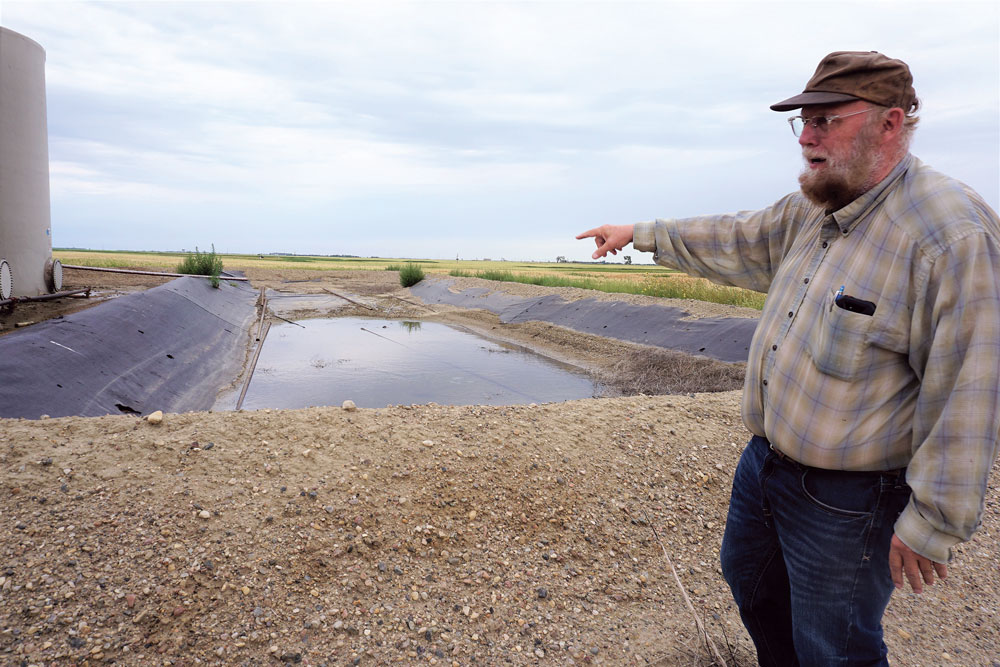
State Rep. Marvin Nelson points out deficiencies in a waste pit with liner holes and metal debris at an oilfield facility in Bottineau County during a tour Aug. 11.
Neglect haunts the aging oil well site in western Bottineau County. A pit for liquid waste reveals metal debris and liner punctures, while a bird’s nest pokes out from a coverless electrical panel.
A number of old oil wells in North Dakota’s legacy fields from the 1960s through 1980s have become environmental hazards, often abandoned or owned by small operators that lack the resources to remediate them. That’s especially the case in Renville and Bottineau counties, where saltwater leakage has created thousands of damaged acres.
The State of North Dakota faces responsibility for millions — or what some say is billions — of dollars in reclamation in legacy fields. The original operating companies are long gone, having captured the prime production before selling the declining assets to less affluent operators that seek to eke the last dollars of profit from the wells before they are closed or abandoned.
Lynn Helms, director of the North Dakota Department of Mineral Resources, the agency tasked with overseeing reclamation, is optimistic that problems can be resolved in time, citing $66 million recent federal funding to help with plugging and reclamation of old wells and another $25 million for another round.
“We’ve got adequate funding. We’ve developed some really good science and processes for finding the contamination and for remediating it. I think we have all the pieces in place. The planning and hiring the workforce and scheduling how the work gets done — that remains to be seen,” Helms said.
“Right now, we’ve got between 90 and 105 orphan wells and probably around 150 to 160 sites that have to be cleaned up.”
The Salted Land Council, an advocacy group for landowners, argues the state’s plan for cleanup is woefully lacking, creating a false promise that damaged acreage will become productive agricultural land again.
Council Chairman Fintan Dooley said the state’s cleanup thus far has been fraudulent in limiting the removal of contaminated soil only from a well site, ignoring saltwater that has migrated off the site to damage hundreds of other acres. Soon after digging and hauling away contaminated soil, replacing it with new topsoil, the unremediated saltwater leaches back in and contaminates the site again, he said. “Some small sites maybe it worked. But they’re applying for $25 million, and they want to do it again the wrong way,” Dooley said. “We can’t allow this pattern to go on.”
Dooley, Democratic-NPL candidate for North Dakota agriculture commissioner, has made reclamation of oil-impacted agricultural lands a key component of his campaign. The 77-year-old Bismarck attorney entered the race to draw attention to the Industrial Commission’s handling of the issue and to push for investing the state’s Legacy Fund money into reclamation.
Farmer and rancher Donny Nelson of Keene, founder of the Salted Lands Council, said money in the Legacy Fund, the state’s oil-tax savings account, came from the oilfields and a good portion should go back to reclaim the oilfields.
“It will be a lot cheaper to do it now when the money is there than to do it down the road. That’s what happened in the ’60s, ’70s. They’re still sitting out there and now its costing them 20, 30, 40 times the money to reclaim them because they just didn’t do it in a timely manner,” he said.
The Salted Lands Council blames much of the salted soils issue on the state, which it says allowed the contamination to happen.
Salt contamination of land and water occurs because the oil production process brings saltwater to the surface. Companies dumped saltwater into unlined evaporation pits from the 1950s until the late 1970s, when North Dakota began requiring pit lines. Upon retirement of the well, many of those lined evaporation pits were cut to drain and dry out, with the state’s permission, the council states. Scientists now know that the accumulated pit salts imperil adjoining lands by leaching vertically and latterly, according to the council, which states salt plumes have traveled as much as a mile and have corrupted watersheds and wells.
“This is all manmade damage,” said state Rep. Marvin Nelson, D- Rolla, an agricultural consultant, during a tour of the salted lands in Bottineau County’s legacy fields this past August. “They destroyed the
lining so that the toxic waste could leach out into the surrounding farmland that the farmer was never compensated for. And then they all walked away and tried to leave the farmer with the liability for what they’ve done. That’s where we are today.”
Additionally, enforcement authority has been lacking, the council states.
Marvin Nelson said when the U.S. Environmental Protection Agency and Corps of Engineers redefined protected wetlands, North Dakota sued to exempt oil companies from having to comply.
“We have tanks that are leaking every day. We’ve had tanks that it’s normal when they pick the tank up that the bottom falls out of the tank. They never flux their tanks. They never test their tanks. They never build an impermeable barrier. They never do anything to comply with the spill prevention control program because they’re not subject to it. So this is the politics of the thing,” Nelson said.
Marvin Nelson also said the state’s definition of reclaimed still results in a yield decrease.
“The standards aren’t very good and, frankly, agriculture is so competitive that any place you have a 20% yield loss, you have non- economic ground to farm,” he said.
“The whole system is morally decrepit,” Dooley said. “What we have done is immoral and it’s illegal and it’s a violation of our constitution.” Now that state has federal money for reclamation, landowners — who have been cut out of the reclamation planning decisions — are demanding the job be done right, Dooley said. They prefer not to have to bring a lawsuit to ensure that happens, he said.
“But we will do one if we have to. We’ve written up the lawsuit,” he said.
Dennis Grzezinski, an environmental attorney in Milwaukee, Wisconsin, who visited North Dakota earlier this month at the Salted Lands Council’s request, echoed the opinion that a lawsuit isn’t the best solution. He also argues that North Dakota needs to devote Legacy Fund money to what he prefers to call an opportunity.
“It seems to us that there’s a real opportunity for employment, a real opportunity for using that money to invest back into the state of North Dakota, into the local overwhelmingly rural, agricultural communities, and restore those properties to their pre-oil industry proper value,” he said.
Part two will continue Tuesday.
Local News

Minot High senior prepares for second graduation
Minot, area graduates to receive diplomas Sunday
Minot High School and Minot North High School will hold their 2026 graduation ceremonies Sunday, May 24, in the ...

MINOT CITY COUNCIL CANDIDATE: Locken: Building a better Minot for all
Charges filed against truck driver for fatal Watford City crash
WATFORD CITY – Charges have been filed by the State of North Dakota in Northwest District Court against a ...
Bicyclist injured in crash in Carrington
CARRINGTON – A juvenile from Carrington was seriously injured Wednesday, May 20, in a crash with a vehicle in ...