
Minot City Council supports converting portion of 16th Street SW to three lanes
Council supports converting roadway to three lanes
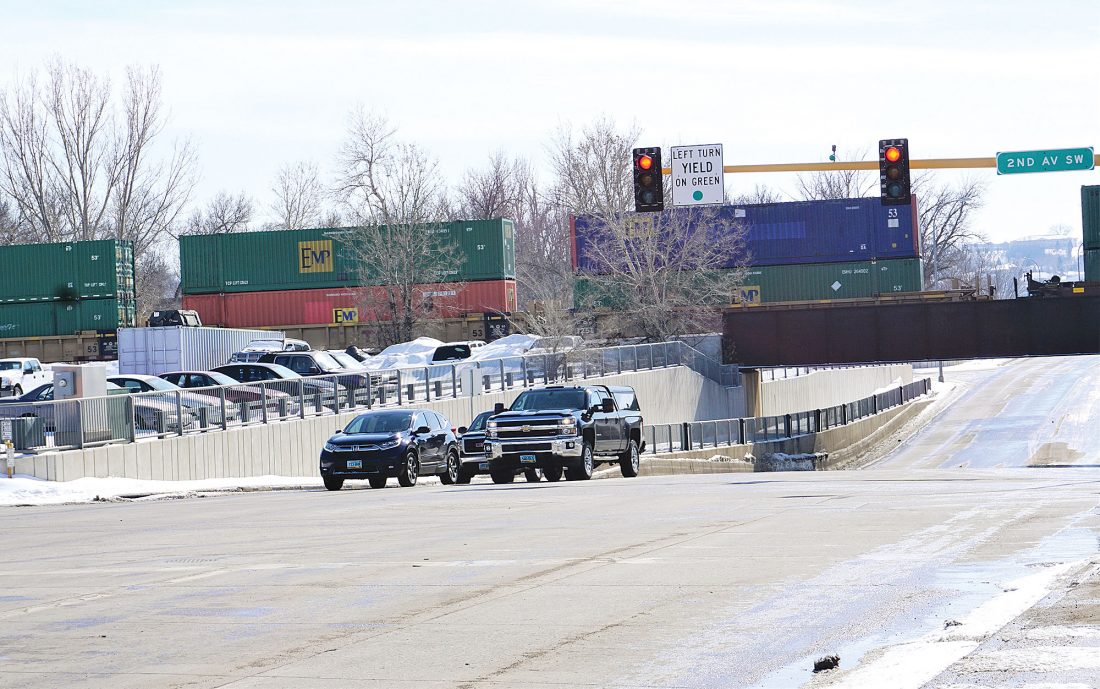
Jill Schramm/MDN Vehicles travel up 16th Street Southwest from Second Avenue Southwest Monday. A study of the 16th Street corridor recommended fewer lanes in the roadway design.
Sixteenth Street West in Minot would go on a road diet under a plan presented to the Minot City Council Monday.
The council agreed to convert the existing four- and five-lane, undivided roadway between Fourth Avenue Northwest and Burdick Expressway into a three-lane roadway, which engineers describe as a Road Diet plan. The change also would incorporate the addition of bicycle lanes.
“There are some safety aspects on this road related to crashes, to access management, that we can help alleviate with converting 16th Street West from a four-way roadway to a three-way roadway,” said Stephen Joersz, city traffic engineer.
A study of 16th Street conducted by the City of Minot Engineering Department found safety issues such as lane drift near the Second Avenue Northwest and Fifth Avenue Southwest curves, where head-on and sideswipe crashes have occurred. The lack of left-turn lanes near Arrowhead Shopping Center also contributes to the number of rear-end and right-angle crashes.
The 16th Street and Fourth Avenue Northwest intersection saw 28 crashes during the five-year analysis period from November 2015 to October 2020. There were 37 crashes between Fourth Avenue Northwest and Second Avenue Southwest and 24 crashes between Second Avenue Southwest and Burdick Expressway. The 16th Street and Burdick intersection saw 40 crashes. The estimated crash costs per year for the corridor was $1.5 million, in 2020 dollars.
The study concluded a Road Diet would help reduce the crash hotspots. Designated center turn lanes would help by reducing the conflicting traffic movements. Studies on other Road Diets corridors have shown a 19% to 47% reduction in crashes.
Adding to the crash risk along 16th Street Southwest are the 29 intersection and driveway access points on the quarter-mile stretch between Third and Seventh avenues. It amounts to an access every 45 feet. A Road Diet could help with this issue, too, according to the city engineering department.
Council member Stephan Podrygula mentioned the public opposition he has heard about the plan for a three-lane roadway.
“Everyone I’ve talked to, I should mention, has been surprised by this and has not been thrilled with it,” he said. “I think we’ll have to have significant public education.”
The big concern is that reducing the lanes will congest traffic, but Joersz said engineering data show that would not be the case.
Sixteenth Street between Fourth Avenue Northwest and Burdick Expressway carries daily traffic volumes of 9,000 to 12,500 vehicles. Using existing traffic volumes, the study found a three-lane road along 16th Street only increased the average travel delay by between two and five seconds in the area of consideration for a Road Diet. Even with traffic growth in the future, a Road Diet is expected to be able to handle the traffic. Having fewer lanes is anticipated to create a more uniform traffic speed, increasing safety.
A Road Diet also could allow for parallel parking in some areas or refuge islands that ease the ability of pedestrians to cross a busy street. The study stated a refuge island could be considered near Perkett Elementary School.
“I think this makes sense,” council member Paul Pitner said. “When you really travel that road, if you sit in the left lane you’re probably going to stop two or three times and have the risk of being rear-ended or you’re going to come up behind someone and sit there and wait for them to turn left. So having a designated turning lane, I think, is the most appealing thing.”
The council unanimously adopted the recommendation to include a Road Diet when Sixteenth Street between Fourth Avenue Northwest and Second Avenue Southwest undergoes a street seal this year. The Road Diet would be incorporated into work between Second Avenue Southwest and Burdick Expressway during an asphalt mill and overlay and concrete replacement/resurface in 2025.
Joersz said the construction of a new high school in north Minot isn’t expected to significantly affect traffic on the Fourth Avenue Northwest to Burdick segment. The city does have the 16th Street and 21st Avenue Northwest intersection on its radar for improvements, though, he said.
Local News
Trinity Homes sees home health, hospice transition
Trinity Health has announced it has contracted with CHI Health at Home and Hospice and CaringEdge to provide ...
Road work in McHenry County to impact traffic
Blu Riderz will be performing aggregate surfacing and reconditioning on Minuteman Missile roads in McHenry ...

Hammer to give Memorial Day address
Bottineau High Concert Choir named 2026 Governor’s Chorus
BISMARCK – Gov. Kelly Armstrong and First Lady Kjersti Armstrong on Wednesday, May 20, announced the Bottineau ...

Minot celebrates Public Works Week with open house
Committee seeks more data in library merger talks
The cost to merge Minot Public and Ward County Public libraries would add nearly $700,000 to first year operating ...