Developer sees good fortune where city sees misfortune in housing project
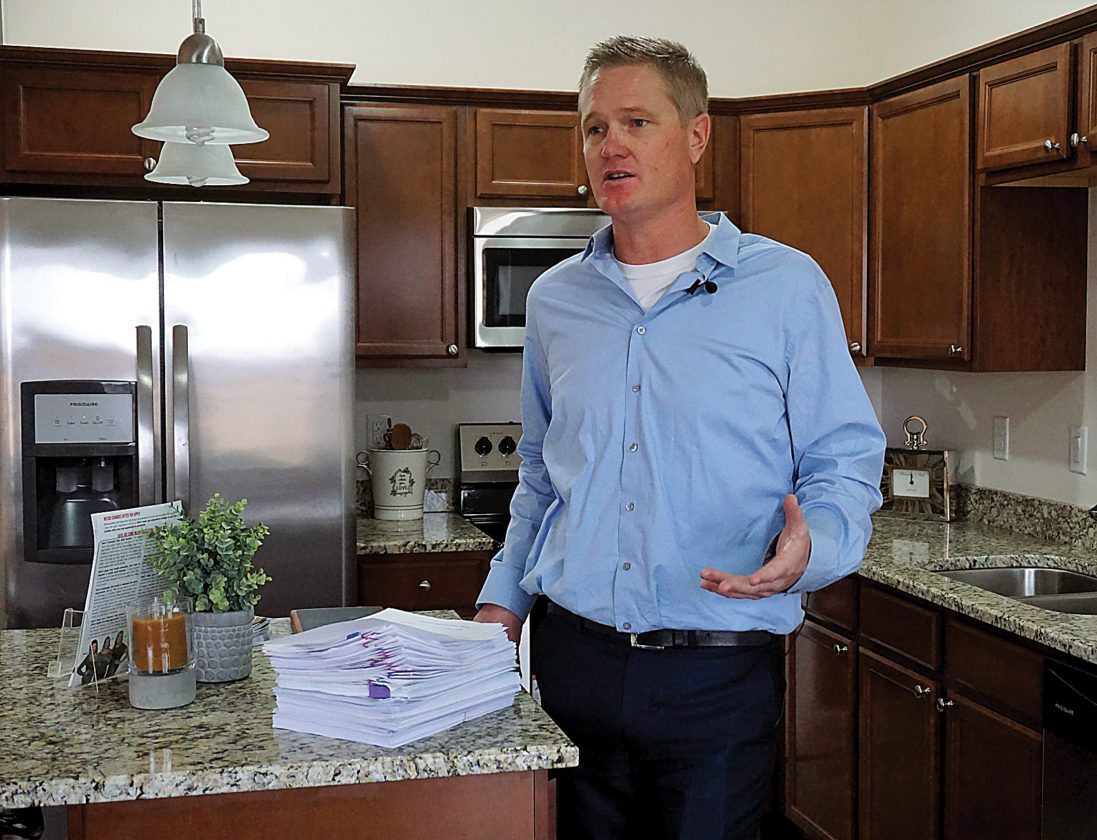
Jill Schramm/MDN Accompanied by copies of paperwork submitted to the city since August, Nathan Smith with 16th Crossing speaks at a new conference in one of the development’s townhomes Monday.
A Minot developer at odds with the city over a construction agreement involving federal funds says he’s not worried about a potential audit or the future of his growing subdivision.
“I am not worried about that because I am doing the right thing,” said Nathan Smith with 16th Crossing. Smith held a news conference Monday to point out the development’s success in creating low- to moderate-income housing in southeast Minot after the 2011 flood.
“This project is not a failure. The City of Minot is trying to paint the picture as a failure. They are wrong,” Smith said.
16th Crossing entered an agreement with the city in 2013 to construct 178 townhomes within two years. The city says 16th Crossing also agreed to provide 350 manufactured homes, although Smith said the agreement was to set aside 350 lots that can be used for manufactured homes. The agreement specified that 51 percent of housing was to be set aside for low- to moderate-income residents.
Smith said he has developed the lots for the manufactured homes and built an estimated 40 townhomes. He said there are 200 occupied units in the subdivision, with about 70 percent qualifying as low- to moderate-income. He said city figures of 34 completed townhouses and 44 percent LMI-qualifying are in error.
Smith said the project was not completed in two years due to the city’s failure to finish the infrastructure construction per the agreement. Under the agreement, the city used $5 million from the federal Community Development Block Grant-Disaster Recovery to build infrastructure. The city said it also put nearly $1 million of additional money into the work.
The delay by the city’s contractor held up home construction because it was impossible to build or sell homes without streets, water and sewer, Smith said. Once infrastructure was completed, the oil economy plunged and the huge demand for housing changed.
“But it is not going to change forever. We are still maintaining inventory. We are still building homes,” Smith said. He said construction is occurring in step with demand, but it isn’t prudent to built homes that can’t be sold, nor would it be possible to finance such a venture, he said.
The city has announced it is taking action to recover HUD funds from the developer because of its concern about an audit by the Department of Housing and Urban Development. Failing to meet HUD requirements could force the city to repay the $5 million grant. Smith said he is not concerned, having hired an independent HUD consultant in Atlanta whose report supports his position that 16th Crossing is not at fault.
Smith produced a stack of paperwork that he said he has submitted to the city regarding the project and HUD compliance since the city began demanding documentation in August. He said the city has not wanted to talk with him to explain why the documentation is inadequate or provide guidance on an acceptable plan for advancing the project. Nonetheless, the project is advancing, he said.
“I am not going anywhere. We are still building,” he said. “It’s not going to change the fact that we are committed to this project.
Townhomes being built in the development start at $139,000 and include amenities such as garages, decks and granite countertops. Smith noted the neighborhood includes a school and a gymnastics center, a proposed park and the start of 7.5 miles of walking trails. He added it includes a fire station for which 16th Crossing donated land at the city’s request.
There are plans for construction of additional single-family homes priced at $230,000 to $270,000.
The city’s action doesn’t change anything for 16th Crossing, Smith said.
“Will there be more homes built out here? Absolutely. There’s still going to be that infrastructure and we are going to still keep building,” he said. “There’s no risk to the residents or future residents. … This project still is moving forward. Residents don’t have to worry about anything adverse to their properties.”
Local News
Minot DAV honors Minot woman for quilt donations
Free suicide alertness training set in Minot
FirstLink is offering a free safeTALK Suicide Alertness Training in Minot. The training will be Friday, June 5, ...
Minot Parks splash pads open
Splash pads at Radio City Park and Oak Park are officially open for the season, according to Minot Parks ...
Man dies from injuries in two-vehicle crash
A 77-year-old man died from injuries received in a two-vehicle crash in Minot Saturday, May 23. According to Minot ...
NDSU Extension to hold fencing school event
North Dakota State University Extension will host a fencing school event on June 10 at the North Central Research ...