
U.S. data center boom comes to ND
Trending
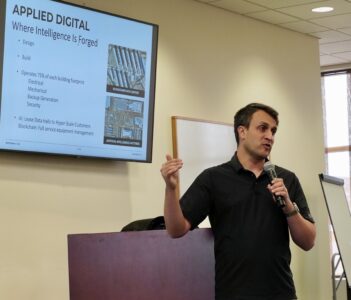
The United States is far ahead of the rest of the world in the area of artificial intelligence and cloud computing and it needs to stay in the lead, according to Nick Phillips, executive vice president of External Affairs with Applied Digital.
That sizable lead has led to adversaries investing in disinformation campaigns that have contributed to the controversy around the development of data centers, said Phillips, who spoke at a meeting of Bakken API and the Minot Area Chamber EDC Energy Committee Tuesday, May 5.
Applied Digital, which has blockchain or data centers in three locations in North Dakota, has faced its strongest opposition in Oliver County, where it proposes to establish a fourth location. Phillips said not everyone is going to like the idea of data centers, but opposition often softens when people gain a better understanding of them. Applied Digital also doesn't oppose appropriate zoning and regulations, he said.
"These are industrial uses for land, so you want to make sure they're in an appropriate place," he said.
A Williston facility faces a lawsuit from area residents over noise, which is a factor with data centers.
Applied Digital has a wall around its Ellendale facility to help dampen sound. At a quarter to half mile from residents, sound generally is not an issue, Phillips said.
"For us, it's really important internally. We have rules about how we site these things. We've been more restrictive than the jurisdictions that we operate in, but it's really important that they're sited well," Phillips said.
Another concern has been the large draw on electrical power by data centers and how that might affect costs to existing electrical customers. Applied Digital's Ellendale site uses about the same electricity load as the city of Sioux Falls, South Dakota, according to Phillips.
Phillips said data centers look for places like Ellendale, with plenty of excess energy.
"By siting our location there, where there's an excess of generation and not enough transmission lines, we've actually been able to save consumers $38 million to date on their power bills. That $38 million has been credits to every single MDU rate payer across the state, not just the ones in Ellendale," he said.
Higher demand for energy reduces rates by spreading the fixed costs, he said.
"We're a very large user, and so we ended up taking a very large amount of those fixed costs," he said.
Phillips said Applied Digital declined participation in a program that would have given it a 10-year property tax break. For 2026, the company's anticipated property tax on its Ellendale site is $4.28 million.
"The reason why we've chosen not to take advantage of that pilot program is because we were asking people to move into Ellendale, and we want to make sure that they’ve got adequate roads, police, fire, schools and so on," he said. "It makes our lives a lot easier to get people to move there if they have all of those things."
Once fully staffed, the Ellendale complex will have about 350 employees.
Applied Digital also has participated with 20% equity in a housing initiative involving the state and a developer that has completed 20 single-family homes. A 40-unit apartment building is to be built later this year, Phillips said.
Applied Digital also established Applied Digital Cares, a grant program that has completed two grant rounds in support of community organizations and projects.
In 2022, Applied Digital invested $180 million into a 180-megawatt blockchain center in Ellendale. In 2023, Applied Digital built its first AI data center in Ellendale, which opened last fall. An expansion should open later this year and a second expansion next year, Phillips said.
"Ellendale is about a $5 billion total investment for us that does not include customer equipment," he said. He explained Applied Digital operates the infrastructure but leases to massive cloud computing companies that have their own equipment.
"Basically, we're just a big landlord with a lot of space," he said.
Currently, about 1,900 construction workers are on site in Ellendale and 600-700 workers in Harwood, Phillips said. The crews consist largely of electricians but other trades involved include pipefitters, carpenters, plumbers and drywallers. Recently, 8,000 sheets of drywall a day were being installed at the Ellendale project, or three truckloads a day, Phillips said.
Current construction at the Ellendale site also has generated more than a million dollars in local sales tax, he added.
Applied Digital began in 2021 with a 106-megawatt blockchain center in Jamestown. The center was an $82 million investment that now employs 40 people.
Last September, Applied Digital began building a data center in Harwood. The company is making a $3 billion investment into a 280-megawatt facility that will employ about 200 people.
Applied Digital also is looking at building a 430-megawatt data center in Oliver County.
North Dakota is attractive for data centers because of its abundant energy and its weather, Phillips said. Data centers require either cooled air or cooled water running in a closed loop to keep equipment functioning. If too warm, air or water is cooled by chillers to between 61-74 degrees.
"There's about 200 days worth of hours that we don’t have to run chillers here, where in other places we would need to use them," Phillips said.
Applied Digital isn't the only company looking at North Dakota for data center development. Critical Data House has proposed a facility at Williston, and NextEra has proposed a data center in Mercer County.
Phillips said he doesn't see a decline on the horizon in demand for more computing power and more data centers.
"If we can build it, customers are showing up, is what we are finding," he said. "I don't see it getting smaller. The compute loads are getting, frankly, bigger."