Parties in shooting case await Supreme Court ruling
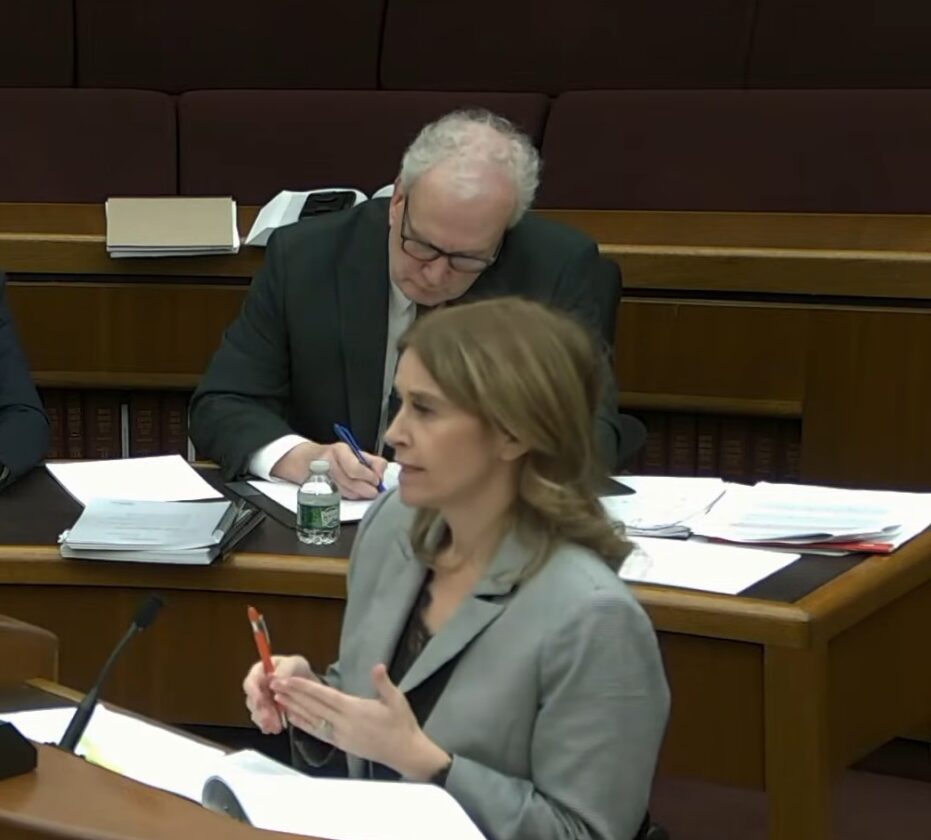
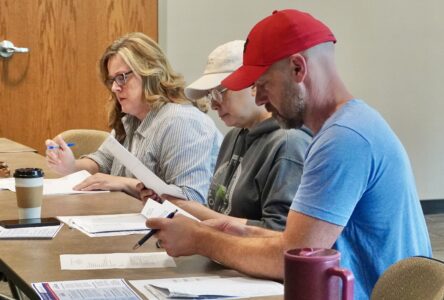
Special Ward County Prosecutor Amanda Engelstad speaks during oral arguments before the State Supreme Court on March 23 regarding supervisory writ seeking to quash a subpoena filed against BEK Communications in the case of Daniel Breijo while BEK Communications' attorney Robin Forward takes notes.
Bismarck attorney Jesse Walstad was allowed to withdraw last week as the attorney for Daniel Breijo, the man charged in the shooting death of serviceman Nicholas Van Pelt, but in March he joined with state prosecutors in arguing against a supervisory writ filed by a North Dakota broadcaster seeking to quash a subpoena.
The subpoena was filed by special Ward County State’s Attorney Amanda Engelstad and sought to compel BEK Communications to provide all unaired interview footage with the lone surviving eye-witness to the shooting, along with all notes and communications with her and related to her interview.
The documentary series produced by BEK included explorations of Breijo’s case, as well as his involvement as a Department of Homeland Security agent in the investigation of alleged illicit aerospace manufacturing at a facility in Dunseith in the year leading up to the shooting and Van Pelt’s murder the evening of Dec. 23, 2023.
According to documents provided by the North Dakota Attorney General’s Office through an information request, the current owner of the Dunseith facility had submitted a whistleblower report on Oct. 23, 2023, to multiple state agencies, including the Attorney General’s Office, the State Auditor’s office and a number of legislators. The report included an allegation Breijo had threatened him after he learned the owner had reported concerns to the FBI and the U.S. State Department.
BEK Communications immediately filed a motion seeking to quash the motion, but presiding Judge Daniel El-Dweek had ordered BEK to provide the subpoenaed information to the court for an “in camera review” to determine whether the motion to quash should be granted.
BEK Communication’s attorney, Robin Forward, began oral arguments on March 23 by arguing the subpoenaed information was protected under North Dakota’s journalism shield law. He took issue with the language of El-Dweek’s order for the in-camera review.
Forward argued the state had failed to establish a sufficient burden of proof to trigger an in camera review and failed to identify specific prior statements by the surviving witness in prior interviews and depositions.
“The state did not carry its burden. You have to have something, some threshold showing to get an in camera review,” Forward said. “They could’ve called police officers at the hearing and taken testimony from them about why they believe BEK might have this information. They didn’t. To be honest, if that’s all they did, then BEK should not surrender its privilege.”
Forward said the subpoena and El-Dweek’s eventual order would have been more acceptable had it been limited solely to the unaired interview footage but argued El-Dweek failed to even consider quashing other categories, such as Outlook calendars and text messages.
“This overlaps. There’s overlapping problems with this specific subpoena I’m talking about. It would violate the Grand Forks Herald case and the journalism statute, and the second is that the subpoena doesn’t meet the rules of criminal rule of procedure 17 and its case law,” Forward said.
Forward argued, under the precedent of the Grand Forks Herald case, El-Dweek erred by finding that quashing the subpoena would violate Breijo’s constitutional rights, saying, “The state and the defendant do not share interests.” He said the judge failed to apply the factors created by the Supreme Court ruling in Grand Forks Herald. Those factors include the free flow of information, confidentiality, compelling interest, exhaustion of other means of getting the information and whether the request or subpoena is frivolous.
“The order cannot survive any kind of scrutiny. It’s BEK’s position that the court should have made a determination based on the record before it after the hearing had concluded,” Forward said. “Our case law is pretty clear that under Rule 16 and under Brady, the state has no duty to seek out evidence and do the defendant’s job for them.”
Forward argued that any disclosure of BEK’s confidential information would have a chilling effect on other news gatherers in the state that obtain confidential information in the future.
“The speculation the state and Mr. Breijo are making is that J.B. has made inconsistent statements in the recordings that BEK has. That’s not enough,” Forward concluded.
Special Ward County State’s Attorney Amanda Engelstad argued the interviews with J.B. in BEK’s series are relevant and of evidentiary value to the criminal proceedings, and the unaired footage would likewise be relevant and provide necessary context. Engelstad further argued the state took the initiative to subpoena the information to ensure the state possessed it, as the defense would not be bound to provide it to the state if it had subpoenaed it themselves.
“The state has no time at this point to look at what he plans on publishing to the jury. So what does the court do? Does it take a week’s recess to give the state the opportunity to review, or is the state just left at a disadvantage,” Engelstad said. “We went about it in the correct manner. There is no other way for the state to obtain this information without a Rule 17 subpoena power.”
Engelstad said she was trying to avoid a pitfall found in a 2022 case involving a state Bureau of Criminal Investigations agent confiscating the phone of a Williston radio reporter, which Attorney General Wayne Stenehjem ruled violated the state journalism shield law.
“We are living in a true crime podcast world,” Walstad said before asking the court to not deprive the district court of its use of the in camera review, describing it as a “protective, discrete, judicial tool for unraveling these sorts of disputes.”
“I would caution the court to carefully consider the ripeness of this petition. There is not a lot of guidance in the law. This Grand Forks Herald case is nearly 40 years old. I would anticipate this sort of issue arising with increased frequency as the nature of investigative journalism changes. It is evolving, the same as our own profession, increasingly to include podcasts in an ever expanding marketplace of investigative journalist productions,” Walstad said. “I think this is a ‘catch-22.'”
Local News
Fedorchak forum to focus on nation’s 250th anniversary
BISMARCK – Congresswoman Julie Fedorchak, R-ND, will host her next Fedorchak Forum on Thursday, June 25, at 6 ...
91st Missile Wing successfully tests readiness, reliability
Dads 101 prepares Minot AFB expectant fathers
MINOT AIR FORCE BASE – To help expecting fathers build confidence and prepare for the realities of parenthood, ...
MSU students earn two national titles
Canvass produces updated tally, write-in recount