
75 years of progress
SRT’s history is one of innovation to meet members’ needs
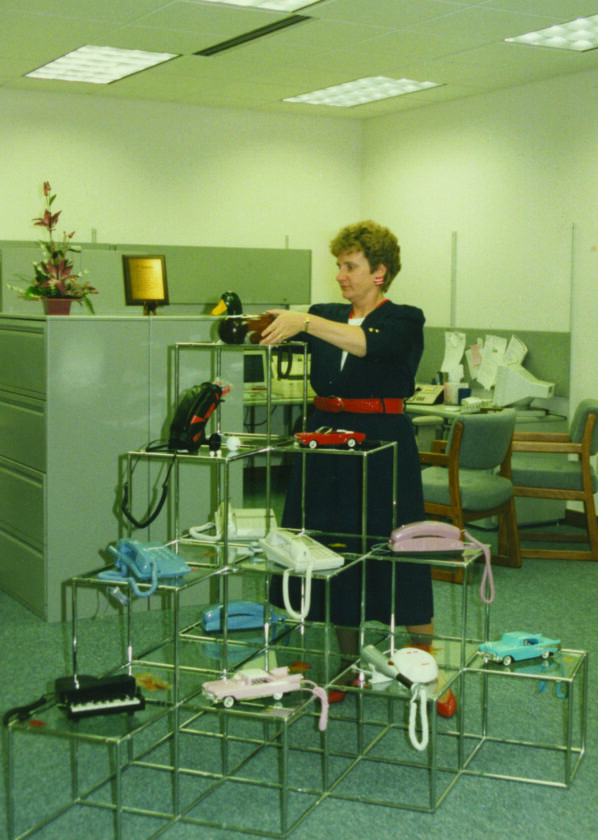
Submitted Photo Novelty phones made calls fun in the 1990s. An SRT employee puts the finishing touches on a front office telephone display.
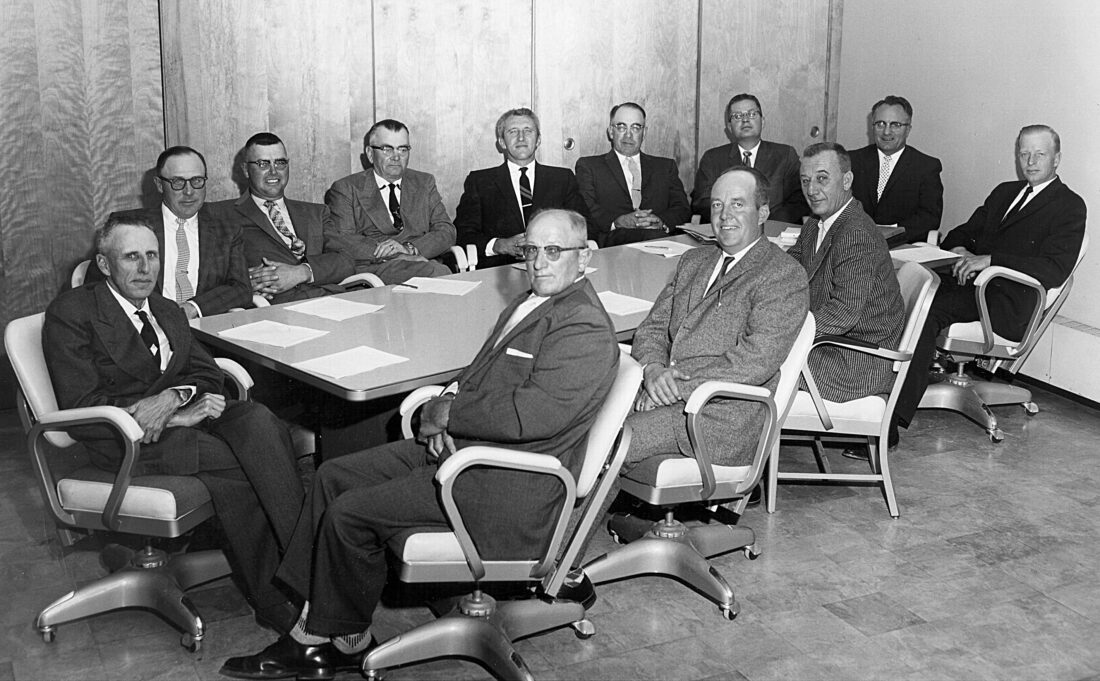
Submitted Photo SRT’s first elected board of directors included: back from left, John Alexander, Ardine Ness, Ingwald Rosendahl, John Sveund, Raymond Fegley, Attorney Herbert Meschke, Manager Paul Froemming, Ray Vendsel; front from left, John Campbell, Walter Wunderlich, Vernon Carlson, Engineer Donald Flahert.
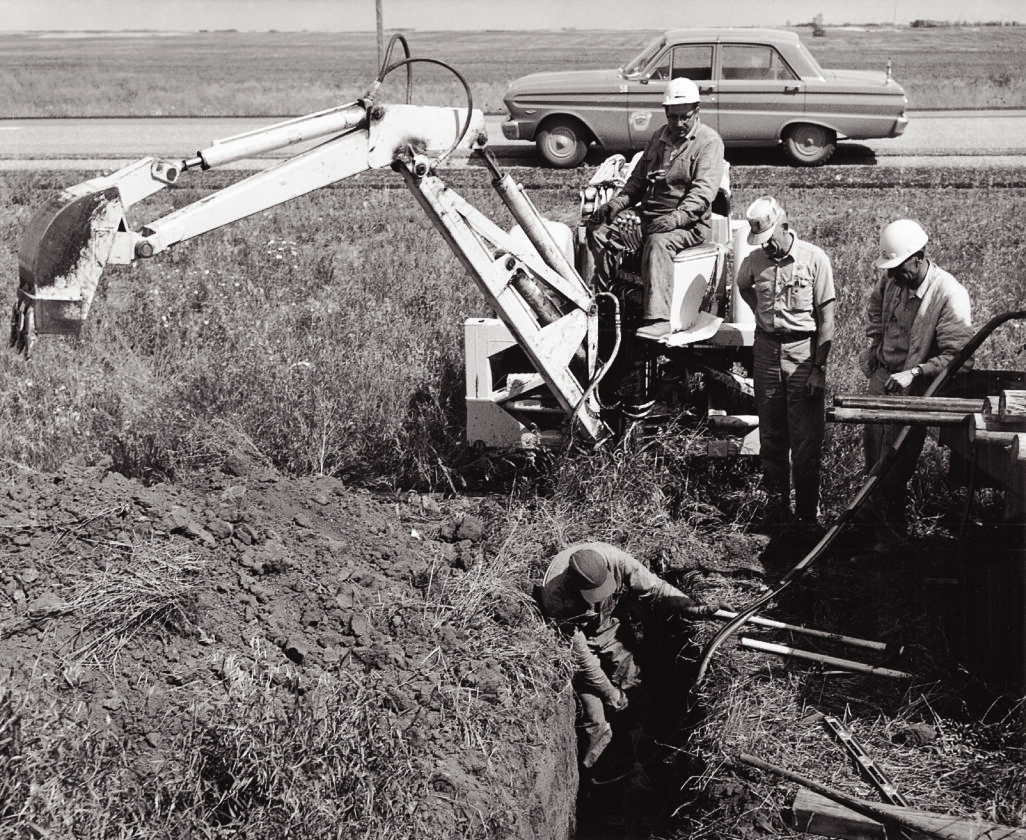
Submitted Photo In the 1960s, SRT embarked on replacing above-ground telephone wires with buried cable.
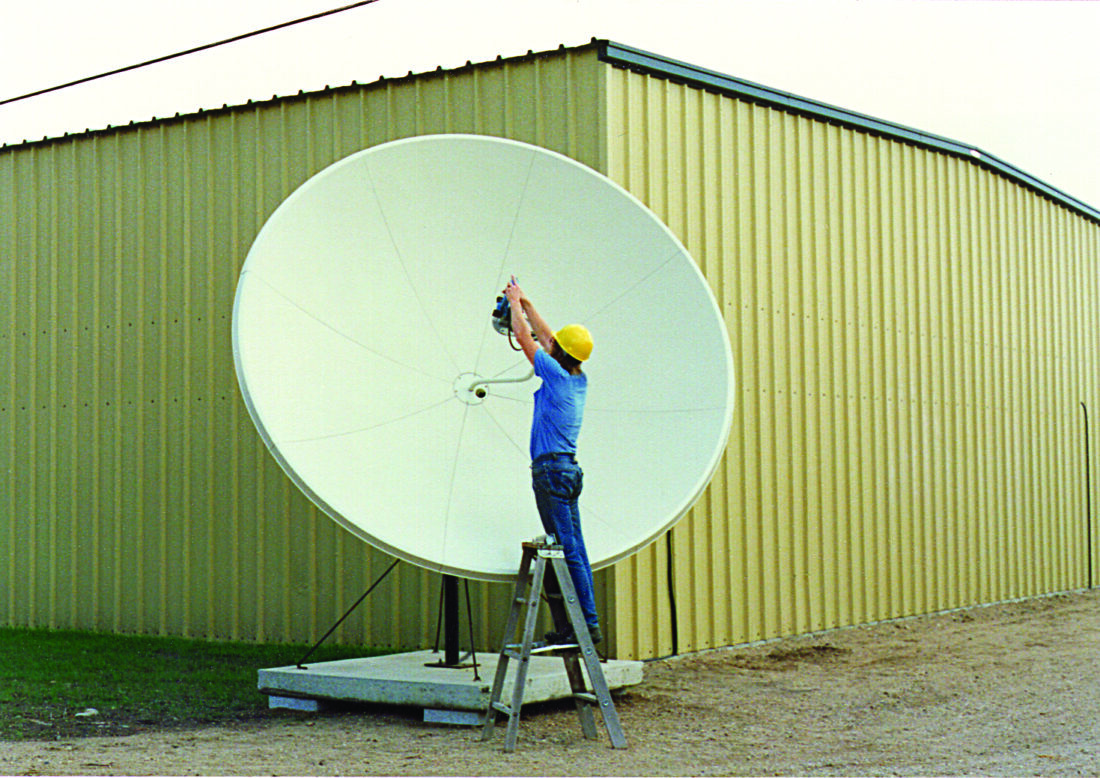
Submitted Photo An SRT employee works on a C-Band Satellite dish. The 1980s ushered in satellite TV service for SRT.
Submitted Photo Novelty phones made calls fun in the 1990s. An SRT employee puts the finishing touches on a front office telephone display.
Submitted Photo SRT’s first elected board of directors included: back from left, John Alexander, Ardine Ness, Ingwald Rosendahl, John Sveund, Raymond Fegley, Attorney Herbert Meschke, Manager Paul Froemming, Ray Vendsel; front from left, John Campbell, Walter Wunderlich, Vernon Carlson, Engineer Donald Flahert.
Submitted Photo In the 1960s, SRT embarked on replacing above-ground telephone wires with buried cable.
Submitted Photo An SRT employee works on a C-Band Satellite dish. The 1980s ushered in satellite TV service for SRT.
Trending
Established to bring telephone service to its slice of rural North Dakota, SRT Telephone Cooperative has innovated and evolved over the past 75 years to become more than just a phone company.
As advances in broadband technologies promise more changes ahead, SRT will keep adapting to meet its members' needs, said General Manager Cassidy Hjelmstad.
"However we can continue to innovate," she said, "we will certainly look to do that."
SRT has adopted "History of Innovation" as its anniversary theme. The co-op's anniversary logo will be visually celebrated on its trucks and other signage through the year.
The annual meeting on June 18 will have an anniversary focus. SRT has commissioned an art piece that will be unveiled at the meeting, and a commemorative video will be shown.
The member-centric celebration includes ongoing member features on social media, and SRT will launch a community tour of about 30 towns in its service area this summer. The visits will be tailored to each town and often will be in conjunction with other community events that bring people together.
"It will be celebratory and fun," said Karim Tripodina, public relations manager at SRT. "When we go to each town, it really is 'Thank you for being part of our membership.'"
In 1949, U.S. President Harry Truman signed an amendment to the Rural Electrification Act of 1935 to provide low cost loans to improve and provide telephone service to rural areas of America. Verendrye Electric Cooperative initiated efforts to form a telephone cooperative in its region 1950. Those efforts resulted in the formation of Souris River Telephone Mutual Aid Corp. in 1951.
Hjelmstad said the telephone cooperative movement was occurring around the region. Also formed in 1951 were Reservation Mutual Aid Telephone Corp., now RTC Networks, with offices in Parshall, Stanley, New Town and Watford City, and Northwest Communications Cooperative in Ray.
Over the years, SRT's reach grew as it added an increasing number of rural members expanding its services.
Dennis Schott, Butte, who served on the SRT board 42 years, remembers the board was split at his first meeting in 1982 over whether to provide computer sales and service. He voted at the second meeting to break the tie, and SRT opened a computer store in Minot. Over time, SRT left that business and entered others.
"We always studied thoroughly on any change we made," Schott said. "We always thought about our customers and what they needed."
SRT also is conscious of its critical role in serving Minot Air Force Base and a regional hospital, Hjelmstad said.
"One of the things SRT has always tried to do is make sure that we have the best networks, and again, our board and our leadership were willing to invest in that," she said.
SRT faced another challenge when 7,500 phone lines went down and two of its buildings were damaged by underground water pressure during the 2011 Souris River flood. SRT created an office in a temporary office trailer and started reconnecting members, getting people back in service in around four days, Hjelmstad said.
Schott, who knew or worked with all the SRT managers, said each one brought something new and directed the board to always think forward.
"They could have worked somewhere else for more money but they were willing to stay there and fight the fight to make SRT what it is today. I'm very proud of the fact that we've gotten to where we're at, that we now have fiber all over Minot. That was maybe one of the biggest undertakings that we did," said Schott, who retired from the board in 2024, just ahead of completion of fiber installation in Minot in January 2025.
A significant milestone in SRT's history was adding Minot, Surrey and Burlington with the purchase of Minot Telephone Company from NSP in 1994.
"It was historical at the time," Hjelmstad said. "It was a huge win for SRT because it, obviously, tripled the size of the co-op."
Randy Burckhard of Minot, then a financial officer with Minot Telephone, recalled NSP took sale bids in 1991, narrowing the 25 bidders to 10 that were allowed a second bid. The SRT bid came in second behind Rochester Telephone, creating some concern by SRT that NSP was dodging selling to a co-op, Burckhard said.
"We were worth $17 million on the books. It sold for $51 million to Rochester - three times its value," he said. The North Dakota Public Service Commission tried to discourage the sale by lowering approved rates, forcing a price drop to $48 million, he said.
Dissatisfied with the new management and seeing profits leave the community, Burckhard was pleased to see SRT get back in the game.
"Three years later, SRT gets a hold of Rochester Tel and says, 'We need to have it. How much do you need? And they paid $61 million for Minot Telephone," Burckhard said.
A small 65-employee cooperative buying a larger 100-employee investor-owned company, with their differing philosophies, was unheard of and carried a tremendous risk for SRT, Burckhard said.
"It was a gutsy decision, but it made sense," he said of SRT's purchase. Population centers were growing. Rural areas were not.
Making a personal transition from finance to public relations with SRT, Burckhard worked with city leaders who were unimpressed with the co-op to overcome their resistance to the new ownership. The former Minot Telephone exchange was phased into cooperative membership two years later.
"At the same time, they eliminated long distance phone calls between Minot and the base, which was a very positive thing. People were very happy with that. And it worked. It happened to work really well," Burckhard said.
SRT paid off its loan early and laid off no employees in the merger, right-sizing its staff through attrition, he said.
Schott said the purchase of Minot Telephone didn't happen without thorough study and advice from legal counsel, but it was a bold decision.
"Because when we bought Minot Telephone, there was a time we didn't know if we could pay out all the wages. That's how tight the money was, but we made sure our employees were all paid," he said. "The employees were very important to SRT and especially helpful to the board in the decisions we had to make."
SRT, with 25,000 members and 26,000 internet agreements, looks much different today because of decisions of the board.
"I recognize we're standing on the shoulders of giants because they have absolutely been an innovative company when it comes to rural telephone and, now, I would say, rural broadband," Hjelmstad said. "We offered DSL, dial-up internet, back before it was even necessarily talked about or really available anywhere else. We had our own cell phone network, a wireless network. There was no wireless service in our entire rural service area. The SRT board and leadership bought spectrum, put up these wireless towers, made the investment and created the wireless network," Hjelmstad said. "It transformed how people were able to communicate - farmers, particularly."
SRT felt the need to step in because wireless companies did not want to serve rural areas, she said.
"It never was done for a profit," Schott said of the wireless service. "It was done for the patrons out there. They wanted better service, and we were the leaders in giving them that."
SRT discontinued wireless service in 2018 as its services became less needed to fill the gap.
"That was hard because we were so proud of the network we had built. But when you're the small guy in north central North Dakota trying to support what needs to be a national network, it wasn't sustainable," Hjelmstad said.
Meanwhile, SRT has expanded into security and surveillance equipment.
Telephone landlines that were so important in the 1950s are declining in use today, but Hjelmstad doesn't see them completely going away. They remain an important feature for some members, she said.
SRT also has seen technology shifting from traditional phone lines to use of internet lines for phone service. SRT offers the voice over internet protocol (VoIP) service, which allows people to use their phones in the same way even though the mechanism for receiving calls differs.
"Technology has forced the world to change," Hjelmstad said. "Credit to SRT, to those that have been able to see that path and set us up to be able to adjust to those innovations and those changing times."
Going forward, new technologies in the way people use devices to communicate and conduct business will continue to challenge SRT to innovate. Hjelmstad said she is excited about the potential, as SRT continues to look for ways to bring new technologies to rural North Dakota.
"What's next for us is to try to find more ways to be a catalyst to continue to support our rural communities," she said.