COVID-19 squeezes hospital capacity
Trinity tightens visitation, recruits more staff
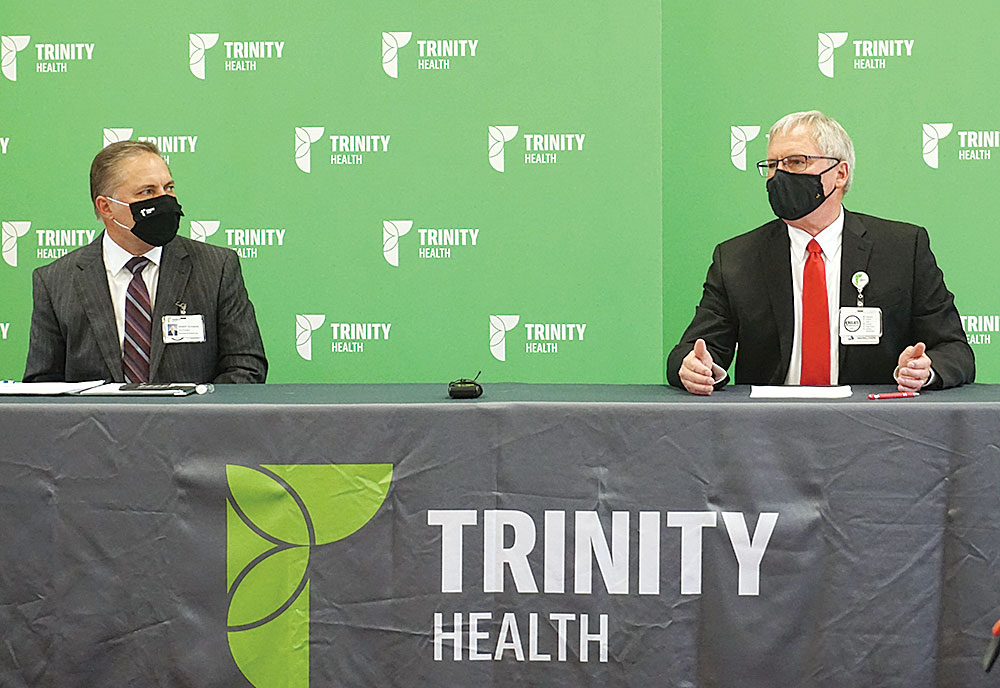
Jill Schramm/MDN Dr. Jeffrey Sather, chief of staff, right, speaks at a news conference at Trinity Friday with Randy Schwan, Trinity vice president, left.
Trinity Health is tightening its hospital visitation restrictions while putting out a call for more nurses as it copes with a growing number of COVID-19 cases.
“We are at that point of capacity virtually every day,” Dr. Jeffrey Sather, Trinity chief of staff, said at a news conference Friday. “We’re either just under it, or we’re at it, or at times we’re over it, trying to find places for our patients.”
Since early March, Trinity Hospital has admitted 151 patients who have been COVID-19 positive, said Trinity Vice President Randy Schwan.
“But 53% of those patients have been admitted over the past six weeks so that’s clearly the time of escalated activity. We average about 25 to 30 patients in the hospital on a daily basis that are being treated for COVID-19,” he said.
The surge in cases has prompted a change in hospital visitation rules. Effective Tuesday, visiting hours will be limited to 10 a.m. to 7 p.m. daily, with just one adult visitor allowed per day at a patient’s bedside. Movement in the hospital will be restricted, and no one younger than 18 will be permitted. All visitors will be screened upon entry, and a mask or face covering will be required throughout a person’s visit.
Exceptions to the one-visitor policy include patients in the pediatric and newborn intensive care units, where two parents or legal guardians will be allowed. Patients receiving end-of-life care may have up to three visitors, with pre-approval required for visits by minor children.
No one will be allowed to visit patients who test positive for COVID-19 with the exception for pediatric patients, who are limited to one parent or legal guardian; maternity patients with newborn, limited to one support person; and end-of life patients, with pre-approval required for all visits.
Patients visiting the hospital for an outpatient procedure, emergency or same-day surgery will continue to be allowed one adult companion, who must remain in the patient’s room. Patients requiring a home caregiver will be allowed one visitor at the time of discharge for care training.
“We’re going to be as respectful and accommodating as possible. But our overarching priority is to keep our patients safe and our workforce safe,” Schwan said.
Trinity plans to make virtual visits available through handheld devices. People already have the ability to send flowers or messages to patients through Trinity’s website.
Trinity also is exploring the prioritization of surgical procedures to manage demands on its resources. Schwan said the hospital has been able to find protective equipment in searching nationwide, but it also is finding ways to reuse and lengthen time of use while following Centers for Disease Control and Prevention guidelines.
“We’re not at a critical shortage, but we do monitor the inventory level of these things every day,” he said.
Schwan and Sather stressed that staffing is a far greater concern than space when it comes to meeting demands on Minot’s healthcare system.
The average hospital stay for a COVID-19 patient is eight days, compared to four for the average patient, and some COVID-positive patients stay much longer, Sather said. Typically, one nurse can care for five patients not needing intensive or critical care services, but that ratio drops to four patients or fewer with COVID-19 care, he said.
“So we have to keep increasing our nursing availability, which is where we’re scrambling now to reallocate nurses within the system,” he said. “This is a jigsaw puzzle every day for our leadership teams to be figuring out.”
Although the COVID-19 positivity rate among Trinity employees is lower than the general community at about 2%, the hospital’s ability to staff for its needs is affected, Schwan said.
Trinity is asking nurses currently out of the workforce to consider coming back. Schwan said the health system has a number of positions that could be filled to ease the pressure as the hospital shifts staff to the COVID unit. Interested individuals can contact Trinity’s human resources department.
Trinity has contracted nurses who are coming next week, but it is getting more difficult to find those nurses, Sather said. Trinity also has recruited staff from areas of the country that have gone through what the Minot region is experiencing and understand the procedures with COVID-19.
In addition to patients hospitalized for COVID-19 treatment, Trinity has seen a number of patients who have been admitted for other reasons but test positive for COVID-19. Both types of patients are cared for in the COVID-19 unit.
Trinity reported about 20% of hospitalized patients are COVID-19 patients, who commonly are hospitalized for low blood oxygen levels, which might manifest as breathing difficulties or as faintness or confusion. About a third of medical/surgical patients are COVID-19 positive. The 19-bed intensive care unit has about 20% of its patients with COVID-19.
“We have expanded our treatment areas for COVID-19 patients, more than once, and we’re looking at another expansion,” Schwan said. Trinity presently is adding 10 beds to the 25 beds available.
Schwan and Sather spoke about the coordination occurring among hospitals in the state as they bump up against capacity at times. Trinity has both sent patients to other hospitals in the state and accepted patients. Regional patients who in the past would remain at Trinity until discharge are more likely to return to the smaller, critical access hospitals closer to where they live once their care requirements have lessened, Sather said.
An average of about 90 patients seek care through Trinity’s emergency room each day, and about 20% to 25% require admission. They are moved elsewhere for hospitalization on “rare occasion,” Schwan said. More frequently than in the past, smaller hospitals looking to refer to Trinity are redirected to another facility, he said.
Sather said the number of Trinity’s hospitalized COVID-19 patients tracks consistently at 3% of the active cases in the region.
“Our teams are diligently working to keep up with that demand, and struggle day by day to keep us right at the edge of that capacity,” Sather said.
“We as a health system have to be nimble and I can’t overstate how proud I am of our staff. We have staff working overtime. We have managers who live, breathe and dream about this at night,” he added. “Our staff is working hard but they’re stretched thin.”
He said the pressures could increase with flu season, which typically brings 50 to 60 patients to the hospital. Trinity encourages residents to get vaccinated for the flu and to take precautions against COVID-19 that include mask wearing, hand washing, social distancing and avoiding large groups of people.
“So a simple ask for us as citizens of our community is to step up like we did during the flood,” Sather said. “Our community worked together. Let’s do it again and take a simple step to protect each other.”
Local News

Auction raises more than $135,000 for Team Minot
Governor’s Photo Contest invites entries
BISMARCK — The 2026 North Dakota Governor’s Photo Contest for Travel and Tourism is now open, inviting North ...
Police impound auction scheduled for Saturday
The Minot Police Department will host its 2026 impound auction on Saturday, May 9. Seifert Auction Service will ...

Supreme Court denies BEK TV’s petition

Learn about native fish at Confluence