
Something fishy is going on
-
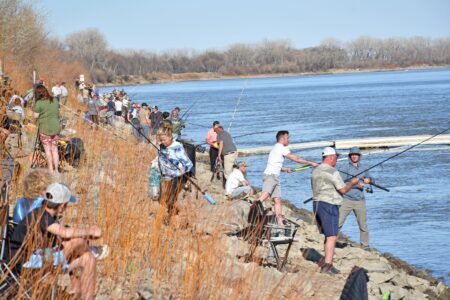
- Submitted Photo A horde of people crowded the shore of the Missouri River for the strenuous sport of paddlefishing. This large group was at the Confluence of the Yellowstone and Missouri rivers, directly east of the Missouri-Yellowstone Confluence Interpretive Center and Fort Buford State Historic Site, southwest of Williston. People were on both sides of the rivers, as well as at some of the sandbars in the Yellowstone. Photo by Roger Riveland.
-
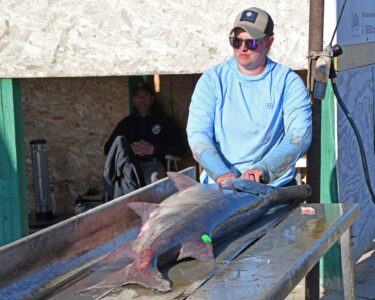
- Submitted Photo After paddlefish are caught and tagged, most of them are processed for free at the fish cleaning station. After washing, weighing and other preliminary steps, the fish are sent up a conveyor belt to the processors who clean the fish and remove the eggs from the females to be, made into caviar. This female specimen weighed in at 74 pounds. Photo by Roger Riveland.
-
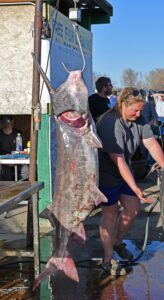
- Submitted Photo A 108-pound female paddlefish that was harvested by Bismarck angler, Todd Mees, is being weighed, washed and recorded at the fish cleaning station on opening day. A total of 344 fish were recorded caught on opening day at the cleaning station. Photo by Roger Riveland.
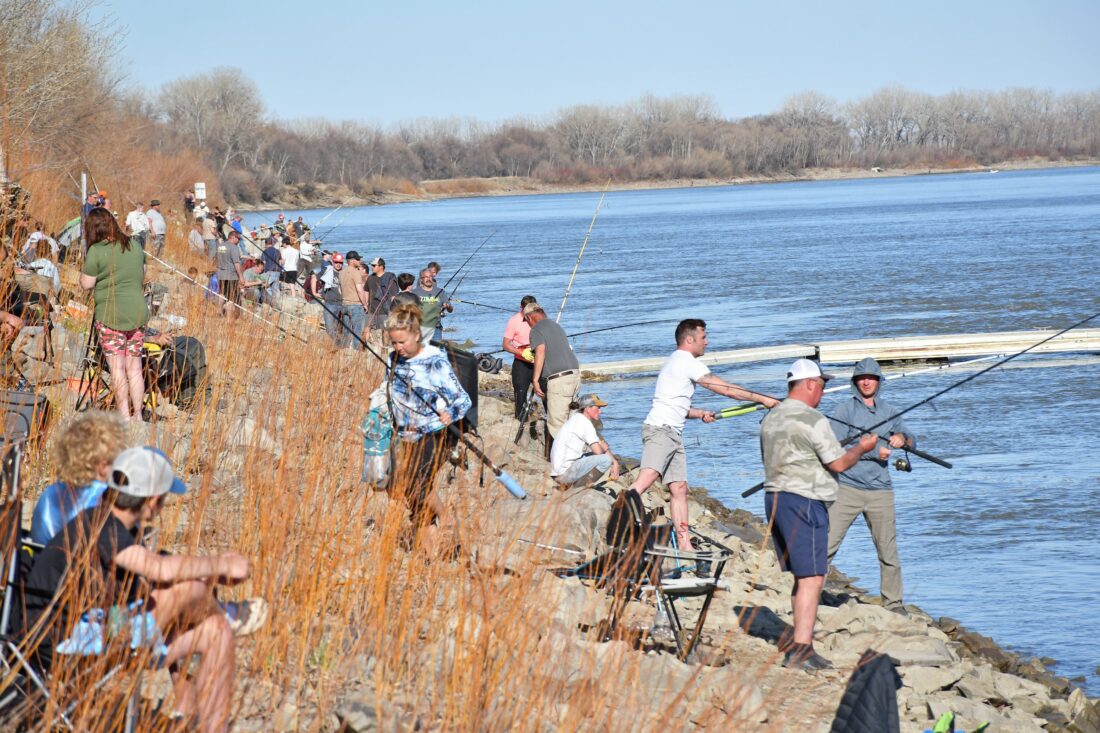
Submitted Photo A horde of people crowded the shore of the Missouri River for the strenuous sport of paddlefishing. This large group was at the Confluence of the Yellowstone and Missouri rivers, directly east of the Missouri-Yellowstone Confluence Interpretive Center and Fort Buford State Historic Site, southwest of Williston. People were on both sides of the rivers, as well as at some of the sandbars in the Yellowstone. Photo by Roger Riveland.
WILLISTON — Opening day of North Dakota’s paddlefishing season, Friday, May 1, was a fury of people vying for their spots along the banks of the Missouri and Yellowstone rivers where the laborious sport is allowed.
Hundreds of participants lined the north bank of the Missouri River directly east of the confluence of the Yellowstone and Missouri. People were on both sides of the rivers and also on some sandbars in the Yellowstone. There are other areas that are popular as well, but the party-like atmosphere is usually centered around the confluence area. This is where people bring their fish to have them processed for free. There is a food truck and paddlefish clothing sales booths on site too.
Anglers going after paddlefish normally use large rods, with 10 and 12 feet lengths common. Large reels and heavy line also are needed to snag and land the large fish. The large treble hooks on the line have a 5-ounce weight, attached by line about 16 inches behind the hook to keep the hook low in the river where the fish are located in the murky waters. If you are going paddlefishing, be prepared for hours of casting and tugging. You need a North Dakota fishing license as well at an additional paddlefish tag, which is sold separately.
The first step, after being lucky enough to snag and land your fish and tag it, is getting it to the cleaning station, where it is washed and the tag number recorded. A check is made for a radio tag, and the fish is weighed, measured and a sample of its jaw bone is taken by the N.D. State Game and Fish for study and to age the fish. The jaw bone has growth rings added each year, similar in nature to trees.
The fish is measured first without the paddle and then the total length is also measured. The nose paddle, which is called a rostrum, represents up to one-third of its total body length. This elongated snout acts as a sophisticated sensory antenna covered in thousands of electroreceptors, allowing the fish to detect the weak electric fields of tiny zooplankton.
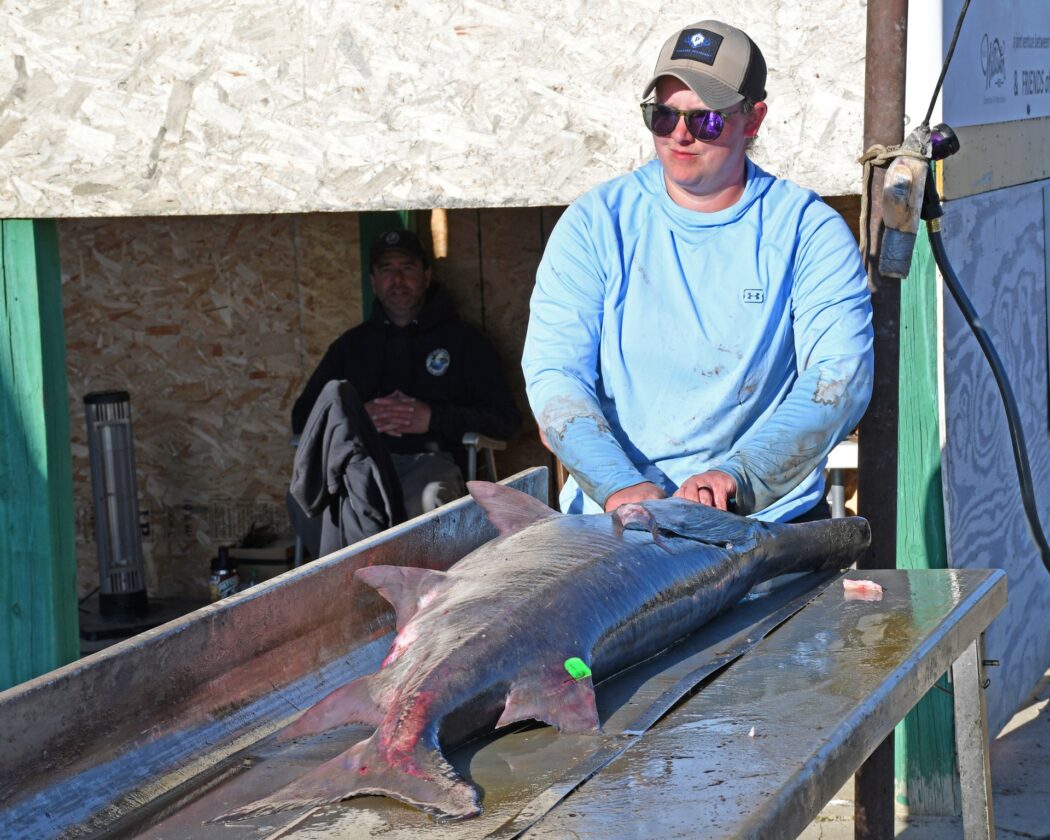
Submitted Photo After paddlefish are caught and tagged, most of them are processed for free at the fish cleaning station. After washing, weighing and other preliminary steps, the fish are sent up a conveyor belt to the processors who clean the fish and remove the eggs from the females to be, made into caviar. This female specimen weighed in at 74 pounds. Photo by Roger Riveland.
The eggs (roe) from the females are saved by the cleaning station and made into a high grade caviar by North Star Caviar.
North Star Caviar information describes the unique nonprofit company that began in 1993 as a joint venture of two nonprofit organizations, the Williston Convention & Visitors Bureau and the Friends of Fort Union/Fort Buford.
The first portion of each year’s proceeds from the sale of caviar is directed to the Game and Fish Department for paddlefish research, information and enforcement. The remaining proceeds are granted back to nonprofit groups in the region for historical, cultural and recreational projects and efforts that improve conditions of habitat and land and water access for outdoor activities.
Some people were taking their paddefish head, with rostrum, to Dakota Skulls, a Minot area business with a tent office set up in Buford near the intersection of N.D. Highway 1804 and the confluence turnoff. Dakota Skulls uses beetles to clean the skull and rostrum down to the bone. The paddle then looks like a finely woven doily of bone once the beetles have done their work.
Opening day had a 344 fish recorded at the cleaning station located just east of the Missouri-Yellowstone Confluence Interpretive Center. The total season harvested fish as of Tuesday evening was 597, as shown on the cleaning station tally board. Daily totals were Friday 344, Saturday 190 and Tuesday 63.
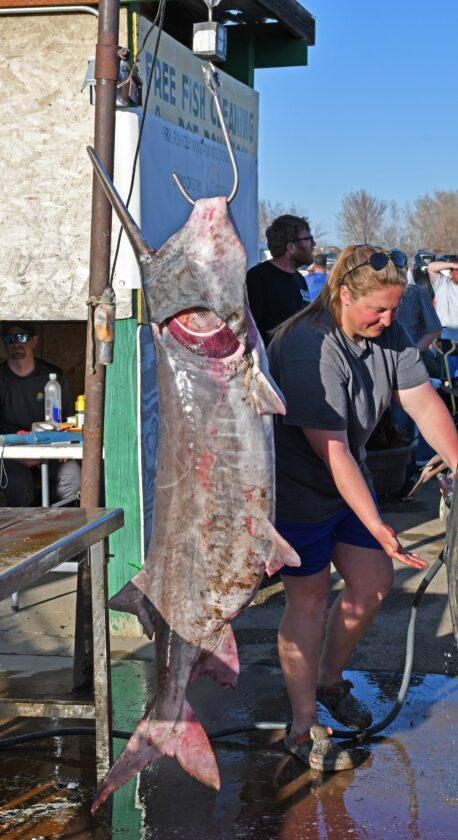
Submitted Photo A 108-pound female paddlefish that was harvested by Bismarck angler, Todd Mees, is being weighed, washed and recorded at the fish cleaning station on opening day. A total of 344 fish were recorded caught on opening day at the cleaning station. Photo by Roger Riveland.
The N.D. Game and Fish Department announced Wednesday, May 6, that the state’s 2026 paddlefish snagging season will close Friday, May 8, at 7 p.m. CDT to any additional harvest to provide long-term protection of the paddlefish population. The 2026 season was scheduled to run to May 21, but officials said it could close early if the 1,000 fish maximum quota was reached.
An additional snag-and-release extended season will begin Saturday, May 9, and run through May 15, according to the department. Paddlefish snaggers with unused tags can continue snagging during the additional snag-and-release season but must release all fish immediately. If a snagger has already used their tag on a harvested paddlefish, they are not allowed to participate in the additional snag-and-release period.
Snag-and-release will be open in that area of the Missouri River starting on the north shore from the Confluence boat ramp, then east (downstream) to the pipeline crossing (river mile 1577) and on the south shore from the confluence with the Yellowstone River, then east (downstream) to the pipeline crossing (river mile 1577). Paddlefish snagging during the extended season is allowed from 7 a.m.-9 p.m. CT. The use or possession of a gaff on snag-and-release days is illegal.
Local News
Upcoming Minot area veterans’ events
July 1: DAV Coffee in Ward County Administration Building Veterans Room at 2 p.m., speaker Attorney Anthony ...
Delta to conclude Williston air service
WILLISTON – The City of Williston has been notified that Delta Connection flights, operated by SkyWest Airlines, ...

Exercise prepares airmen for expeditionary operations

America’s 250th Birthday: July 4 celebrations set for Minot, area
MSU receives federal health grant
BISMARCK — Minot State University will receive $110,631 to improve the timely documentation, reporting and ...
ND launches Dakota BOT
BISMARCK – The North Dakota Department of Commerce and North Dakota Information Technology (NDIT) have partnered ...