75th Anniversary
Martin Cross: Founding Member of National Congress of American Indians
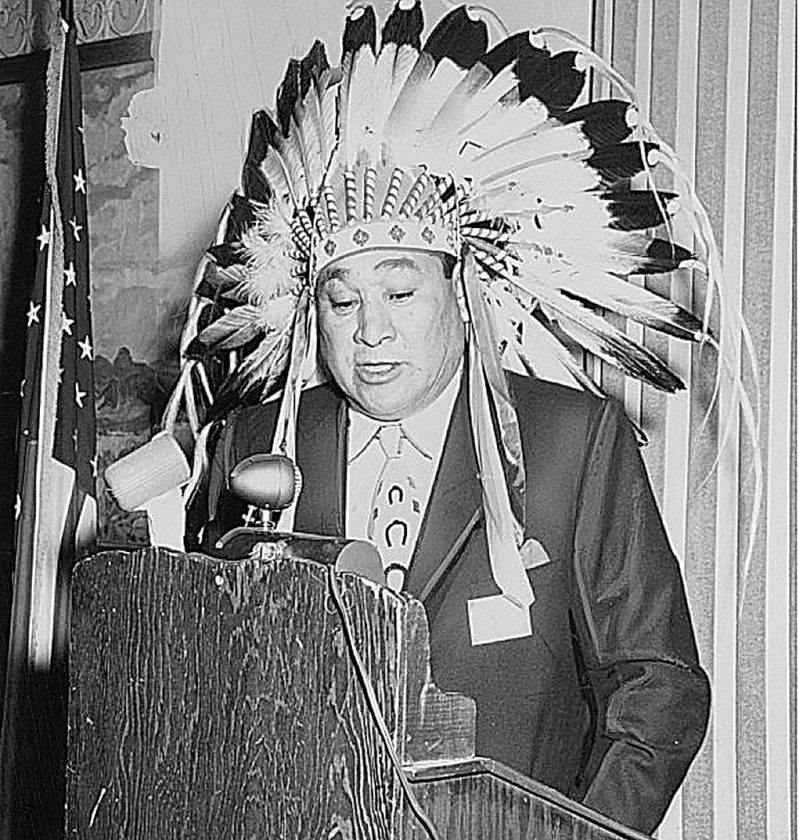
Martin Cross spoke at the National Congress of American Indians meeting in Phoenix in 1954. Cross, of the Fort Berthold Reservation, was a founding member of NCAI. Submitted Photo
-
- Martin Cross spoke at the National Congress of American Indians meeting in Phoenix in 1954. Cross, of the Fort Berthold Reservation, was a founding member of NCAI. Submitted Photo
-
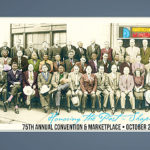
- Submitted Photo Martin Cross, a founding member of the National Congress of American Indians, is shown in this poster promoting the 75th anniversary of the organization. He is seated in the front row, sixth from left.
Several months before, in May, a small group of Indian people gathered at the YMCA in Chicago. In this group was D’Arcy McNickle (Flathead) who was an assistant to John Collier, Indian Affairs Commissioner. Most of the others worked for the Bureau of Indian Affairs. They agreed that a national organization was needed to advocate for Indian people. They set Nov. 15-18, 1944, as the dates to hold the convention in Denver. Letters of invitation were sent to all Indian tribes.
When the letter arrived at Fort Berthold, Martin Cross was very new to tribal leadership. He was 38 years old, a rancher who lived near Elbowoods. In 1944, life was very difficult for Fort Berthold people and most other Indian reservations. All the resources of the reservation were being directed toward the World War II effort. The Tribal Council had no money for travel. The councilmen served without compensation of any kind. It must have been a great financial hardship for these representatives to travel to Denver for five or six days. The records show that the organizers of the conference did not have adequate funds themselves and had in fact asked the participants to help defray the costs of the gathering. So obviously it was a very “spartan-like no-frills” gathering. The group photo taken at this inaugural event is of 60 men and seven women in front of the Cosmopolitan Hotel in Denver. Despite their lack of financial resources, they laid the foundation for an organization which has withstood the test of time and which has grown stronger each of its 75 years of existence.
Representatives from 50 Indian tribes from 27 states met in this first-of-a-kind Indian gathering. In those four short days, they organized, elected officers, drafted and unanimously adopted a constitution and by-laws, selected the name “National Congress of American Indians” and considered and acted upon 18 resolutions, 17 of which they passed. Despite the many challenges of travel costs, distance away from home and the mid-November weather, the founders of this organization accomplished the great task of unity and advocacy on behalf of “the Indians of the United States and the Natives of Alaska” (from the Preamble of the NCAI Constitution).
Martin Cross continued to represent the Three Affiliated Tribes at NCAI for many years throughout the 1940s and the 1950s. He served as vice president in 1953-54 and on the executive council in 1954-56. In December 1949, he helped draft a letter from the NCAI to the Senate Committee on Interior and Insular Affairs. This letter urged support for the Three Affiliated Tribes in their effort to correct the injustices of PL 437 (the taking of 158,000 acres of Fort Berthold Indian land for the Garrison Dam) and to correct a number of defects in the law. In 1953, the NCAI passed a resolution supporting the restoration of mineral rights under the Garrison reservoir to the Three Affiliated Tribes. In 1984, 31 years later, Congress passed a law returning the tribal mineral rights on land under the Garrison reservoir.
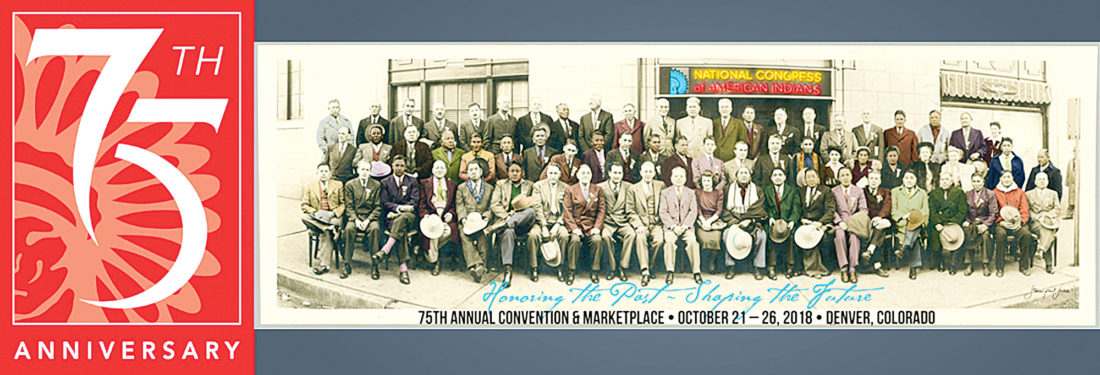
Submitted Photo Martin Cross, a founding member of the National Congress of American Indians, is shown in this poster promoting the 75th anniversary of the organization. He is seated in the front row, sixth from left.
Over the next years, the NCAI convention was held in many cities throughout the United States. In 1963, Bismarck was selected as the convention site. Robert F. Kennedy, U.S. Attorney General, was the guest speaker. No one was happier about this than Martin Cross who served as chairman of the Entertainment Committee for this event. In a July 22, 1963, letter to his daughter he wrote, “I was hoping you could come to the NCAI convention in Bismarck Sept 10-13. We will have the biggest and best convention the NCAI ever had. I am in charge of the evening entertainment.” This included a dance at the World War Memorial Building, an elk and buffalo meat barbecue at the Kiwanis Park, an all tribes powwow, an adult Indian prize dance for all tribes and the introduction of Miss Indian America.
In February 1964, Martin Cross, along with the tribal education committee, traveled to the Pierre and Flandreau Indian Schools in South Dakota and Wahpeton Indian School in North Dakota to visit students and tour the facilities. In a letter to his daughter from Wahpeton, he wrote that he was very tired and not feeling well, but he welcomed the opportunity to visit the schools he had attended school as a young man. Two months later in April, Martin Cross died of a massive heart attack at his ranch on the Fort Berthold Reservation. In his archives was a collection of NCAI correspondence and reports for the nearly 20 years he had been associated with the organization
The NCAI will hold its 75th anniversary conference in Denver where their first meeting was held in 1944. Their website states the following: “The National Congress of American Indians, founded in 1944, is the oldest, largest and most representative American Indian and Alaska Native Organization serving the broad interests of tribal governments and communities.”
In recognition of his role as a charter member of the NCAI, the family of Martin Cross has donated funds to assist in the 75th anniversary conference. A page in the program will congratulate the NCAI and recognize Martin Cross’ contribution to the organization.
Marilyn Hudson lives in Parshall. She is one of nine children of Martin and Dorothy Cross.
Local News
Missionaries to speak at Minot Baptist
Patrick and Victoria Weimer, missionaries to Iceland as pioneer church planters since 1997, will be speaking at ...
US 52 work to affect several communities
Work on U.S. 52 that is expected to begin May 4 will affect Harvey, Drake, Anamoose, Martin and Fessenden, ...

Governor tours Minot’s flood construction
Police officer struck by vehicle
The Minot Police Department is investigating an incident on Wednesday evening which resulted in a police officer ...
Parties in shooting case await Supreme Court ruling