
Dry conditions put the spotlight on crop insurance
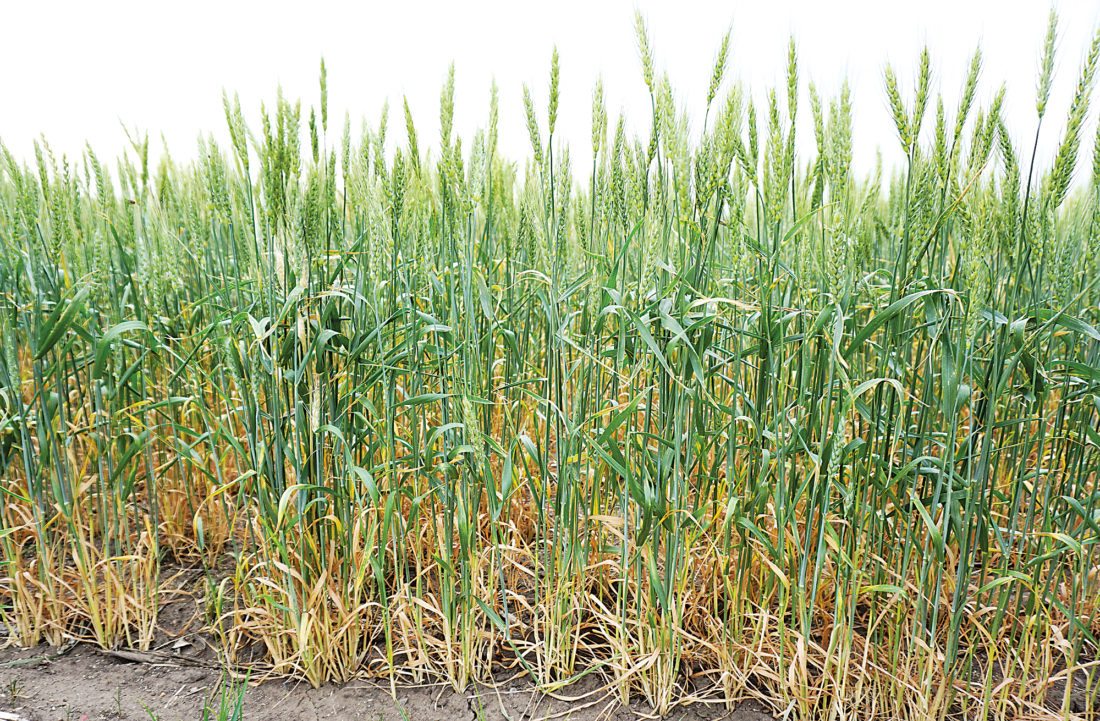
Jill Schramm/MDN Many crops are showing evidence of a lack of rainfall this summer. Crop insurance policies will provide some loss protection for selected growers effected by abnormally dry conditions.
Given the dry conditions throughout much of North Dakota, and its effect on crops struggling to grow in sweltering heat with little or no moisture, there’s not much doubt many farmers are familiarizing themselves with the finer details of their crop insurance policy.
Those producers whose yields are going to be much less than hoped for this year will at least be able to buffer their loss, if they are properly insured. The decision to do so had to be made by March 15 of this year, the deadline for sign-up. Crop insurance is based on the projected price of a crop.
“If the price is higher in the fall than what was projected in the spring, we follow that price,” said Jerry Essler, Essler’s Farmers Union Insurance in Kenmare.
Brent Wollschlager, Parshall, is also an agent for Farmers Union Insurance and handles crop insurance policies. He says there are a few different ways to write a crop insurance policy.
“They can protect yield or revenue,” said Wollschlager. “It is based off their production history, by crop, of what they’ve done in the past.”
Farmers must report their acreage to the Federal Crop Insurance Program. Crop insurance is sold as a percentage of protection. The percentage of protection can be as little as 50 percent but producers usually choose to insure in the 65-75 percent range. If a crop insurance policy is based on a 40 bushels per acre guarantee on wheat at a rate of 70 percent, yield would have to fall below 28 bushels per acre for the crop insurance policy to take effect.
Under the above described scenario, a producer whose harvest amounted to only 25 bushels per acre would receive payment for an additional three bushels which would bring the total to 28 bushels, or 70 percent of the land’s historic yield.
“It’s not cheap and it’s no way to make money, but it helps farmers get through the tough years,” explained Wollschlager.
It is anticipated that a number of farmers will be looking to their crop insurance to help minimize losses caused by drought conditions this growing season, particularly in areas to the south and west of Minot. Farmers whose harvest falls short of their long-term average and who have a crop insurance policy, must submit a claim in a timely manner.
“An adjuster will determine their loss,” said Wollschlager. “There are many things that could cause a loss. The price could fall or it could be drought. If the price goes up it will help offset some of the cost per bushel. That’s farming. It’s a gamble.”
According to Essler, a crop adjuster can appraise a field prior to harvest to determine the expected yield and whether or not a crop insurance payment will be made. A producer then has the option of harvesting the field and obtaining an actual yield or accepting the adjuster’s estimate. He cannot do both. A crop on which insurance has been paid can still be cut for hay or other purposes but cannot be sold.
In order to qualify for certain Federal Farm Programs, most producers are required to carry at least a minimal amount of crop insurance.
“Crop insurance is there to help the farmer farm again next year,” said Essler. “That’s why it has always been there.”