
MAFB history of honor
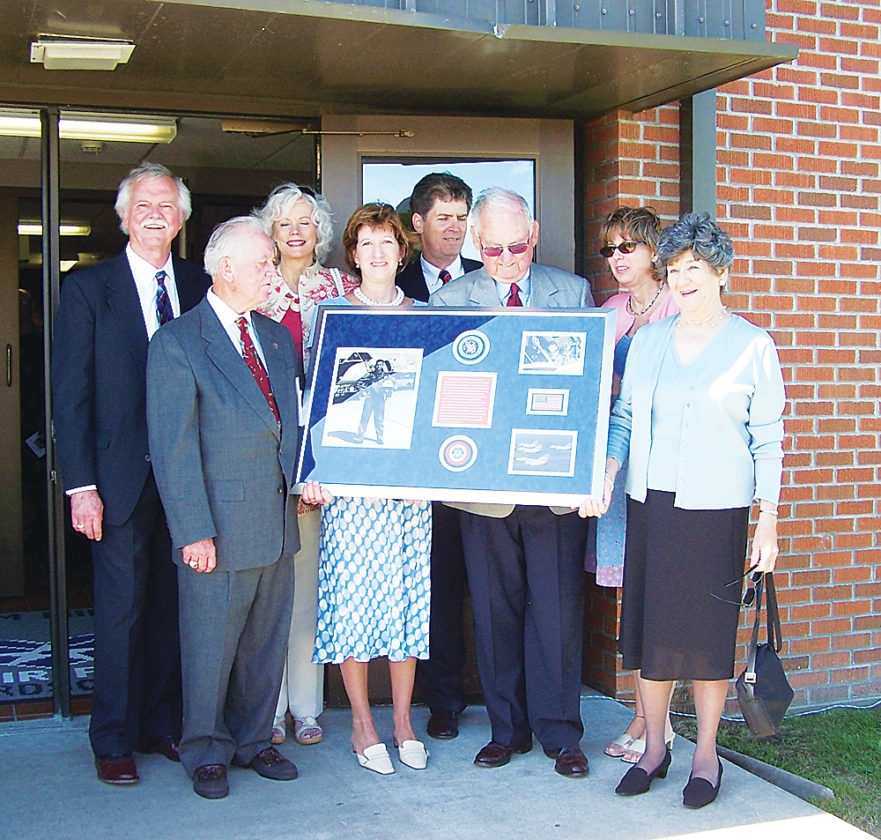
Eloise Ogden/MDN The family of Capt. William D. Richardson are shown in this photo taken Aug. 12, 2005, during a rededication of Richardson Hall, a dormitory at Minot Air Force Base named in honor of Richardson. Originally, the hall was named in his honor in 1967. His F-106 plane crashed south of Bismarck in 1963.
MINOT AIR FORCE BASE – The late Chief Master Sgt. Fredrick “Fred” Gantzer is the most recent person to be honored with having his name on a building at Minot Air Force Base.
On April 21, a new B-52 two-bay maintenance facility was named in Gantzer’s honor. Originally from Wheeling, W.Va., Gantzer was chief of a maintenance crew working on B-52 bombers. His career included two tours of duty in Vietnam and two tours of duty at Minot AFB.
Twenty-four buildings plus a park at the Minot base have been named to honor various individuals.
According to the 5th Bomb Wing Historian’s office, the memoralization program is to “provide lasting honor and pay tribute to deceased as well as living Air Force military and civilian personnel with records of outstanding and honorable service. This program also fosters favorable relations between the public and the Air Force.”
The criteria for selection states all memorializations “should be carefully evaluated to ensure that only the most deserving persons are selected. These selections should bring honor and goodwill to the Air Force and local communities.”
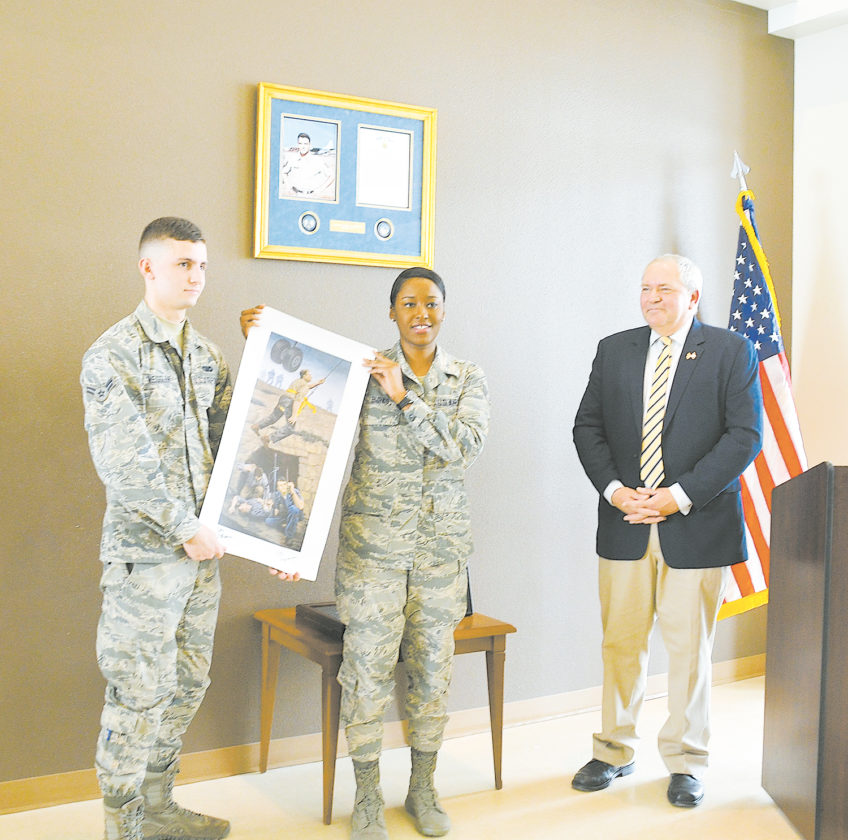
Photos by Eloise Ogden/MDN Cory Etchberger, son of the late Chief Master Sgt. Richard Etchberger, is at the right after presenting to Minot Air Force Base airmen at Etchberger Hall, a lithograph by military artist John Witt and signed by Cory and his brothers. The presentation was Feb. 19, 2015, during a ceremony when the dormitory was named for Chief Etchberger, a Medal of Honor recipient.
The 5th Civil Engineer Squadron has provided information about those buildings and park, and their naming. The information follows:
® Fowler Hall, Building 122, a dormitory, was named in honor of Col. John H. Fowler. Fowler was commander of the 5th Fighter Interceptor Squadron at Minot AFB from Nov. 18, 1965, until his death. He was directly involved in the test programs for the F-102 and F-106. Fowler was killed in an F-106 crash near Carpio Oct. 14, 1966. Date of memorialization: Oct. 6, 1967.
® Richardson Hall, Building 123, a dormitory, was named in honor of Capt. William D. Richardson. Richardson, originally from Delta City, Miss., was a member of the 5th Fighter Interceptor Squadron until his death Dec. 19, 1963, in an F-106 crash 40 miles south of Bismarck. At the time of his death, Richardson was squadron flight commander. Date of memorialization: Oct. 6, 1967. Richardson Hall was rededicated Aug. 12, 2005 during a memorial tribute with Richardson’s wife, two daughters and other family members attending.
® Lufbery Hall, Building 130, a dormitory, was named in honor of Maj. Raoul G. Lufbery, the leading U.S. ace with the Lafayette Escadrille in World War I. As a fighter pilot, Lufbery claimed 17 kills and 73 hits during his career. Date of memorialization: Oct. 6, 1967.
® Blanchard Hall, Building 131, a dormitory, was named in honor of Lt. Gen. William H. Blanchard. Blanchard was a former deputy chief of staff for Plans and Operations at Headquarters U.S. Air Force. He prepared the detailed operations order for delivery of the first atomic bomb on Hiroshima. His decorations included the Distinguished Flying Cross and Silver Star.

A B-52 bomber sits outside Gantzer Maintenance Facility at Minot Air Force, April 21, shown in this photo by Airman 1st Class Alyssa M. Akers. Previously Dock 8, the new hangar was renamed in honor of Chief Master Sgt. Fredrick “Fred” Gantzer who served in the Air Force for 31 years, including over a decade at Minot Air Force Base.
® Francis X. Deignan Education Center, Building 156, library/education center, was named in honor of Lt. Col. Francis X. Deignan, Deignan was commander of the 906th Air Refueling Squadron at Minot AFB, arriving at the base in August 1983. In May 1985 he was appointed assistant deputy commander for Operations of the 91st Strategic Missile Wing. He retired in July 1986 and died in April 1987. Date of memorialization not available.
® Gen. James H. Doolittle Club, Building 174, officers club, named in honor of Gen. James H. Doolittle, who led the air raid on Tokyo April 18, 1942, one of the most dramatic incidents of the Pacific War. He was awarded the Medal of Honor. He was promoted to general in 1985 and died in 1993. Date of memorialization: May 1, 1998.
® Geiger Hall, Building 205, a dormitory, was named in honor of Capt. Francis E. Geiger. Geiger, of Dickinson, was killed in Vietnam July 22, 1965. His medals included the Distinguished Flying Cross for his action as a forward air controller. Date of memorialization: Oct. 6, 1967.
® Arnold Hall, Building 207, a dormitory, was named in honor of Gen. Henry H. Arnold. Arnold was a pioneer airman who was taught to fly by the Wright brothers. He was commander of the Army Air Forces in the victory over Germany and Japan in World War II. He retired from service in 1946 after earning many military honors. Date of memorialization: Oct. 6, 1967.
® Kelly Hall, Building 210, a dormitory, was named in honor of Capt. Colin P. Kelly Jr. Kelly was America’s first hero of World War II. He was killed two days after the attack on Pearl Harbor as he bombed an enemy battleship off Luzon, Philippines. He was awarded the Distinguished Flying Cross. Date of memorialization: Oct. 6, 1967.
® Chennault Hall, Building 211, a dormitory, was named in honor of Maj. Gen. Claire L. Chennault. Chennault was the leading World War II leader of the famed Flying Tigers in China. The Air Force gave him the honorary grade of lieutenant general July 18, 1958. He died nine days later.
® MSgt. Irwan A. Johnson Profession Development Center, Building 260, was named in honor of Master Sgt. Irwan A. Johnson. Johnson, who was born in Begley, Minn., but considered Lakota, N.D., his home of record, was a radio operator/gunner on the B-17F “Red Ass” during World War II. When the plane was attacked by German fighters the crew bailed out near Renslage, Germany, where they were captured. Johnson spent 24 months as a prisoner of war at Stalag 17B. He earned a Purple Heart for injuries suffered during the war. After his release from the POW camp, he continued his military career and served in both the Korean and Vietnam wars. He retired March 1, 1967. Date of memorialization not available.
® Castle Hall, Building 275 (identified for demolition), a dormitory, was named in honor of Brig. Gen. Frederick W. Castle. Castle was killed while leading an air division on a B-17 bombing mission over Liege, Belgium, on Dec. 24, 1944. He was awarded the Medal of Honor for remaining at the controls of an ill-fated plane which enabled his crew to parachute to safety. Date of memorialization: Oct. 6, 1967.
® Wadell Hall, Building 276, a dormitory, was named in honor of Lt. Col. Paul M. Wadell. Wadell, the former deputy director of Personnel at Minot AFB, was killed in an automobile accident April 16, 1967. During his career he flew penicillin to Butte, Mont., to save the life of a sailor who was ill with pneumonia. He also was the last person to operate the Atlas E missile before it was phased out. Date of memorialization: Oct. 6, 1967.
® James M. Crawford Airman Leadership School at 327 Tanker Trail was named in honor of Chief Master Sgt. James M. Crawford. Crawford was an aerial gunner and weapons maintenance superintendent in the Air Force. Minot AFB was among his assignments. He was active in the Minot community including two terms as president of the David C. Jones Chapter of the Air Force Association and board of directors of the Minot Area Chamber of Commerce. Date of memorialization: May 25, 2006.
® McAdoo Sports Center, Building 455, a gymnasium, was named in honor of Col. Lowell F. McAdoo. McAdoo became deputy commander for Operations of the 91st Strategic Missile Wing at Minot AFB in July 1983. He died of a heart attack June 30, 1984. In his honor the McAdoo Award is awarded annually to recognize the best intercontinental ballistic missile operation support squadron in Air Force Global Strike Command. Date of memorialization not available.
® Simonson Security Police Complex, Building 547, a security force squadron building, was named in honor of Senior Master Sgt. Ronald H. Simonson. Simonson served in a multitude of security force positions and his assignments included Minot AFB. He died on duty April 16, 1987, serving as law enforcement superintendent. Date of memorialization not available.
® Patterson Maintenance Facility, Building 867, a hangar, was named in honor of Lt. Col. David R. Patterson. A former enlisted B-52 crewmember, he later earned his commission and held a number of maintenance and logistics positions around the country, including his first assignment at Minot AFB from 1995-1998 as the 5th Logistics Support Squadron and 5th Munitions Squadron commander. He returned to Minot AFB as deputy commander of the 5th Maintenance Group. On Sept. 18, 2004, he died from injuries suffered in a fall from an obstacle on the base confidence course while participating in a team building exercise. Date of memorialization: May 4, 2007.
® David C. Jones Youth Center, Building 286, was named in honor of Gen. David C. Jones. Jones, who claimed Minot as home, was appointed chief of staff of the Air Force July 1, 1974, and chairman of the Joint Chiefs of Staff June 21, 1978. He was presented an honorary doctorate degree from Minot State University in 1979. Date of memorialization: Aug. 24, 2002.
® Howard Weapon System Trainer, Building 476, was named in honor of Maj. James Howard. Howard who was born in Logan, graduated from Minot High School and attended Minot Teachers College. On Nov. 8, 1944, while serving in World War II, he was hit by flak while strafing targets near the town of Kluse, Germany. Witnesses saw his plane smoke, fall off on one wing and crash from 50 feet and explode on impact. Date of memorialization: Jan. 15, 2000.
® Kenneth O. Gillespie Fire Station, Building, 892, was named in honor of Kenneth O. Gillespie of Minot. When Minot AFB opened on Feb. 17, 1957, Gillespie was appointed the first fire chief. He served in that capacity for the next 15 years. As the first fire chief, he planned and organized the Minot AFB Fire Department and supervised nearly 80 military and four civilian personnel. He also provided important training to more than 500 firefighters attached to mutual aid fire departments in the area and around many missile sites. He also deployed to Vietnam in 1967 to serve as the chief of Fire Protection at U.S. Army Headquarters Command. He died from a stroke in December 1972. Date of memorialization: Oct. 2, 2002.
® Franks Hall, Building 774, the precision measurement equipment laboratory, was named in honor of Staff Sgt. Ralph Franks. Franks died suddenly of a heart attack at the age of 42, the day after his daughter Judy’s graduation from high school in late May or early June in approximately 1972. Date of memorialization: ca. 1972
® Etchberger Hall, Building 221, a dormitory, was named in honor of Chief Master Sgt. Richard Loy Etchberger. Etchberger and his family lived at Bismarck for a time when he was stationed at a radar site north of Bismarck. On March 11, 1968, when the secret radar site Etchberger was at in Laos near the Vietnam border was attacked by North Vietnamese soldier’s, Etchberger, one of seven survivors, tended to wounded, called for air strikes and fought off advancing North Vietnamese troop until a rescue helicopter arrived. He helped load the wounded before boarding himself. As the helicopter headed toward an air base in Thailand, an enemy soldier below fired his AK-47 into the underside of the aircraft, fatally wounding Etchberger. He was awarded the Medal of Honor. Date of memorialization: Feb. 19, 2015.
® Vosler Hall, Building 216, dormitory, was named in honor of Tech. Sgt. Forrest Lee Vosler. On a mission to Bremen, Germany, Vosler was hit twice by 20mm shrapnel after taking the place of one of the gunners. Despite his injuries, he managed to tend to the wounded tail gunner, repair the damaged radio equipment and send off distress signals before the aircraft ditched in the sea.
® Bud Ebert Park was named in honor of Claude “Bud” Ebert. Ebert was chief of Morale, Wellness and Recreation at Minot AFB. He is credited with the success of the annual “Day of Love” when senior citizens from the Minot area are welcomed to the base on Thanksgiving Day for dinner, entertainment and conversation. The event continues at the Minot base. Date of memorialization not available.
-

- Eloise Ogden/MDN The family of Capt. William D. Richardson are shown in this photo taken Aug. 12, 2005, during a rededication of Richardson Hall, a dormitory at Minot Air Force Base named in honor of Richardson. Originally, the hall was named in his honor in 1967. His F-106 plane crashed south of Bismarck in 1963.
-

- Photos by Eloise Ogden/MDN Cory Etchberger, son of the late Chief Master Sgt. Richard Etchberger, is at the right after presenting to Minot Air Force Base airmen at Etchberger Hall, a lithograph by military artist John Witt and signed by Cory and his brothers. The presentation was Feb. 19, 2015, during a ceremony when the dormitory was named for Chief Etchberger, a Medal of Honor recipient.
-

- A B-52 bomber sits outside Gantzer Maintenance Facility at Minot Air Force, April 21, shown in this photo by Airman 1st Class Alyssa M. Akers. Previously Dock 8, the new hangar was renamed in honor of Chief Master Sgt. Fredrick “Fred” Gantzer who served in the Air Force for 31 years, including over a decade at Minot Air Force Base.
Local News
Lane closure required at south Minot interchange
A soil settlement issue has been discovered at the site of a culvert replacement project at the intersection of ...
Vehicle fire extinguished in SE Minot
Milestone
Angelo State University SAN ANGELO, Texas – Kevin Brown of Minot earned a Master of Security Studies in ...

Return to Lake Tschida brings memories
Produced water spill occurs near Cartwright
CARTWRIGHT – An undertermined amount of produced water spilled from a pipeline about seven miles northwest of ...
Detour planned on 16th Street NW
Beginning Tuesday, June 9, the intersection of 16th Street and 11th Avenue Northwest will be closed for about ...