
MSU receives works from master printmakers
-
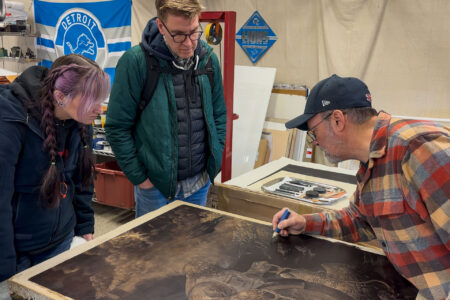
- Submitted photo Printmaking student at MSU, Britt Rohn, left, and Minot State University art professor, Ryan Stander, center, watch as artist Michael Barnes demonstrates maniere noir lithography at his in-home studio in Chicago.
-
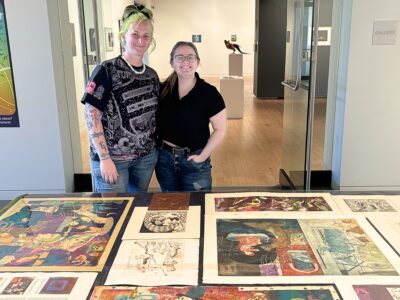
- Angie Reinoehl/MDN Minot State University students Britt Rohn, left, and Kylie Anderson, right, played a role in obtaining original works created by master printmakers Michael Barnes and David Driesbach. Here they stand in front of MSU’s newly collected Driesbach pieces, which were donated by the artist’s family.
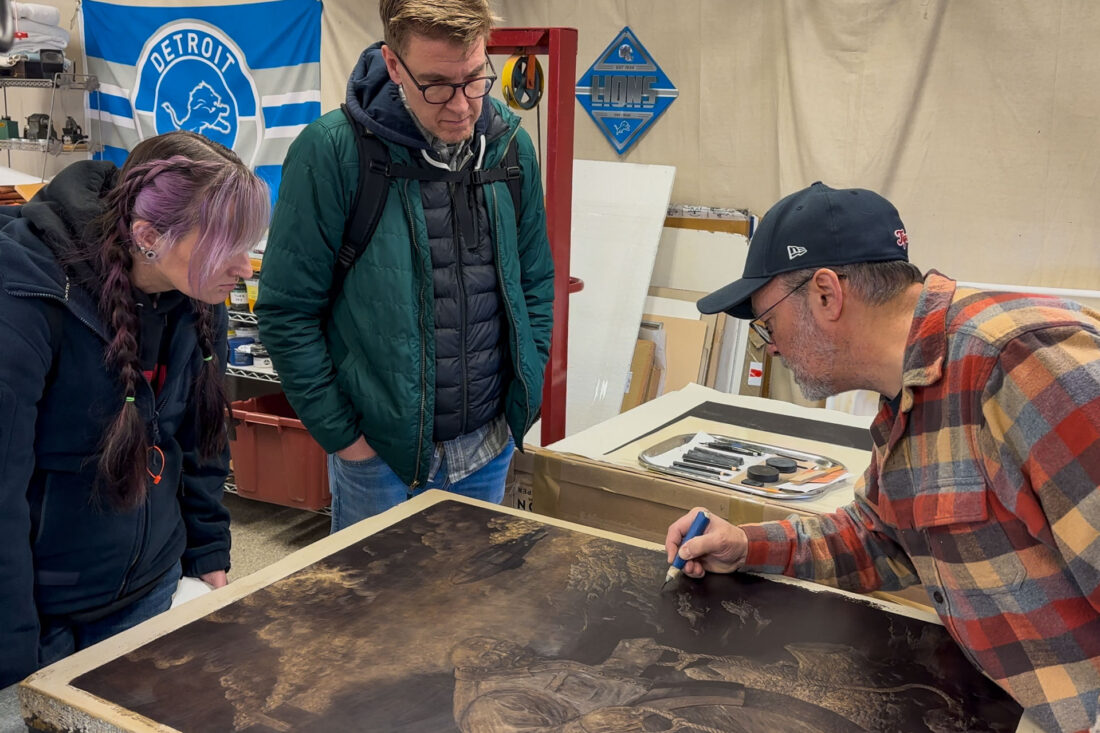
Submitted photo Printmaking student at MSU, Britt Rohn, left, and Minot State University art professor, Ryan Stander, center, watch as artist Michael Barnes demonstrates maniere noir lithography at his in-home studio in Chicago.
Students, Minot State University staff and community members alike congregated on April 14 at the Northwest Arts Center on the MSU campus for the unveiling of 142 prints created by notable master-printmakers Michael Barnes and David Driesbach, who both have ties to MSU.
Printmaking is an image transfer process in which artists work with a matrix of etched stones or metal plates coated in ink that are pressed onto paper. Artists use numerous layers to add intricate details and depth to their works, which create complex final products.
These donations were preceded by a research visit to Barnes’ in-home studio in Chicago and then to Northern Illinois University (NIU), where he is the current head of printmaking. On this trip, NAC Director Greg Vettel, MSU Professor Ryan Stander and art students Britt Rohn and Kylie Anderson got a behind-the-scenes look at Barnes’ process.
“Being able to go on this trip really put a lot of things about museum studies into context for me. It’s one thing to read about the processes in a book or writing essays,” Anderson said, “but to actually interview the artists, do inventory, and actually getting to pick out pieces to create a narrative when curating something for the public to see – it’s something I don’t think I would’ve been able to do until I was actually in the field if not for this trip.”
“My hope is it opens up this idea that a lot of art is building connections and relationships,” Stander said. “It’s really exciting for me to think about them getting to know and appreciate it on another level.”
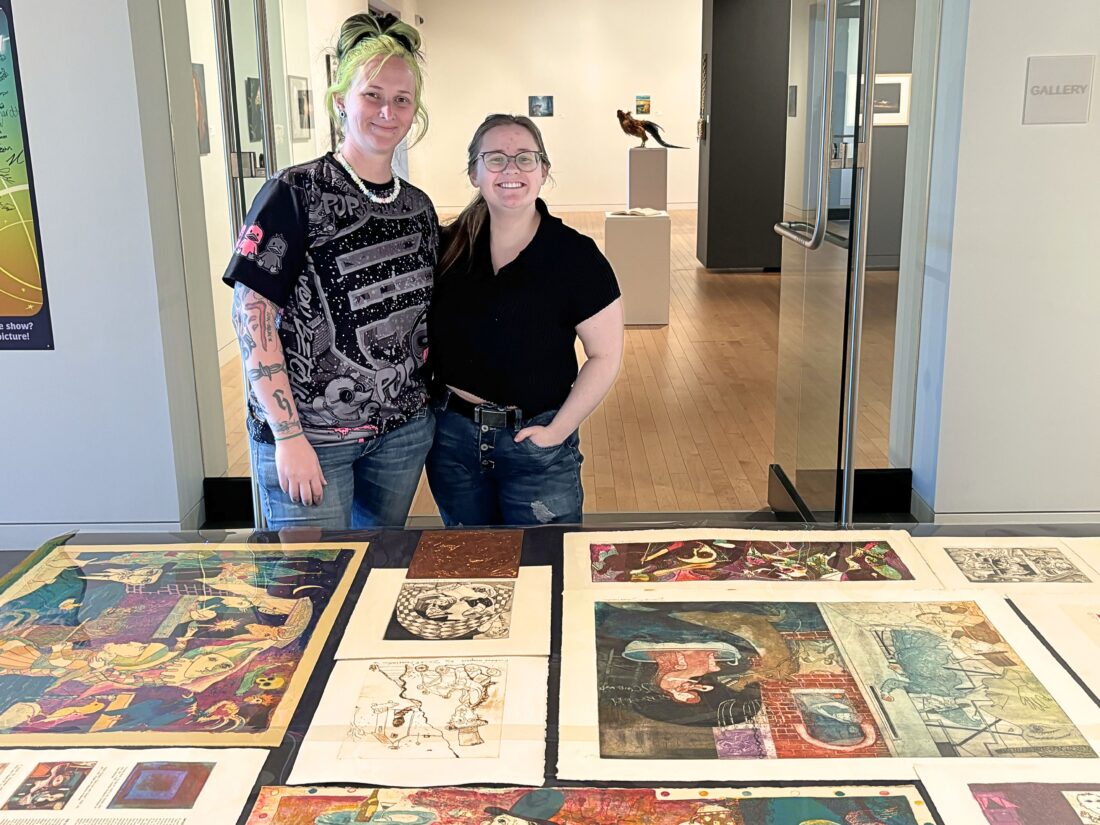
Angie Reinoehl/MDN Minot State University students Britt Rohn, left, and Kylie Anderson, right, played a role in obtaining original works created by master printmakers Michael Barnes and David Driesbach. Here they stand in front of MSU’s newly collected Driesbach pieces, which were donated by the artist’s family.
Driesbach was an influential 20th century printmaker and educator whose career spanned over six decades. After serving in World War II, he was drawn to printmaking and studied under Mauricio Lasansky, an artist who is considered to be one of the fathers of 20th century American printmaking. Some of Driesbach’s prints are dated from 2016, which are a few of his final works he created before he died in 2019.
Stander described Driesbach’s work as theater-like, saying, “His prints combine humor, mystery and dream-inspired scenes. They’re filled with symbolic objects, architectural spaces and you see repeated objects over and over.”
Stander, who has been a professor at MSU for 14 years, shared that his mentor, John Kaericher, was heavily influenced by and studied under Driesbach at NIU.
“This little hub has this long trajectory of influence that reaches down to me, and now to my students 40 years later, which is pretty amazing,” he said.
When describing Barnes’ artistic style, Stander said, “His prints emerge into the strange, surreal or dystopian lands. They feature transfigures, biomorphic creatures who are engaged in strange and comical tasks.”
These prints will be entered into the Artist Study Collections at MSU, where students will have a unique hands-on opportunity to view sketches, notes and other associated materials Driesbach and Barnes used through their printmaking processes. Vettel said these donations will enhance the educational aspect to these collections as students will learn about each artist’s decisions, techniques and materials used for each piece.
“It’s important because you can only see so much on the screen, but in person you can see the gritty details, the mishap lines, the torn edges,” Rohn said. “You can see the artist’s purpose and meaning within the actual context of their physical work. You can feel the passion.”
Finishing his speech on the significance of these generous donations, Stander said, “Together these represent this enduring legacy of two artist educators, and we hope to see that this work gets out into the community and continues to inspire students here.”
Arts and Entertainment

America at 250: Age of innovation still influences nation
RETIREMENT’S COMIC RELIEF: They’re our kind of influencers

America at 250: New techniques revolutionized energy extraction in Pennsylvania

Centenarian reflects on faith, family, fatherhood

A daughter’s perspective on Father’s Day
A gift to Minot: celebrating heritage, community, tradition
This weekend the Scandinavian Heritage Association is hosting its annual Midsummer Festival at the Shirley ...