
With roots in ag, Rugby Manufacturing grows strong
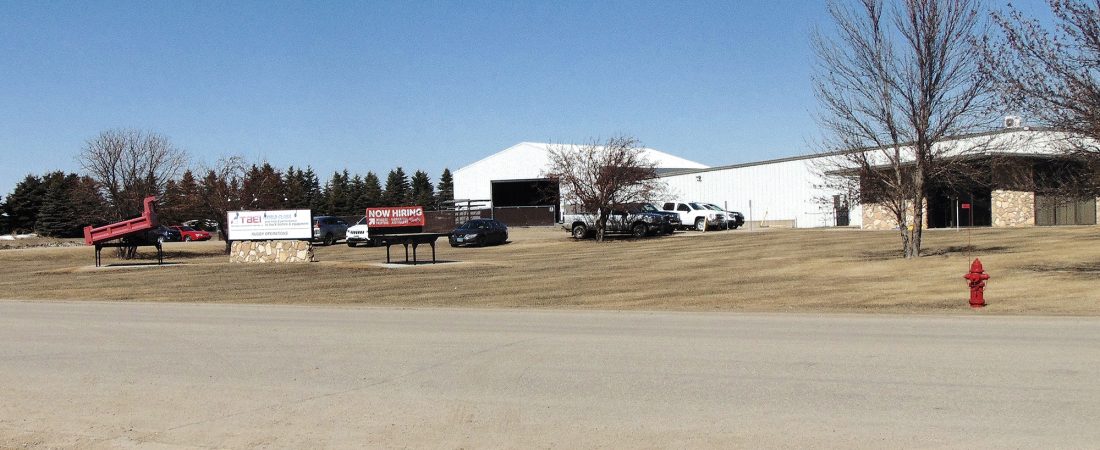
Sue Sitter/MDN Rugby Manufacturing
RUGBY – Like many industries in North Dakota’s rural towns, Rugby Manufacturing has roots in agricultural implement production.
According to Rugby Manufacturing’s website, the company was founded in 1969.
The website summarizes the history behind the firm, referred to by those who work there as “Rugby.”
“Since (1969), we have grown from a small agricultural equipment manufacturer to a cutting-edge truck equipment expert, offering a wide array of superior products nationwide, through a robust network of distributors,” the website says.
General Manager Jeff Duchscher related the story behind the company that became a fixture in the Pierce County community. “They started it in Rugby and that’s where the name Rugby Manufacturing came from – the town. The brand of equipment we sell is Rugby brand, so we use the Rugby name quite often,” he said.
Duchscher said the Socha family founded and ran the company for 30 years.
The family had immigrated to the United States from Canada and sold the company in the late 1990s. Founders Jerry and Bonnie Socha retired to Lake Metigoshe after selling the business and their children moved to various locations in the United States and Canada.
Duchscher described how Rugby Manufacturing evolved from a producer of farm implements to industrial equipment and accessories.
“When (the company) started originally, it was to produce specifically for the agricultural industry – various agricultural products from harrows to sprayers to bail haulers, things like that.” Duchscher noted.
“Over that time, truck bodies and hoists were developed,” Duchscher said. “Some of the original ones were also for the ag industry. There were grain bodies and hoists that were used for agriculture. Slowly over time, the transition was more into the industrial sector. So, we built dump bodies for Class 3-5 trucks that were in the primary business model. The hoists were part of the business through much of the history and they still are today.”
“As far as today’s product line, specific to the ag industry, we still have some products that are used quite often,” Duchscher noted. “Some of our larger hoists are used with grain bodies. We no longer build the grain bodies themselves due to the size and nature of our business. The size of the product we build is much smaller than what’s typically used in farming applications today.”
Duchscher added, “We still supply hoists and we have various models – underbody scissor hoists, twin telescopic conversion hoists that are still commonly used for the grain bodies.”
Duchscher said the variety of hoists produced at Rugby Manufacturing continue to be popular with customers in a variety of work settings.
“Then we also have a line of platforms, flatbeds and rancher bodies that is commonly for a wide variety of applications anywhere from ag use to commercial landscape companies, things like that,” Duchscher said.
Duchscher said Rugby Manufacturing ranks as a leader in scissor hoist production, although most of their products have industrial, rather than agricultural uses.
“We haven’t forgotten our roots,” Duchscher said, “but by and large, the ag market used to be 100 percent of our business for the first 15 to 20 years of our company and right now, if it makes up about five percent, that would be about it.”
Duchscher said since 1999, Rugby Manufacturing was owned by and sold into the private equity sector. “We were owned by a couple of different investors for the next 20 years.”
“In that time,” Duchscher said, “One of those private equity companies purchased a variety of dump body manufacturers that were similar to us so we had sister companies in Minnesota, Alabama, Mississippi and Texas. They created and formed TBEI, which stands for Truck Bodies Equipment International. That was an accumulation of a variety of dump body manufacturers.”
“Then, in 2017, Federal Signal purchased the rights to TBEI. Federal Signal is a publicly traded, New York Stock Exchange company. They own a whole variety of other companies as well,” Duchscher noted.
“Long story short, we’re part of the TBEI family, owned by Federal Signal, TBEI division,” Duchscher added.
“As far as our future, I wouldn’t say we’re targeting the agricultural sector but the products that we have and our product mix hasn’t changed the overall scope of what they’re used for in the past 10-15 years and we don’t intend to change that going forward,” Duchscher said. “So we’ll still have hoists, hydraulic packages that are used to set up for grain bodies and grain trucks and we’ll still have flatbeds and platforms that have a variety of uses, agricultural among other things.”
“So,” Duchscher added, “At this point, we’re not tailoring any new products for the ag market, but we’re not eliminating any or moving ourselves away from the ag market either.”
Duchscher said of Rugby Manufacturing, “Right now, the business and the brand are very, very good. A couple of our main segments, the Class 3 to 5 dump bodies, we’re the leading manufacturer in the country, and our underbody scissor hoists, we’re the leading manufacturer in the country.”
“At the current time, we have 110 employees at this location,” Duchscher noted. “Obviously, our other locations have additional employees.”
“Right now, our business has continued to grow,” Duchscher added. “We’re going on about 10 to 11 straight years of growth and we’re definitely looking to hire more and expand.”
Rugby Manufacturing sends some manufacturing work to other locations due to space concerns in its present building, according to Duchscher.
“We have a building expansion currently in process and I’m looking at additional employees as I speak,” Duchscher said.
“Right now,” Duchscher added, “We look to continue with that success and we’ve put a lot of focus on our platform line of products in the last couple of years. We continue to gain market share there as well. That’s what’s driving our growth right now.”
“And like I said,” Duchscher added, “business is good and at this time, we’re hiring people and expanding the business. That’s a good thing.”