
Minot was small railroad town in 1900
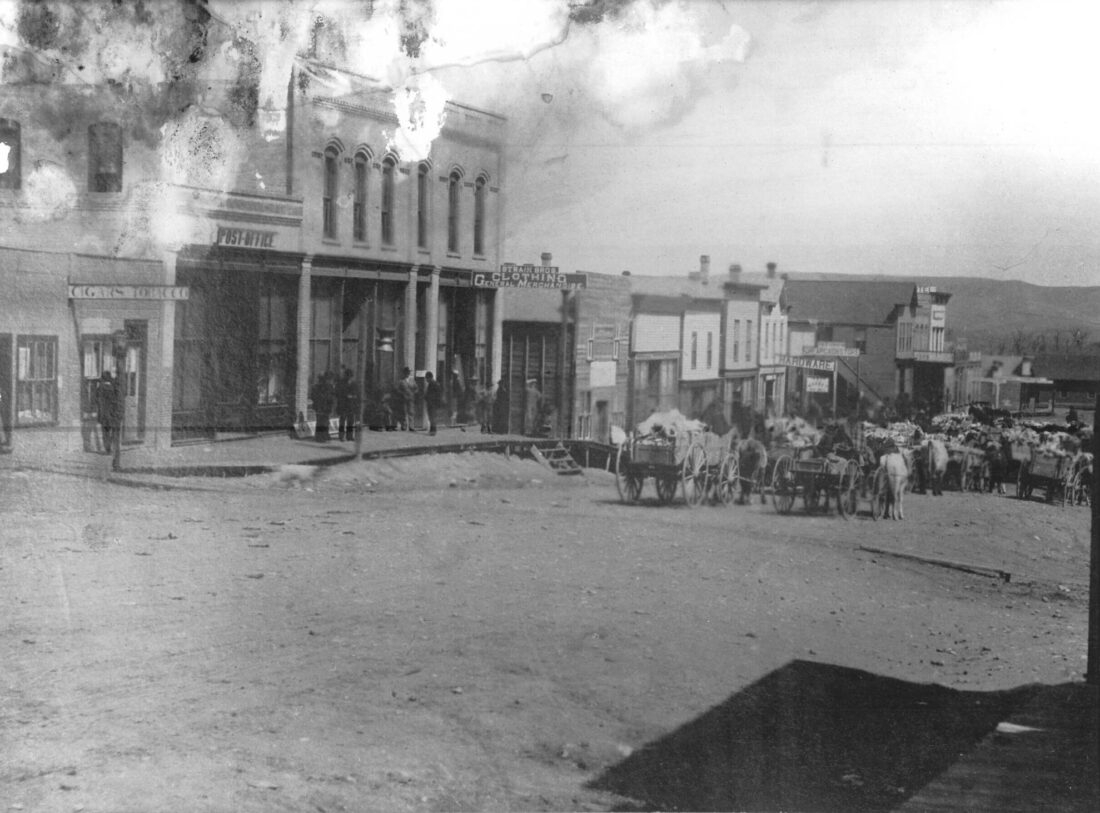
A photo from the North Dakota State Archives and Historical Research Library, taken in the 1880s, shows buffalo bones being hauled in Minot.
In the summer of 1900, the city limits of Minot were confined to a modest area not that much larger than the original city limits established in the 1880s.
On the east side of Broadway, the city was bounded by the Great Northern Railroad right-of-way to the north and by Fifth Avenue on the south; the eastern edge of town was Fifth Street. And north of the river east of Broadway, there were two blocks in the Oakland Park Addition to Minot.
On the west side of Broadway, there were two blocks in the Watne Addition and the expansive Brooklyn Addition covering 160 square acres and divided up into 90 city blocks. It measured thirteen blocks from north to south, from south of the Great Northern Railroad right-of-way down to Fourteenth Avenue. At its widest, it measured ten blocks from east to west, from the west side of Broadway over to Twelfth Street. (These boundaries refer to the streets as they are numbered today.)
There had been a court case over 120 square acres within the Brooklyn Addition between Charles Clouse and George Jarvis, a case filed by Clouse against Jarvis, as well as John Wellcome and Editor Marshall McClure. In May 1889, John Wellcome was both the Minot city attorney and a Ward County commissioner. He had just represented Minot in the Dakota Territorial Legislature when it convened from January to March 1889; Wellcome was the only Minot resident to ever serve in that body.
In June 1889, Wellcome resigned as Minot city attorney and moved to Butte, Montana Territory, to practice law. It is not clear when Charles Clouse had filed his lawsuit, but his suit was dismissed in April or May 1889 by the 6th Judicial District Court.
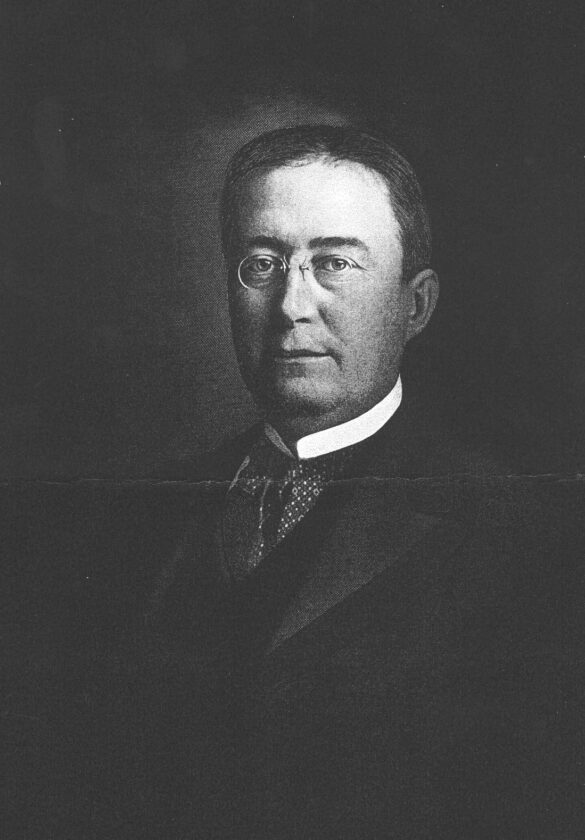
John B. Wellcome
Right after the lawsuit filed by Charles Clouse was dismissed, the Brooklyn Addition was surveyed by Surveyor J. I. Bailey, who completed his work early in June 1889. His work was notarized on July 3, 1889, by James Johnson and registered with the county on November 22, 1889. George Jarvis was eventually given a patent (Patent Number 1537) to all 160 acres in the Brooklyn Addition on July 29, 1890.
At the time the Brooklyn Addition was registered, ‘the proprietor’ was Algernon Wilcox, not George Jarvis. Wilcox was a real estate speculator from New York. He headed the Prudential Real Estate and Trust Company, which was based in New Jersey.
It is not clear just when Wilcox interested himself in the Brooklyn Addition or what arrangements he had made with George Jarvis concerning his intention to sell lots within the Brooklyn Addition, mainly to residents on the East Coast.
Two early residents of Minot described the fraudulent practices Wilcox resorted to, as he advertised lots within the Brooklyn Addition. Lillian Cooper McConnell was the daughter of John Cooper who had moved to town in 1887. In the 1930s, she recalled that Wilcox sold lots from this to school teachers and preachers in the East.
Misleading photographs of the lots were responsible for the sales. When the owners found out about their lots, some of them found that their land was on such a steep hillside that it almost stood on its edge.

Mark Berg
Another early city resident who discussed this was Thurlow Jacobson. (He had been named for Thurlow Weed, editor of Harper’s Weekly.) Thurlow first visited Minot in 1887 and returned in 1892 as a hardware dealer. He claimed Wilcox ‘had beautiful pictures made of this addition showing streets, avenues, boulevards, with plenty of trees and a navigable river flowing through the midst of it and with steamboats on the river. He circulated these pictures together with plenty of attractive literature through the eastern states and sold a large number of lots to various classes of people.
Because of Wilcox’s advertising blitz, sales of lots in the Brooklyn Addition were quite brisk in 1890 and 1891 – even though Brooklyn Addition was mainly riddled with coulees full of brush at this time, without steamboats or boulevards.
It is likely that few people resided in the Brooklyn Addition when Richard Jones conducted the census of Minot from Friday, June 1, to Monday, July 2, 1900. Richard Jones had moved to Minot in 1887, when Minot was, as Jones recalled, “but a small village extending but three blocks on Main Street.” At first, Jones had worked for Western Union, but then took up different jobs with the local railroad company and later with a Minot bank. By 1900, Jones was involved in cattle raising.
Jones tallied 1,277 people residing within the city limits in 1900. They were split up among three wards. The First Ward included all of the city east of Main Street. The First Ward was five blocks wide from east Main Street to Fifth Street and six blocks from north to south, beginning just south of the Great Northern Railroad right-of-way and going down to Fifth Avenue.
The Second Ward, where Richard Jones lived with his wife Viola and their daughter Erma (or Irma), went from the south side of First Avenue south to Fifth Avenue, a distance of four blocks, and from the west side of Main Street to Broadway, a width of two blocks. But the Second Ward also included most of the Brooklyn Addition west of Broadway (about 80 of the 90 blocks there).
The Third Ward went from the north side of First Avenue up to the Great Northern Railroad right-of-way, a distance of two blocks and then from west Main Street over to Broadway, a width of two blocks. But it also included the two blocks in Oakland Park north of the river, as well as the two blocks in the Watne Addition north of the river and west of Broadway and finally, the northern-most ten blocks in the Brooklyn Addition.
Richard Jones had begun his census work in the Second Ward, where he lived. He counted 223 people in the Second Ward from Friday, June 1, to Tuesday, June 5. (He rested on Sunday, June 3.) He counted noses in the Third Ward next, from Thursday, June 7, to Thursday, June 14. The census figure for the Third Ward was higher, amounting to 375 people. Jones took the longest time with the census for the First Ward, working from Friday, June 15, to Monday, July 2. (Jones recorded no entries for June 17, 24, 27, 28, 29 and 30, or for July 1.) The First Ward had the most people, 679.
Minot’s population of 1,277 in 1900 was an increase of 702 over its population in 1890, which was 575. However, Minot was not among the top ten cities in the state in terms of population in 1900, trailing both #9 Devils Lake (1,729) and #10 Mandan (1,658).
Because Richard Jones began his count in the Second Ward, the first four names in Minot’s 1900 census were Sarah Clark, Ida Clark, Nina Johnson and Neva Johnson. Sarah was Ida’s mother and the grandmother to Nina and Neva. The mother of the two girls, who were twelve and nine respectively, was Ethel Clark Johnson, a Clark relation who had been the wife of John Johnson. Ethel passed away in 1891, and after her death, her two daughters were taken in by Sarah and Ida. Ida Clark was the third woman to teach in the Minot public schools, following Luella Austin and Sadie Webber. (Sadie Webber was also in Minot in 1900. She was counted as a 49 year old teacher from Pennsylvania, residing in the First Ward, where her residence was on the west side of Third Street, the very site now occupied by Bethany Lutheran Church.) Sarah Clark was also born in Pennsylvania. Ida was born in Minnesota, and Nina and Neva were both born in Minot.
Minot’s mayor at the time of the 1900 census was Christopher Johnson, He had just been reelected for a second two-year term in April 1900. Johnson resided in the Third Ward, where Richard Jones listed him as 32 year-old attorney from Wisconsin, living with his wife Caroline, their son Melvin, and their two daughters Alma and Clara. Christopher Johnson was the seventh Mayor of Minot. Three of the previous six mayors were still in town. The first mayor, James Scofield, was living in the Second Ward with his wife Lottie Parker Scofield. Lottie was the only daughter of William and Elizabeth Parker, owners of the Leland Parker Hotel. Lottie and James had been married for ten years by June 1900. James was listed as a 40 year-old liveryman. Scofield had served as mayor from August 1887 to April 1888.
The fourth mayor was Peter Lee, who was in office from April 1895 to April 1896. Like Scofield, Lee also lived in the Second Ward. He was a 39 year-old dry goods merchant born in Norway. Lee was married, and he and his wife Lucy had five children (four sons and a daughter), ranging in age from one to ten.
The fifth mayor was John Wilson, who also served just one year, from April 1896 to April 1897. Like Johnson, Wilson lived in the Third Ward. He was employed as a 36 year old baker born in Canada. He and wife Jessie had a daughter and a son. Minot’s sixth mayor, Hiram Van Wagoner, serving from April 1897 to April 1898, lived just east of town in Nedrose Township. He was a widower by then, who lived with sons Harry (age 10) and Benjamin (age 7), and daughter Tessie (one year old). Van Wagoner had engaged in some brickwork on Minot’s brick school house, as well as in several other brick-building projects around town, including a Gothic-style church.
In 1900, Minot was very much a railroad town with 125 people earning a living by working either for the Great Northern Railroad or for the Soo Line Railroad. This railroad work force was virtually one-tenth of the total town population.
-
- A photo from the North Dakota State Archives and Historical Research Library, taken in the 1880s, shows buffalo bones being hauled in Minot.
-
- John B. Wellcome
-

- Mark Berg
Local Columnists
Minot was small railroad town in 1900
Tax credit delivers meaningful relief
What a difference a year – and a bold policy change – makes. Across North Dakota, property tax statements ...
Transparency needed to reduce health costs
Healthcare prices are out of control. The average cost of a three-day hospital stay in the United States now ...
ND’s justice system locks citizens out of courts
North Dakota’s Constitution guarantees openness. Article I, Section 9 promises that “all courts shall be ...

ND voters deserve fairness, not division
Voting Rights Act became law 65 years ago
August 2025 marks 65 years since the Voting Rights Act came into law and changed the course of history in ...