
County takes easement concerns to federal level
Trending
Having already reached out at the state level, the Ward County Commission and its soils committee are taking their concerns about perpetual federal easements on agricultural land to the congressional level.
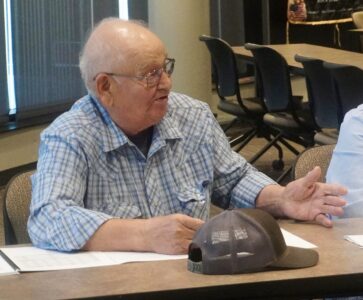
To that end, Commissioners John Fjeldahl and Ron Merritt and Soil Committee members Arden Haner, Stephanie Hagen and Jim Mostad met Tuesday, July 14, with Cassie Bowers, director of State Operations and Community Relations, for Congresswoman Julie Fedorchak.
Fjeldahl, county commission chairman, said the local position is that diminished use of agricultural property due to the easements isn't reflected in the property taxes. Restrictions can prevent farmers from enhancing their practices, said Fjeldahl, who cited his own case of being unable to remove a rock pile.
"This is the first step to try and address that, both through state level authority, and, hopefully, federal level," Fjeldahl said.
It was noted the Fish & Wildlife Service (FWS) purchased easements for $1 an acre in the 1960s and those easements have continued even when land changed hands. Fjeldahl said FWS is soliciting additional easements on properties today at $100 an acre or more.
"U.S. Fish & Wildlife pays no taxes on it ever, that I'm aware of, and yet they have a controlling interest in the property," he said.
The easements often deal with wetlands, which cannot be drained without the landowner losing the right to participate in the federal farm program. Although the land may have been normally dry and wetlands minimal at the time the easement was signed, FWS now uses Global Positioning System data to establish a much larger wetland, based on the wettest year, said Haner, chairman of the soils committee. Landowners never were compensated for those extra acres, he said.
Fjeldahl added the only recourse for farmers is claiming a tax break for inundated property during occasional years when the water is high.
Haner also said counties and townships cannot build roads that impact wetlands without creating additional, mitigating acres elsewhere.
"You either pay to mitigate it or create another," Fjeldahl said. "And the cost of that has gotten horrendously expensive."
Hagen recalled when roads around her home were flooded to the extent an ambulance couldn't get in should residents with existing health issues need one. A neighbor pumped water off the road into a tree row and was chastised by FWS, she said. She cited another instance in the county in which a woman was unable to get her medicine delivered because they were not allowed to remove water from the road.
"They don't only control your land; they actually control your life, whether you’re going to live or die. It's not right," Hagen said.
Haner said FWS easements have affected school bus routes and mail routes that they were never intended to affect.
"The intention was never to give them that much power," he said.
Mostad reinforced the county and soil boards' positions.
"It appears that the easements are, in our estimate, unfair, and some of the things that have been brought up here show that," Mostad said. "As you can see, there's plenty of frustration here."
Bower acknowledged the issues impacting Ward County.
"It's the same concerns we've heard across the state," she said, noting there has been some ongoing discussion on the federal level.
The Ward County Commission and Soils Committee passed a joint resolution March 3 asking that easements that diminish use of the land be factored into determining valuation for tax purposes. The resolution also requested FWS be required to pay the tax on easement property if it limits the use of the property without compensating landowners.
Fjeldahl said there will be efforts to get the resolution introduced as state legislation.
Haner also suggested Congress appropriate funds to enable North Dakota State University, which calculates taxable valuations on ag land, to study the valuation issue and make a recommendation to the Legislation.