General: Modernization critical to nuclear mission
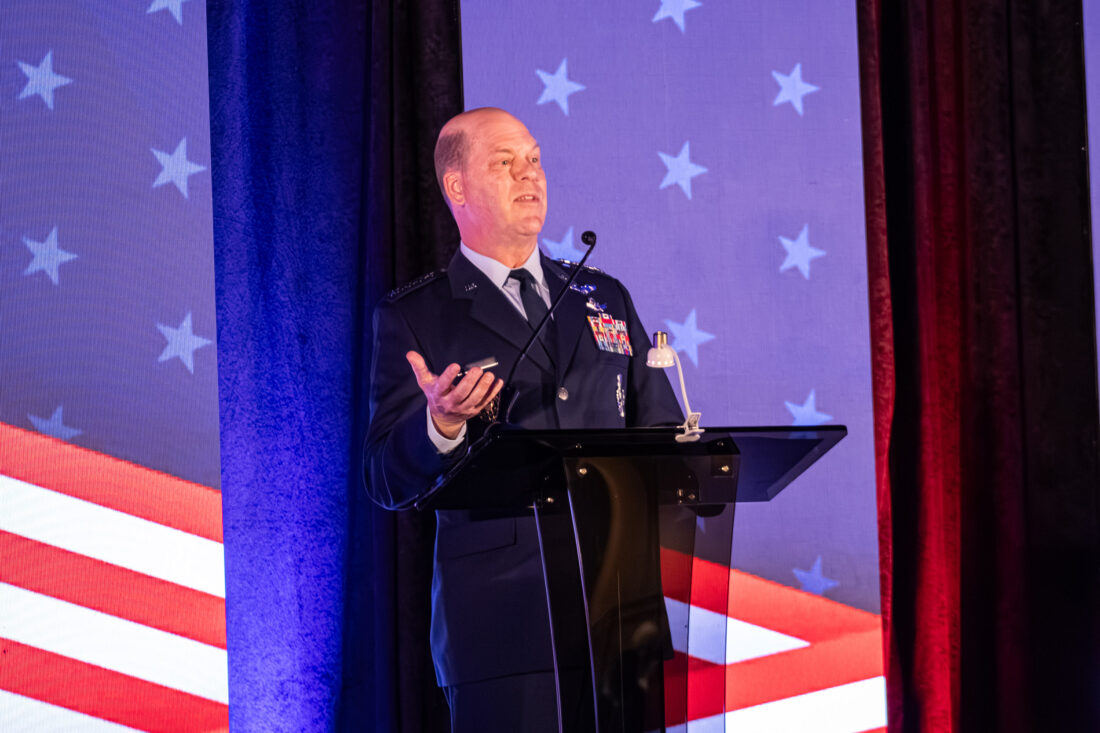
Submitted Photo Gen. S.L. Davis, commander of Air Force Global Strike Command and commander of Air Forces Strategic-Air, U.S. Strategic Command, gives the keynote address at the 2026 North Dakota Nuclear Triad Symposium held in Minot Tuesday, April 28. Photo from Minot Area Chamber EDC.
The strategic deterrence mission has never been more important than today, said the commander of Air Force Global Strike Command and commander of Air Forces Strategic-Air, U.S. Strategic Command.
Gen. S.L. Davis gave the keynote address at the 2026 North Dakota Nuclear Triad Symposium Tuesday, April 28, at the Clarion Hotel in Minot.
Davis said this year marks the 17th anniversary of Air Force Global Strike Command. The command is based at Barksdale Air Force Base, Louisiana. He said it is a testament to the vital role the command plays as an Air Force major command responsible for two-thirds of the nation’s nuclear triad and home to Minot Air Force Base which hosts the Rough Riders of the 91st Missile Wing and the Warbirds of the 5th Bomb Wing.
Davis was commander of the 91st Missile Wing from June 2011-June 2012,
“The long-range nuclear and conventional strike capability uniquely provided by this command and these wings underpin every operational plan in the Department of War and assures our allies across the globe. No sister service — ally or partner — possesses ICBM or long-range bombers. We are it, and readiness is key to that combat capability,” Davis told the symposium participants.
He said over the last year that readiness has been clearly demonstrated through a series of decisive operations on the bomber side.
“Just in the last year we conducted Operation Rough Rider where we deployed B-2s to Diego Garcia for the first time in the history of that platform to conduct operations in Yemen,” Davis said.
“Everyone is tracking Operation Midnight Hammer, an impressive military operation where we took seven B-2s from Whiteman Air Force Base (in Missouri), flew them around the globe to strike in the heart of Iran, completely undetected not only by Iran but by other adversaries that were watching and looking for that activity,” he said.
In Operation Absolute Resolve, he said B-1s fired the first and opening shots to clear the way for the helicopter assault force that was supporting the law enforcement operation. He said the B-1s weren’t initially part of the plan but were called in later. He said within a week of beginning to start that operation the team Dyess (AFB in Texas) rallied. “They launched actually three different nights to conduct that operation before all the elements were in place and all the indicators were in place to actually execute,” Davis said.
Operation Absolute Resolve was the U.S. military mission in January that captured Venezuelan President Nicolas Maduro and his wife.
He said the B-1s dropped a number of JDAMS (Joint Direct Attack Munitions), with all hitting within about a minute to essentially once again open the door for the forces to go in.
More recently in Operation Epic Fury, he said B-1, B-2 and B-52 bomber crews conducted missions from the U.S. to Iran nonstop for eight days. He said the B-1s and the B-52s then transitioned seamlessly to forward operations from RAF Fairford (in United Kingdom), flying multiple pulses of bombers each day.
“Every Air Force Global Strike Command wing participated in the CONUS to CONUS missions and every Air Force Global Strike wing is now forward deployed to RAF Fairford with the exception of the B-2s which were continued to be postured to conduct CONUS to CONUS missions,” Davis said.
“Today we have 23 bombers in the UK (United Kingdom). That is the most bombers there since World War II, along with a thousand airmen that are providing support for those,” Davis said. “In total, more than 160 missions were flown, 32 of those were CONUS (Continental United States) to CONUS missions. Missions from Fairford were relatively short — they’re only about 20 hours each — with the CONUS missions upwards of 40 hours in duration.”
He said the B-1s were particularly instrumental in the rescue of the downed F-15E pilot. “We sent four B-1s once again in the opening salvos of that operation. Those four B-1s dropped 95 2,000-pound JDAMs to basically slow down any response by the Iranians to that rescue force..
At the same time, Davis said the ICBM force quietly did what they’ve always done for the last 63 years. “They operated, secured and maintained the Minuteman III at an unbelievable level of high readiness approaching 100 percent in some austere and often hard conditions. It’s an impressive accomplishment given the age of the weapon system and the size of the missile field. While readiness requires a variety of parts and vehicles and equipment, it relies on the hundreds of airmen who report every day in the missile field. It is their grit, hard work and determination that delivers readiness,” he said.
Nuclear modernization
While readiness is the key to combat capability, he said simultaneously they must execute a once in a generation modernization effort, fielding critical replacement systems such as the B-21 Raider, the LGM-35A Sentinel, upgrades to the B-52, the MH-139 Gray Wolf and the long-range standoff missile.
“This is arguably the largest modernization portfolio for any single command in the Department of War. Success here will require continued sustainment of nuclear systems we rely on today as we field this future force,” Davis said. He said they cannot decommission a platform, then sequentially bring on the replacement. Instead, we must maintain our war fighting awareness while simultaneously modernizing our force.
Davis said considerable progress has been made in the Sentinel program, naming several including the Sentinel Site Activation Task Force (SATAF) Detachment 12 activated May 21, 2025, at Minot AFB, making a significant step in preparing this base for the next generation ICBM.
Other modernization programs include the B-52. Davis said that despite being more than 70 years old, the B052 will continue as a key element of the bomber force but he said it is becoming increasingly difficult to maintain so several ongoing efforts are being done to culminate in the new B-52J model.
Among the modernization efforts, he said is the MH-139 Gray Wolf helicopters replacing the aging Huey helicopters
Davis noted that the systems being modernized are all fully supported in President Trump’s fiscal year 2027 budget that was recently sent to Capitol Hill.
“The fact that the nuclear triad and the associated support systems fared so well in this budget is really a testament to the hard work of Task Force 21 and the team here,” Davis said.
He acknowledged that for the military members and their families knowing the community stands firmly behind them, they are better prepared to focus on the mission. “Your continued commitment strengthens that foundation every day,” he said.
Other speakers included Gov. Kelly Armstrong; Col. Ty Cisneros, chief of Command and Control division, A10 ICBM Modernization at Air Force Global Strike Command; Dr. Rebecca Heinrichs, Hudson Institute senior fellow and Keystone Defense Initiative director; John A. Hill, foreign policy adviser to Davis at Air Force Global Strike Command; Col. Jesse Lamarand, commander of the 5th Bomb Wing at Minot AFB; and Col. Jimmy Schlabach, commander of the 91st Missile Wing at Minot AFB. U.S. Sens. John Hoeven and Kevin Cramer, and Rep. Julie Fedorchak gave prerecorded messages. Mayor Mark Jantzer, member and former longtime chair of Task Force 21, and Brekka Kramer, Minot Area Chamber EDC president and CEO, gave remarks.
Local News
Milestone
North Dakota State University FARGO – Area students were among North Dakota State University graduates this ...
Music camp continues concert performances
DUNSEITH – Session 4 at the International Music Camp culminates on Saturday, July 11, with a performance or ...

MSU Summer Theatre presents ‘Death by Design’
Fire emergency order in place for grasslands
BISMARCK – The Dakota Prairie Grasslands (DPG) issued an updated Emergency Fire Closure Order for National ...
Area trail projects receive grant dollars
BISMARCK – The Maah Daah Hey Trail restoration and the Three Affiliated Tribes National Park East Side Trail ...