
Air Force official stresses Minot AFB missions during recent visit
Trending
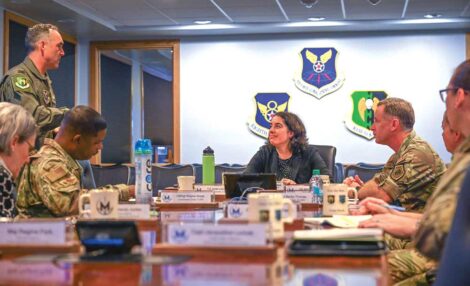
Two legs of the nation's nuclear triad were front and center on Tuesday when Undersecretary of the Air Force Melissa Dalton visited Minot Air Force Base.
Dalton is the 28th under secretary of the Air Force, the Air Force's second highest ranking official who oversees the organizing, training and equipping the U.S. Air Force and Space Force. Dalton's visit to Minot came amidst visits to Malmstrom AFB in Montana and F. E. Warren AFB in Wyoming, to assess each base's needs and readiness.
Dalton heralded the integral role the 5th Bomb Wing and 91st Missile Wing play in the United States' nuclear deterrent, as well as the crucial connection the airmen and their missions have with the Minot community.
"It's so terrific to be able to be here and interact directly with our airmen and their leadership, given the weight of the responsibility and the mission that they carry here for two legs of our strategic deterrent, both the bomber wing and the ICBM (intercontinental ballistic missile) wing," Dalton said. "It's also really great to be able to meet with some of the civic leaders from Minot. It's clear to me that the partnership between the community and the base here is vital in order to be able to sustain the mission here."
Dalton said Minot AFB's dual mission has never been more vital in the nation's history with the rise of two near peer competitive nuclear competitors in Russia and China. She indicated these aspects of the triad were long overdue for investment in nuclear modernization to ensure the nation's nuclear deterrent is safe, reliable and effective. In addition to the transition to the Sentinel ICBM, Dalton said plans were moving forward to modernize the B-52 bombers' engines and radar systems as they are expected to be fielded out to 2050.
Sen. Kevin Cramer, who serves on the U.S. Senate Armed Services Committee, was on hand for the visit, and has been supportive of the modernization efforts, particularly around the transition from the Minuteman III ICBM to the Sentinel platform.
"At the beginning of my term in the Senate on the Armed Services Committee, I was having to really work hard to convince enough people that all three legs (of the nuclear triad) were important, that the ground-based strategic deterrence still mattered. Our enemy has dictated the value more than any of us ever could to having all three and having that diversity, and that's what makes it a deterrent in the first place," Cramer said.
Dalton said the Air Force is absolutely committed to delivering the new Sentinel capability to Minot AFB, but the program is restructuring and refining the requirements. In the meantime, Dalton said the Air Force is working to sustain the Minuteman III capability until the Sentinel program is online so there is no gap in nuclear commitments. She said a study of the initial implementation of the ICBM program in the 1960s has been especially informative and provided a number of lessons to avoid friction with local communities when the time comes to transition to Sentinel.
"What was clear, though, was how essential that partnership was to the program's success. Clear communication and transparency is going to be the name of the game. To strike the right note and ensure that everyone is on the same sheet of music," Dalton said. "And with that partnership can also come a common sense of pride in what we are collectively delivering for the nation, given unfortunately the threats that we are facing, that partnership is helping build our nation's defense."
Dalton said an environmental analysis for the project has been made available to the public, and that existing land under Department of Defense auspices to the extent possible would be used for the Sentinel sites. The external workers and contractors involved in the transition will be housed in hubs to facilitate access to work sites, housing and shopping. Those who enter the hubs will be screened and expected to agree to a code of conduct.
"I think there's also a real opportunity here, Senator Cramer and I we're talking about this a little bit earlier today, for harnessing talent in Minot and the broader state community with some early identification of the type of skill sets that we're going to need to develop the Sentinel Program and implement it," Dalton said. "Thinking about trade schools or universities that can be helpful as pipelines for that talent is something that I think we can also partner on with the community."
Dalton identified several quality of life conditions at Minot AFB after speaking directly with several airmen including medical support, housing, schools and childcare, which she said she would be taking back with her to Washington.