Minot State communication disorders students to explore new roles
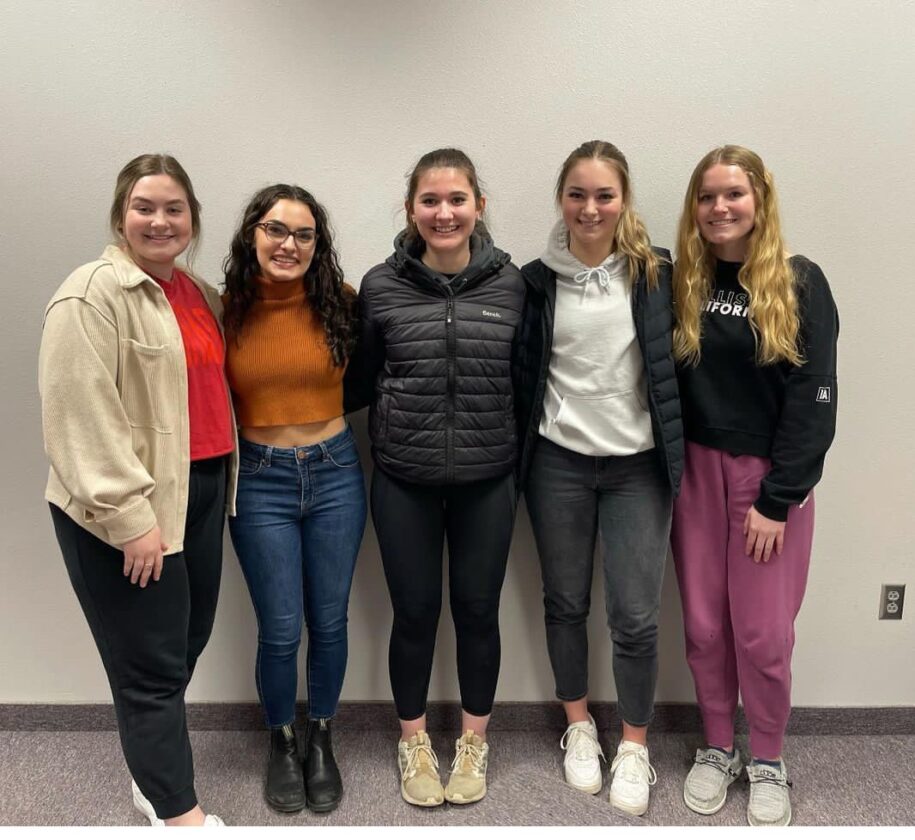
Submitted Photo Minot State University National Student Speech Language Hearing Association executives are Grace Candrian, Kennedy Koshman, Sadie Scherger, Iris Jessen and Tanisha Nickel.
Minot State University is hosting the 31st annual National Student Speech Language Hearing Association Conference on Friday, March 22, from 7:30 a.m.-5 p.m. in the third floor conference center in the Student Center.
This year’s topic will be “Thinking Outside the ‘Box’ – Exploring Roles of Speech Language Pathologists (SLPs/SLPAs) in Dyslexia.”
The National Student Speech Language Hearing Association (NSSLHA) is the only national student organization for pre-professionals studying communication sciences and disorders (CSD) recognized by the American Speech-Language-Hearing Association (ASHA). Its goal is to inspire, empower and support students in the field of communication sciences and disorders and to give them the tools to navigate their academic careers while preparing them for their professional ones.
This year, the conference will feature speakers who will share their expertise on “Exploring Roles of SLPs/SLPAs in Dyslexia.”
“We are lucky to have two speakers this year, Heather Caska and Karina Kadhi. Both the women are coming from Arizona and work together as a speech-language pathologist and speech-language pathologist assistant duo,” said MSU’s NSSLHA Chapter Secretary Iris Jessen.
“They will share topics on communication disorders through the lens of dyslexia, early identification, assessment, intervention, legislation and more,” she said.
Those attending will be able to identify at least three features of dyslexia, identify at least five skill areas to assess when identifying dyslexia, discuss the three principles and six key elements of structured literacy intervention and more.
The full scope of what speech language pathologists do, both in private practices and in schools, is commonly misunderstood. They work to prevent, assess, diagnose and treat speech, language, social communication, cognitive-communication and swallowing disorders in children and adults.
“This is a great opportunity for professionals and future professionals to learn,” Jessen said. “As a student, this will help me in my future practice as a speech language pathologist.”
Local News
Wind project hearing raises road concerns
Research Center precipitation
On Friday, May 22, at 8 a.m., 0.07-inch of moisture was recorded at the North Central Research Extension Center, ...
Interior to return $28M to Native families
The Department of the Interior on Friday, May 22, announced that $28 million has been distributed to tribal ...
Open houses set for Compatible Use Study
The City of Minot is updating the 2015 Minot Air Force Base Joint Land Use Study with a Compatible Use Study ...
Faith in action: Cru delivers water filters in Mexico