Board rewrites policies, map for tax incentive program
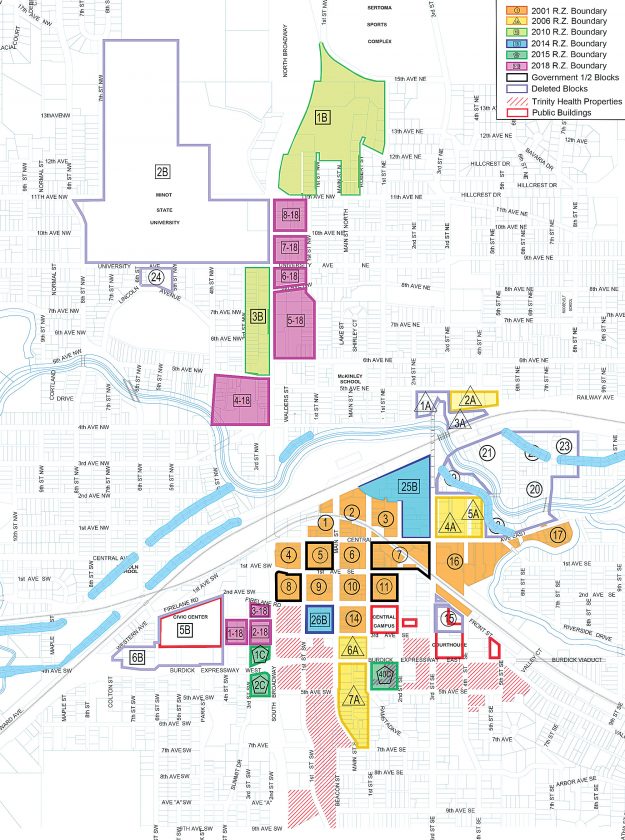
Submitted Map A map of Minot’s Renaissance Zone shows 2001 blocks in orange, 2006-added blocks in yellow, 2010-added blocks in light green, 2014-added blocks in blue, 2015-added blocks in dark green and eligible, non-zone blocks in pink. The striped properties belong to Trinity Health. Blocks completed or public are outlined. The blue strips represent preliminary sites of potential flood protection projects downtown.
A tax incentive program aimed at revitalizing Minot’s downtown and nearby properties is about to get an update.
The city’s Renaissance Zone Review Board is developing changes to the zone’s boundaries and operating plan. A final draft is still a few months away from going to the city council, and before that happens, the public will get a chance to examine and comment on the proposed plan.
“We have had a lot of discussion about the plan – and goals in particular we want the program to deliver,” said council member Josh Wolsky, who serves on the review board.
For instance, the board is considering partial tax exemptions rather than the all-or-nothing tax-break policy that has been in existence for improvement projects in the zone. Wolsky said the need to re-visit the existing Renaissance plan also became apparent a year ago when tax exemptions went to a project that eliminated apartment units above a commercial building.
“We have talked over and over again about wanting to prioritize mixed-use development, particularly downtown. The Renaissance Zone seemed like a pretty effective tool to encourage that development,” he said.
Seeing the zone fail to meet that objective in that particular incidence, the board questioned whether policies in place were facilitating the biggest return, Wolsky said.
Meanwhile, the Renaissance Zone map requires updating. The board wants to delete unnecessary blocks, add new blocks and come back from where it has strayed from state rules on how blocks can be identified. Minot’s zone was created in 2001 with 23 blocks. It now has 41 blocks, just shy of the maximum number of 42 allowed by state law.
John Zakian, Minot resilience program manager, said Minot has closed out blocks once development has been completed but has not officially removed those blocks from the zone. By eliminating 11 completed blocks or blocks that contain public/nonprofit buildings that aren’t eligible for program benefits, the city can free up slots for up to 12 new blocks to be added.
“So there is a significant potential for positive shift in how we are using the zone,” Zakian said.
Among properties eligible for inclusion are several along Broadway between the downtown and Minot State University as well as certain Trinity properties that may become vacant once the medical center moves to a new campus under construction in southwest Minot.
The last revision of the development plan in 2015 had produced only minor changes. Changes under consideration in this year’s proposal include:
® partial property-tax benefits rather than a full five-year, 100 percent tax break on building improvements. Benefit would depend on the value of a project.
® application requirements that give a clearer sense of the value of a project, such as number of jobs created, residential benefits and long-term projections on activities that will result.
® new methods to measure accomplishments.
® time limit on how long a preliminary approval can remain in effect before an applicant must make the building improvements. Applicants must obtain preliminary approval for tax breaks before proceeding with building improvements under the program but do not receive tax breaks until a project is completed.
Zakian explained that by leaving preliminary approval open indefinitely, an applicant can let a proposed project languish, tying the city’s hands in ever doing anything different with that block or closing it out. Because situations can change over a period of years, it’s not unreasonable to set a time limit, he said.
As proposed, applicants with inactive projects would have to come back to the review board to present an explanation and status report to retain preliminary approval. The committee sought information last year from six applicants whose approved projects were inactive.
Zakian said applicants also should make a reasonable case that without the tax benefit, the project would not happen.
Long-time board member and chairman Pete Hugret said he sees a need to revise outdated rules, including altering the board size from nine to 11 members to increase public involvement. He also wants the Renaissance Zone to encourage infill where infrastructure exists, avoiding the need for expensive, new infrastructure on the city’s perimeter to accommodate growth.
“Let’s take care of what we have,” he said. “I would like to see some of the older buildings rehabbed and let’s get them used.”
Hugret said he would like the city to exercise some control over any vacated Trinity properties. Trinity would retain ownership as the city seeks new uses, he said, but he wants to avoid more situations in which properties deteriorate under inactive ownership by outside investment firms.
As the review board contemplates new policies, it already is moving ahead in some areas.
Last year, the program began charging an application fee of $500 for commercial properties and $150 for residential properties to aid with its expenses, which previously had been absorbed as part of city operations.
Since last April 2018, the review board, which had been meeting infrequently, began meeting monthly. Board members note a heightened working relationship with the state Commerce Department, which oversees the Renaissance Zone program, since they stepped up board activity and began work on an operations plan that better aligns with state guidelines.
Currently working with three active building projects, the city is trying to promote more activity in the Renaissance Zone.
“We have elevated the awareness of it,” Zakian said of the zone. “I probably had at least five conversations with potential businesses, probably in the past four or five months, several which I think will come to fruition sooner rather than later. So there’s a lot more interest. The problem is it’s never really been marketed.”
With the new mapping and completion of a revised plan, he said, Minot will have tools to market both internally to existing property owners and externally to potential investors outside the community.
Zakian said the Renaissance Zone could dovetail with other downtown designations to pool the value of different incentives. Getting the downtown included in a national Main Street program would create a competitive advantage for some federal programs. The downtown area already has been designated an Opportunity Zone, which carries capital gains tax benefits for re-investment and automatic qualification for some federal programs. For example, the city could get Economic Development Administration grants within the Opportunity Zone to build infrastructure that promotes economic development or to capitalize a revolving loan fund.
Zakian said the programs are an investment into the city’s future.
“If you don’t have this incentive and benefit, the odds are these projects aren’t going to happen,” Zakian said. “What you’re doing is inducing future investment and increasing over time the property tax revenue coming to the city.”
Local News
Wind project hearing raises road concerns
Research Center precipitation
On Friday, May 22, at 8 a.m., 0.07-inch of moisture was recorded at the North Central Research Extension Center, ...
Interior to return $28M to Native families
The Department of the Interior on Friday, May 22, announced that $28 million has been distributed to tribal ...
Open houses set for Compatible Use Study
The City of Minot is updating the 2015 Minot Air Force Base Joint Land Use Study with a Compatible Use Study ...
Faith in action: Cru delivers water filters in Mexico