
Spinning wool of joy at North Dakota State Fair
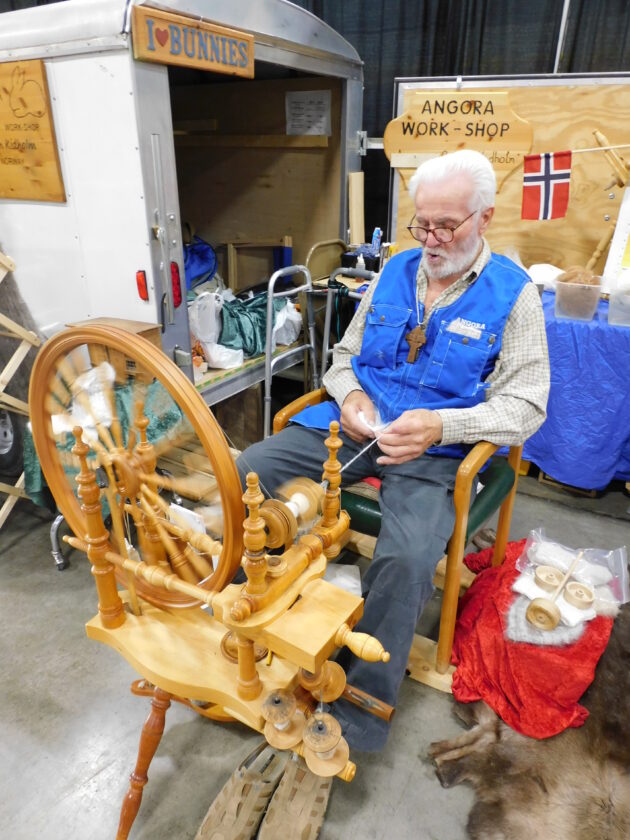
Audin Rhodes/MDN Ossian Kidholm, a wool spinner from Norway, enjoys visiting Minot and the U.S. and said he’s the richest man in the world because of the joyful life he’s lived. Kidholm spins Angora rabbit fur into thread for visitors’ entertainment throughout the week in the North Dakota State Fair Center.
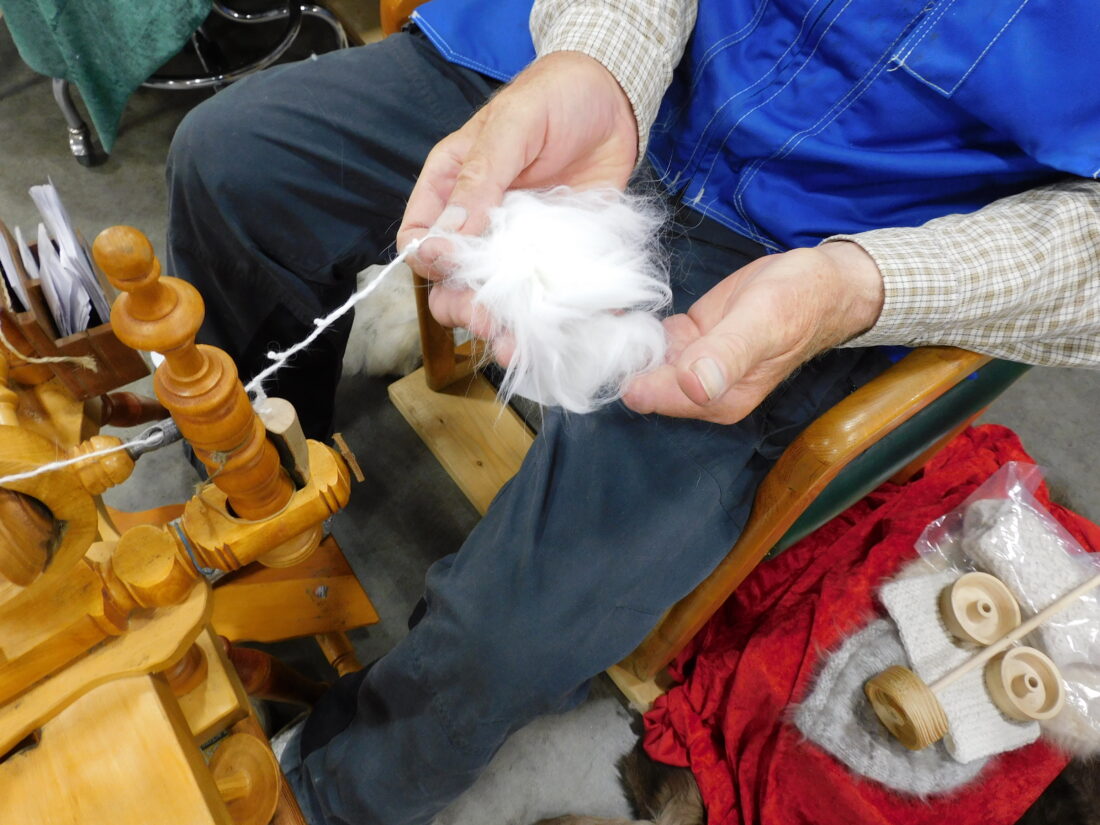
Audin Rhodes/MDN Ossian Kidholm, a wool spinner from Norway, holds up the fluffy Angora rabbit fur he is spinning into thread in the North Dakota State Fair Center. Ossian said Angora rabbit fur insulates better than sheep's wool and is stronger.
Audin Rhodes/MDN Ossian Kidholm, a wool spinner from Norway, enjoys visiting Minot and the U.S. and said he’s the richest man in the world because of the joyful life he’s lived. Kidholm spins Angora rabbit fur into thread for visitors’ entertainment throughout the week in the North Dakota State Fair Center.
Audin Rhodes/MDN Ossian Kidholm, a wool spinner from Norway, holds up the fluffy Angora rabbit fur he is spinning into thread in the North Dakota State Fair Center. Ossian said Angora rabbit fur insulates better than sheep's wool and is stronger.
Trending
The fairy tale "Rumpelstiltskin" is about whether a miller's daughter can spin straw into gold and riches.
For Ossian Kidholm, a wool spinner from Norway who is giving free wool spinning demonstrations and education at the North Dakota State Fair this year, life's riches come from the kindness and joy he shares with others.
"To be rich is not dependent on money. To be rich depends on how you hold your life," Kidholm said. "My heart is full of happiness. I'm the richest man in the world. I don't have money. It is not important for me to have money."
Kidholm is originally from Denmark but first traveled to Norway when he was 17 years old as a gardening student. Kidholm fell in love with Norway's country, language, culture and people and eventually decided to become a permanent Norwegian transplant in 1962. He currently lives in Notodden, Norway.
Notodden is home to Norway's largest stave church, the Heddal Stave Church, which is much larger but similar in construction to the Scandinavian Heritage Association's Gol Stav Church replica in Minot.
Kidholm has visited the U.S. a total of 33 times. Three times in San Francisco, three times in Michigan and the remaining 27 times have all been to Minot for the Norsk Hostfest and this year for the North Dakota State Fair as well.
"The only thing I don't like about the U.S. and Minot is when I have to leave. I really don't like to leave ... I think that the American people are warmer than the Norwegian people," Kidholm said. Kidholm likes how Americans are friendly and affectionate. "That is the way to do things. Give (people) a hug," he said.
The spinning wheel Kidholm uses during his U.S. visits for the Norsk Hostfest, was brought over from Norway by a friend of Kidholm's in 1996. This spinning wheel is only one of 59 spinning wheels in Kidholm's collection.
"The best wheel in the world is standing in my living room in Norway. I met a spinning wheel maker in Grand Rapids, Michigan, by the name of Ken Lennox," said Kidholm.
Kidholm is repairing some of the wheels in his collection and has repaired more than a thousand spinning wheels and has even taught some wheel makers what he knows.
Lifelong student
"I have been a student all my life. I've been learning and learning and have been teaching a little. And life has been wonderful. It is wonderful to learn," Kidholm said. "But when the school gave me my education, it was too square for me. I wanted it to be rounder, to learn by doing."
Kidholm had nine different careers throughout his life, some of which were gardening, transportation, bussing, heavy construction, drilling, etc.
"I have had a very busy life. ... It is important for a crazy, playing boy to have joy every day," Kidholm said about his diverse careers and his appetite for learning and joy.
For Kidholm, some of this joy now comes from creating and expressing himself through spinning, something Kidholm only started doing when he was around 40 years old.
"Have you seen the painting 'The Scream'? Do you think it is pretty? I think it is not pretty at all but that man (Edvard Munch) told us what was living in his heart that day. That is what I am doing with spinning. I'm trying to tell people who I am. I'm alive, happy, crazy yes, absolutely, but happy. Proud," Kidholm said. "I am letting the thread get what it wants to get. Just having fun. But it has to be quality."
Kidholm has more than 100 different wools in his collection but the most common type is Angora rabbit wool. "Ninety percent of my spinning is Angora," he said.
"(Angora) is 10 times warmer than wool from sheep and four times stronger, but it's too expensive," Kidholm said. He explained sheep wool is one of the lower grade wools compared to Angora.
"Of course we do like the sheep," Kidholm said. He gestured to the sheep wool socks he was wearing, "Of course we do, look at my socks!"
"But Angora is better and cheaper to produce than sheep. ... One good Angora (rabbit) is giving the same insulation quality you can get from three sheep," Kidholm said.
One of the most difficult things about spinning for Kidholm is working with poor quality wool. Kidholm held up the fluffy white Angora rabbit fur he was currently spinning into thread and said, "You see this is in wonderful condition."
According to Kidholm, wool is in a bad condition when it has become "felted,” or matted. "(Matted fleece) is telling me that the animal has had a bad life. The owner should do a better job and clip it more often," Kidholm said.
Spinning a life
Kidholm has spun around 1,000 pounds of yarn in his lifetime. Most of the wools he's spun have been Angora but he's spun other wools as well. Kidholm has also educated more than 3,000 students on spinning.
"When I'm giving my students 20 hours of education, the first day we are learning how the wheel is working and we are exercising the thread. We don't spin the first day," Kidholm said.
On the second day of Kidholm's course his students are spinning, and on the third day his students are making two-ply yarn.
Kidholm said the three-day course is hard work and some students who are used to picking things up fast feel frustrated when they don't get it right away.
"Don't let the wheel be the boss. Tell the wheel what to do," Kidholm said. Kidholm controls the wheel solely with his pedal and not with his arms and hands. The adjustments he makes to the wheel speed are subtle yet extremely precise.
"All my education is free. I don't ask for money. The (students) are paying for their traveling, gasoline, toll road and ferries and so on. But nothing for their education from me," said Kidholm.
"One girl said to me after the class, 'Thank you for the price. I don't have any money.' I was there for her. I gave her an idea of how to create happiness and yarn," he said.
Kidholm said spinning is more common in the U.S. than it is in Norway. "There are many wheel makers in the U.S. and many, many spinners," he said.
"Less than 10% of spinners are men. More men should enjoy this nice activity," Kidholm said about the gender difference in the spinning community.
Kidholm told a story about a type of woman in Norway who spins at night while her husband and children sleep. This type of woman puts fire on the stove and food on the table for breakfast when her family awakens. And her family thinks nothing of it but little do they know, the woman is spinning throughout the entire night, making clothes for her family and herself.
"Girls and women are working and giving much, much more than boys and men. ... Thank you girls! We should like to support you," Kidholm said. "There are very few men (spinning). I'm sorry because of that."
Kidholm was married to his wife for 47 years. The two have since separated but they raised a family together and are now proud grandparents. Kidholm said he does not have any great-grandchildren yet. "That can happen very fast. If you were to ask me next year perhaps I will say yes," he said.
Kidholm will be 80 years old this October. "The life is too short in the last end. ... We take everything one day at a time. And we have to say to our Father upstairs, 'thank you for this day,'" he said.
"Begin to think as a youngster. You have today. Do what you want to do today. Perhaps you will be given a day tomorrow too," Kidholm said.
Kidholm will be spinning Angora fibers into wool thread and yarns for the rest of the week in the State Fair Center building of the fairgrounds.