
Bicycles, grain towers and local legends
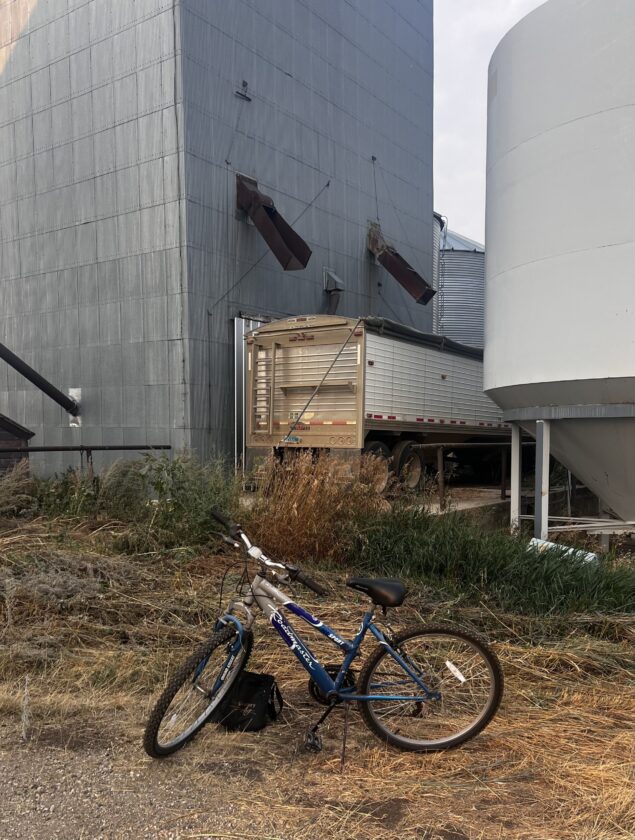
Dane Glasoe’s bike and lunch are parked next to the middle house of the Wildrose C & D elevator complex on the north edge of town.
The bicycle is parked on some parched weeds and grass with a lunch cooler and thermos perched next to it on the edge of town. The bicycle seems incongruent next to industrial grain hopper bins and the silver hulk of the Wildrose grain elevator – a vertical sentinel and reminder of years past when rail cars stopped here to load grain. The grain complex, which my father and uncle purchased several decades ago for additional grain storage, consists of three houses or grain towers and two annexes.
The bike is my cousin Dane’s mode of transport this morning to start his long day of work. He is downloading canola from his large grain truck, which can hold 50,000 pounds of seed, to empty it before he drives it back out to the field to harvest more canola. Tall and fit, Dane stands on the elevator platform in dusty jeans and a T-shirt while he watches thousands of tiny round seeds slide down in a black, river-like flow from the hopper opening into the elevator bottom where the seeds travel up a leg or shaft with multiple metal cups carrying and transporting the grain to its storage house where it will remain until Dane markets the canola for sale and delivery elsewhere.
Canola is an edible rapeseed that is used to make canola oil, which is marketed in the U.S., Canada, Europe and Japan. North Dakota farmers like Dane lead the U.S. in canola production. Farmers here seeded a record high 2.05 million acres this season, according to the Northern Canola Growers Association.
Dane Glasoe, who graduated in 2014 with an agriculture degree and minor in plant science from NDSU, began renting and farming land from his uncle and aunt, Bob and Rose Howard, before he graduated from college. He returned home each spring to plant his crop and began harvesting before classes started. He also traveled home during weekends to finish the harvest. Dane also achieved the equivalent of a minor in soil science and considered obtaining a masters in it, but summer research commitments would have kept him at NDSU. He instead returned home after college to farm full time and increased his acreage with land purchases at public auction and lease agreements with multiple landowners. Dane also farms the original quarter of land our great-grandmother Clara (Siggerud) Glasoe homesteaded as a single young woman in 1905.
His parents, Lance and Mary (Murphy) Glasoe, grew up on rural farms in the area but did not meet until Mary was visiting her sister, Rose, on her farm and ranch. Lance and Mary were both well-established in their careers and adulthood when they married. Dane arrived several years later prematurely, and I remember the tears in my mother’s eyes as she told us all to pray for our wee cousin who could fit in my uncle’s hand.
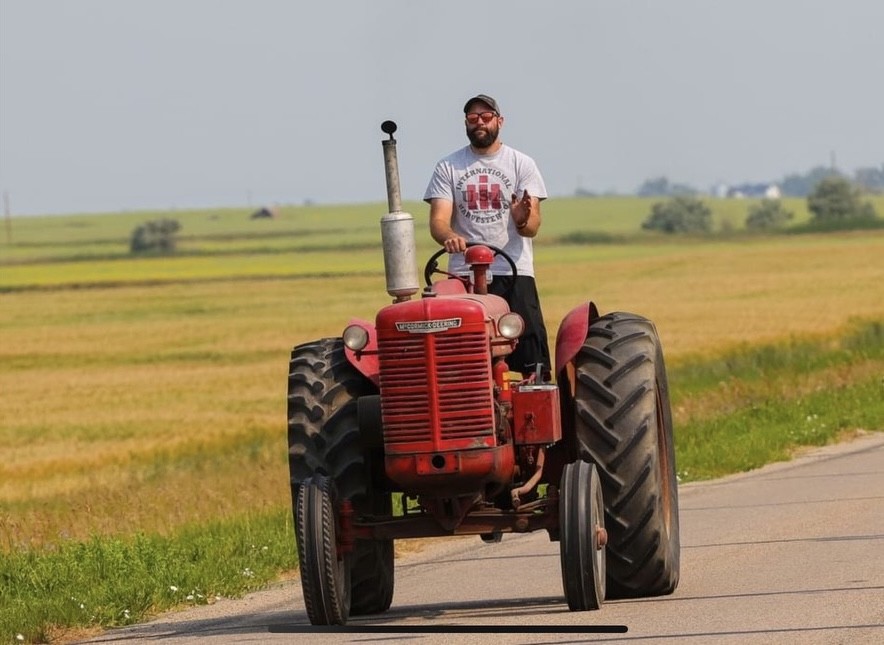
Dane Glasoe drives one of his family’s vintage tractors.
Dane spent the first weeks of his life in a prenatal intensive care unit in Bismarck. I worked for my uncle the summer of 1992 when Dane came home and for several summers after that. Mary would always invite me inside for a coffee break and fresh homemade wheat buns; Dane loved to ride on my back while I pretended to be a bucking bull, and he would giggle and squeal as we galloped between the dining and living room. He was an avid reader as a little boy and had an attention span far beyond his years for books. His parents’ entire basement was filled with LEGO creations he made in his spare time.
Such solitary entertainment and learned pursuits prepared him well for life as a farmer and a mindset of continual self-education. My cousin, not unlike his ancestors who homesteaded, is independent-minded and self-reliant; he alone owns, manages, markets and operates his farm business.
Several years ago he purchased a house in Wildrose, which places him near several sections of land he farms and the Wildrose grain elevator complex where he stores some of his grain.
Dane, who buys and restores vintage farm equipment and automobiles in his free time, utilizes a grain complex that has stood for more than a century. The Wildrose grain elevators once boasted the largest grain complex in the United States while it was the town at the end of the line for the Great Northern railroad company. The railroad in 1910 established the town of Wildrose – named for the wild rose bushes growing on the prairie. Within one year there were 35 businesses based in town. “Wildrose was branded ‘The busiest little town in the northwest,'” according to Wildrose information.
Wildrose was the largest primary grain market in the nation from 1911 to 1916; farmers from as far as 50 miles away hauled their grain by wagon and horse for sale to Wildrose. Three hotels and three livery barns hosted farmers as they waited in line to unload their grain. Photos in the Wildrose Jubilee Book 1910-1960 showcase four elevators: the National, the Farmers Elevator, C.O. Highum’s elevator and Martin Gulson’s elevator. One burned down, but the other three still stand.
While Wildrose once boasted more than 500 hundred residents, that number has dwindled to a few more than 100 residents. Dane, a Wildrose resident and local farmer with multi-generational roots, is one who remains and carries on the traditions and work of rural North Dakota.
Caraballo is a fifth-generation rancher and farmer who manages Glasoe Angus near Wildrose.
-
- Dane Glasoe’s bike and lunch are parked next to the middle house of the Wildrose C & D elevator complex on the north edge of town.
-
- Dane Glasoe drives one of his family’s vintage tractors.
Local News
Founders’ Museum exhibit open at ND Capitol
Saying thanks to military members, families
Identification of crash victim released
MERCER – The North Dakota Highway Patrol has released the name of the victim of a one-vehicle rollover occurring ...

Young performers present ‘Newsies, Jr.’
Local election news available online
SRT to hold annual meeting, election June 18
SRT Communications will hold its annual meeting and director election on Thursday, June 18, at the North Dakota ...