
What happens if Measure 4 passes?
Senator offers tax replacement scenario
Trending
Political realities could mean budget cuts and higher state taxes if voters approve an initiated measure to abolish local property taxes, according to Senate Majority Leader David Hogue, R-Minot.
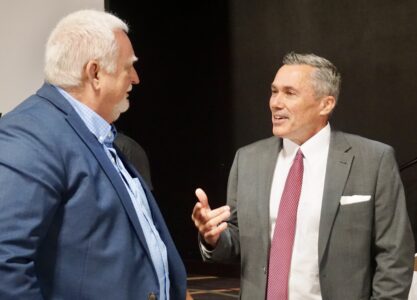
Hogue spoke Monday at a Minot Area Chamber EDC meeting to provide an outline of how legislators might meet the requirement in Measure 4 for the state to replace the property taxes of political subdivisions.
Hogue said he believes the Legislature would find $3.15 billion to replace property taxes by using money already being given to political subdivisions, spending from the state's rainy day accounts and raising sales, income and gas taxes.
"The Legislature is a political body of diverse people, and there's going to be compromise. So, as much as one faction of the Legislature might want to cut budgets - extreme cuts - there's going to be another faction that's going to want some new taxes. There's going to be another faction that says, 'hey, we can reduce what we already provide to the political subdivisions,'" he said.
Hogue projected a biennium scenario in which the motor fuels tax goes up by 10 cents, corporate and individual income taxes are raised 10% and the sales tax is increased by 1%, with certain sales tax exemptions eliminated. Overall, the plan would generate $808 million, he said.
The state budget is $19.6 billion, with about a third of revenue coming each from general, federal and special funds, he added. The general fund is about $6 billion. Cutting 5% would save $305 million per biennium, he said.
"It's unlikely that we would do across the board cuts because that's just not good judgment," he said. "But that's what a 5% cut will yield."
The Legislature currently provides funding to political subdivisions in programs such as oil and gas taxes to production counties, Hub City, Prairie Dog, airport improvement and direct state aid from sales tax. Cutting those appropriations by 10% provides $108 million to go toward the $3.15 billion, Hogue said.
"You see where it gets us," Hogue said of the total in his scenario. "My point is, we're not halfway there yet and we've already had 10% increases in our taxes, 5% general fund decrease. So we have to find somewhere else besides new taxes and budget cuts, unless they're going to be more severe, for us to get there."
He suggested legislators would look to the rainy day funds for a one time fix, including the Legacy Fund, Budget Stabilization Fund, Common Schools Trust Fund and Strategic Investment and Improvement Fund.
He also said going after money in the Resources Trust Fund could impact projects such as the Northwest Water Supply and Mouse River Enhanced Flood Protection. However, he said, the political reality is those large projects serving urban areas would gobble up the dollars, cutting rural water projects out of the fund.
Combining $975 million that might be available from trust funds with the $1.22 million from higher taxes and the shift of existing funds still leaves the Legislature about $1 billion short of $3.15 billion, he said.
Rep. Lori VanWinkle, R-Minot, responded that the described crisis in funding comes despite the Legislature having increased the state budget the past three bienniums. VanWinkle said legislators always have found funding for projects it wants, but not when a request comes from the people.
"Somehow, it's there for every other $3.15 billion increase but not for us," she said.
"There is no crisis of funding. Here's the measure. And here's a proposal how to address it," Hogue replied.
He said legislators won't cut the $6 billion general fund in half to replace property taxes.
"That doesn't make sense. We're not going to take every dollar of Legacy Fund earnings, because they're already pledged to paying for our roads, paying for our bonding for our large water projects," he said.
Minot City Council member Mike Blessum asked about the $1.4 billion approved by legislators beyond the governor's budget request last session.
"And now we're asked to be careful about what we're spending here," he said.
Hogue said revenues have exceeded projections, allowing for additional spending. That spending included $515 million in tax relief and funding a state health laboratory and other needed infrastructure, he said.
Charles Tuttle of Minot asked about the economic benefits of eliminating property taxes.
"It would be a robust economy from doing this, and we can afford to do it - obviously, with the increase we've had every biennium with government spending," he said.
Hogue had no figures on the revenue growth that might be expected from residents spending money that otherwise would go to property taxes. He said the sales tax increase would not be substantial because not all the money would be spent and some would be spent on nontaxable items. He also said the largest property taxpayers often are out of state corporations. Property tax is levied on residential, agricultural and commercial property and on property that is centrally assessed through the state, including railroads, pipelines, air carriers and publicly traded utilities.
Hogue also presented figures showing the aggregate property tax in the state's largest eight cities is up 42% on average over the past 10 years, or 3% more than the 39% rate of inflation.