
Tattooer gives industry insights
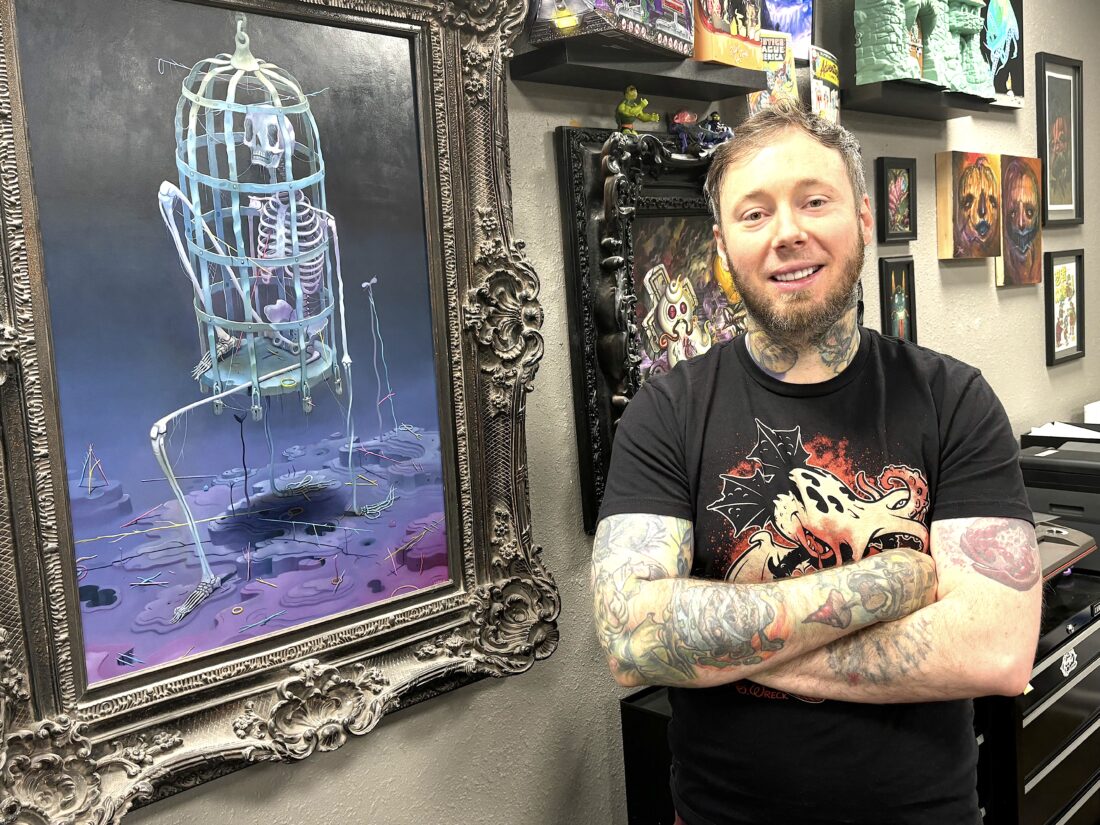
Angie Reinoehl/MDN Tattooer Jordan Ross has been in the craft for nearly 20 years and has stressed the importance of maintaining a competitive edge to stay relevant in the ever-changing industry. More recently he has experienced the pros and cons of the introduction of artificial intelligence firsthand and shared how it might impact the industry.
Local tattooer Jordan Ross has been in the industry since 2004. In practice for nearly 20 years, he has seen his fair share of change in the industry.
Tattooing is the process of pigmenting someone’s skin, or dermis, with micro pigment particles. What is seen today is modern electric tattooing, which evolved from using bone, tooth and plant pigments to electric tattoo needle bars, cartridges and medical-grade sterile ink.
Ross said there are two components to being a competent tattooer. On one hand, there’s being an artist – someone who is able to create an image on a medium. The other is being a tattooer, which encompasses the techniques needed to do the physical application of a sterile procedure. In order to have a well done, long-lasting tattoo, Ross said a good tattooer has to master both.
Image creation can be time-consuming so Ross does it ahead of the appointment. He gathers information and reference points, and researches the tattoo to ensure any traditional meanings of the image won’t be an issue.
“Because tattooers aren’t versed on every image ever, they’re kind of prone to mistakes without doing research. There’s a lot that goes into doing a correct, well-done tattoo,” Ross said.
Ross first draws all of his images on a tablet, then later transposes the image onto the skin via acetate carbon stencils and draws directly on the skin to complement the shape of the body. He said oftentimes clients will have an image sourced from the internet they want tattooed, which he called, “print and play,” in which simple drawings are etched into the skin.
When he first broke into the field, licensing was a major gray area until health departments started to step in. Twenty years ago there were some shops that were above board but he said some smaller areas that didn’t have an influx of tattooers who were well educated were still catching up on the industry standard of procedural sterility,” Ross said. “Image creation went from ‘crude biker-knowledgeable application’ to creations highly scrutinized by clients who are very knowledgeable.
Learning the tricks of the trade were once only taught from master to apprentice, but with education being readily available on the internet and television, major strides have been made in the industry.
“I mean, some of the clients now might be more knowledgeable than the tattooers 20 years ago,” Ross said.
Artificial intelligence is a new aspect of tattooing that started showing up in Ross’s shop late last year. Clients have brought in AI-generated images as inspiration, which Ross said has its own set of pros and cons. While utilizing AI helps customers transpose their vision for their tattoo, it can add unrealistic expectations.
AI-generated images aren’t perfect – hands are often generated by AI not anatomically correct. Words are also frequently incorrectly spelled. From a distance the image will look “okay” but the finer details are often incorrect and the entire piece needs to be redrawn.
“It also adds crazy standards to the tattooer. When people bring in art and say ‘I want this,’ it’s like the top tier artists, just the best in the world stuff – super famous tattooers. Or it’s AI that has an almost infinite amount of detail per square inch. The bar is set so high for that image creation, it’s almost impossible for the tattooers to meet those expectations,” Ross said.
He added a lot of tattooers fall short because their images don’t translate well onto skin. Pigment moves, migrates and fades over time – the skin cells also die and age. A successful tattoo has to be simple and strong yet bold enough to hold up in the skin for years to come.
Ross said he finds it interesting how fast competitive tattooers have to improve their skills in order to stay relevant. He said tattoos that used to be impressive 15 to 30 years ago are now entry-level tattooing skills.
“As time goes on, you want to give yourself a competitive advantage by learning higher skills and techniques so you’re not just replaced by the 18-19 year old that walks in the door,” Ross said.
As the industry exploded and new artists began to saturate the art form, tattoo styles branched off from the traditional Americana and tribal styles into more niche ones. Black and gray wash tattoos took off in the penal system, where inmates had nothing but time, skin, and black ink. Black and gray realism and neo-traditional became extremely popular and branched off into hyper-realism, new school, illustrative, and trash polka.
“The more artists started diving into the skill set, the more it just started to get weird. Just like with paintings – they’re trying to differentiate. They’re trying to add a niche for them so they keep their jobs and they’re not just replaced by everyone that can do the exact same thing,” said Ross.
Being a tattoo artist does come with some workplace hazards. Ross said it can be detrimental to their health as hunching over clients all day breaks down the connective tissues in the back, hips and eyes. The machines are also loud, which affects hearing.
Between image creation, tattooing, networking and business operations, Ross said the job isn’t the typical nine-to-five, but rather an around-the-clock gig.
“We kind of say it’s more of a lifestyle than a job because to really do well you almost have to eat, breathe and sleep it day in and day out,” he said.
Ross added that being responsible for sterility, the operating facility, equipment, image creation, insurance and more, tattooers aren’t paid nearly as much as other professionals, such as doctors, who break the skin or are responsible for clients’ health.
With the tattoo industry booming now more than ever, the market is wide open.
“It’s just an outlet for a lot of different things. People use it for an outlet for stress, healing, image improvement, closing or opening a chapter in their life or just something cool they want. It has such a broad mass appeal. I’ve had murderers in the same room with doctors. I’ve had lawyers in the same room with felons,” Ross said. “I don’t think the market can really get any bigger at this point. There’s no one left.”
Local News
Ray launches community complex project
RAY — The City of Ray has launched the Ray Community Complex Project, planning and developing new recreational ...
Storm stirs dust in region
A dust storm triggered multiple hazard warnings by the National Weather Service on Thursday, May 14. Southwestern ...

Food bank marks construction on statewide distribution center
Rural Health Award recipients announced
GRAND FORKS – The annual Dakota Conference on Rural Health will recognize North Dakota rural health advocates for ...

Defendant sentenced to 20 years in stabbing case
Victim of crash near Kensal identified
KENSAL — The North Dakota Highway Patrol has identified the victim of a one-vehicle crash that occurred Monday, ...