Public entities wage war against gopher population
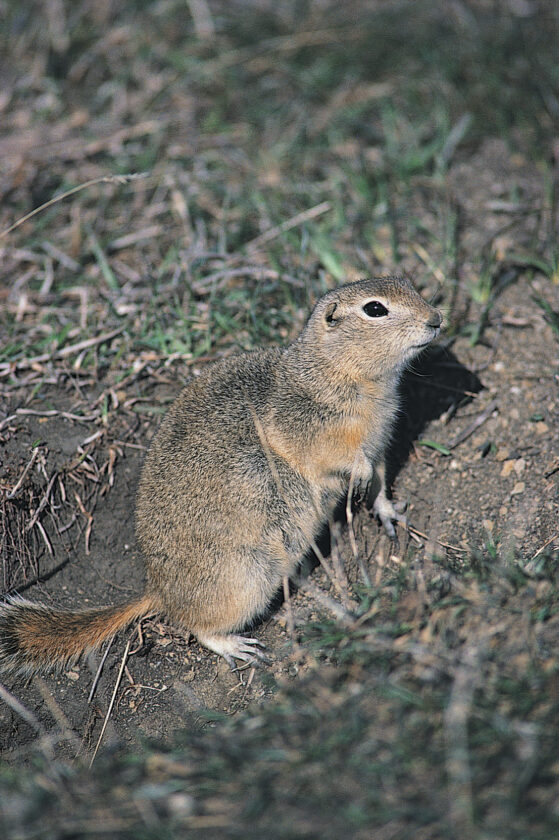
Submitted Photo The gopher, or ground squirrel, is prevalent in North Dakota and can be a pest when numbers get out of hand. Photo courtesy North Dakota Game & Fish.
Despite throwing money into a number of eradication efforts, Minot’s public officials are frustrated to still be losing in the battle against those pesky varmints known as ground squirrels – often referred to as gophers.
“Minot North is being built right now, and we think the mascot should have been the gopher. It’s severely infested,” Jared Ewards, facilities manager at Minot Public Schools, said in expressing his exasperation.
“Around Washington school, they say our colony there is between 1,000 and 1,500 and it’s spilling over into the neighborhoods,” he added. “We’re trying to be proactive. We just don’t know good ways to do it, and it is expensive.”
Representatives of Minot Public Schools, Ward County, the City of Minot and Minot Park District shared their struggles with ground squirrels at Thursday’s Liaison Committee meeting.
Calyn Beckman, finance director for the Minot Park District, said the worst areas for the district are the soccer complex and Polaris Park, both in northwest Minot.
“A lot of it is just trying to fill the holes so that it is safe,” Beckman said. “We have a lot of complaints about it but don’t have good answers.”
In addition to the Washington school area, gophers are beginning to populate around Perkett school, Edwards said.
“For a number of years, we’ve been doing something to combat those Richardson’s ground squirrels,” he said. “We’re able to keep the numbers down, but they’re still a nuisance. When they’re on our playgrounds, they become a hazard for safety. There’s big holes everywhere.”
He noted the schools regularly record incidents of students getting hurt from tripping in the holes.
The Minot Fire Department has placed a bounty on the heads of the gophers around Station 5 in the area of St. John the Apostle Church. Police Chief Kelli Kronschnabel said firefighters have been armed with pellet guns, and a contest is underway within the department to see which station can eliminate the most gophers.
Poison, snaring and trapping are more common methods of gopher control. Keeping the number manageable was the consensus of the committee regarding the direction to take on the ground squirrel problem.
“You’re never going to get rid of them, but it’s definitely better that you maintain at the number it is rather than continually growing,” Beckman said. “If we can just maintain it to a small enough population that we can fill in holes as needed, then at least we’re OK.”
“But the problem is trying to get there,” Edwards said. Gophers are active during the day so it can be difficult to implement control methods safely in areas heavily used by the public. Poison also can present a potential danger to birds that prey on gophers, he said.
Beckman added the park district has had problems with gophers recognizing poison and kicking it out of their holes back onto the field.
Liaison Committee chairman and city council member Mark Jantzer said the entities need to continue to work on solutions, share ideas with each other and engage community members facing the same issue.
Gophers aren’t the only hazards on public lands, either, as pointed out at the meeting.
“We’ve had skunks on our playgrounds,” Edwards said. “We have a beaver right now that’s got a tree that’s ready to come down. It’s about a 70-foot cottonwood that looks like it’s going to take out highlines and transformers that feed our Head Start area.”
Local News

Time capsule, sculpture highlight pioneer reunion
Defendant in Spirit Lake shooting pleads guilty
A Fort Totten man has pleaded guilty to two separate counts of assault and voluntary manslaughter in U.S. District ...

Moen Family musicians return to Frozen Fingers Festival
Accommodating growth

Discovery well anniversary