Testing your hay supply for horses
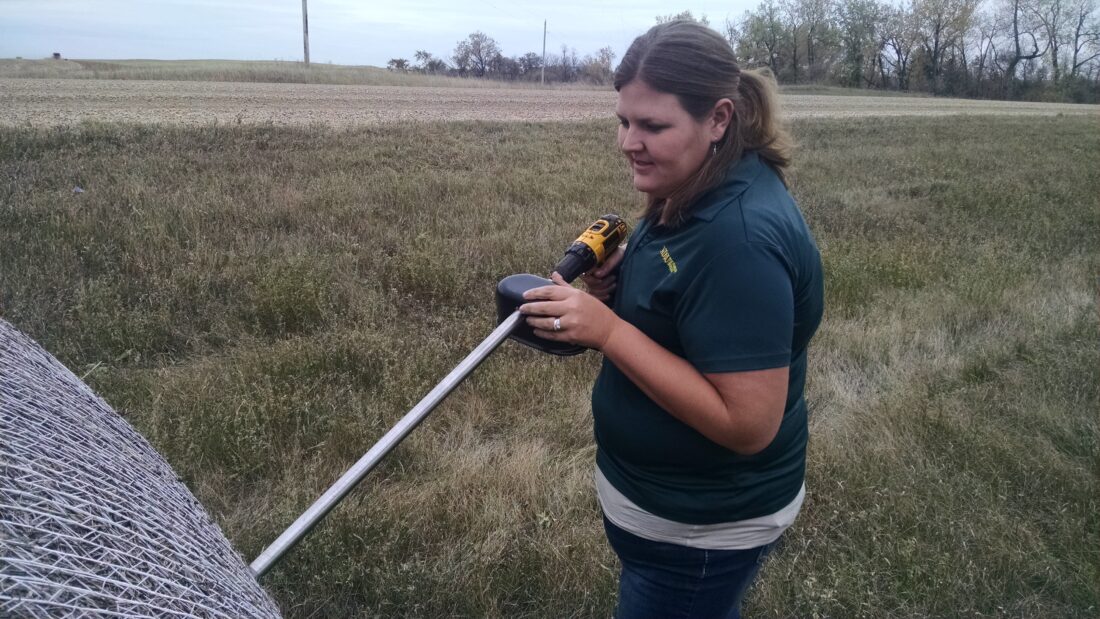
Submitted Photo Paige Brummund, extension agent, agriculture and natural resources, samples a bale with a hay probe. Hay probes can be checked out from your county extension agent.
Horses are designed to eat a forage-based diet and therefore hay should make up the majority of what they eat. Most horse owners are skilled in selecting hay based on its appearance and smell, but may not know how those qualities match up with the actual level of nutrients in the hay.
Getting a hay analysis completed is the most accurate way to determine the nutritional value of your hay. If you are buying hay, the seller would ideally have a test completed and be able to provide you a copy of the results. If you are putting up your own hay, having a test done before feeding the hay to your horses is recommended.
So why does this matter? The information you receive back will allow you to balance your horse’s ration to best meet its nutritional needs. If you are underfeeding or your horse is lacking the required nutrients, your horse may lose weight and show other signs of poor health. On the other hand, if you are overfeeding your horse, you are not only wasting money on excreted nutrients, but your horse is at risk of becoming obese and experiencing health issues related to their extra weight. In addition, some horses have metabolic conditions that require a low starch ration. There is no way to determine the nutrient levels of your hay without getting a lab analysis completed.
Useful information on a Hay Analysis Report
Understanding the lab report can be overwhelming. Below are some general guidelines to help you better interpret your results.
Dry Matter (DM): This measures the moisture content in your hay. Most hay will be around 10-18% moisture, or 82-90% dry matter. Lower-moisture hay will be more brittle resulting in leaf loss, whereas higher-moisture hay will be at risk of molding. Hay over 25% moisture is at risk of excessive heat damage and may even start on fire by spontaneous combustion.
When looking at the numbers for the values below, look at the column with the dry matter figures rather than the “as fed” or “as sampled” figures. The DM figures will give you a better “apples to apples” comparison between different hay samples.
Crude Protein (CP): Crude protein varies significantly in hay depending on the type of hay and the maturity of the plant when it was harvested. Most mature, idle horses require around 12% protein, however growing horses, lactating broodmares, and horses in moderate to high levels of work require more CP. Grass hay in North Dakota typically ranges from 6-14% CP and alfalfa hay typically ranges from 14-21% CP.
Digestible Energy (DE): This figure is important for balancing the energy in an equine ration. Most hay ranges from .76-.94 Mcal/pound. For a moderate sized mature horse in light work, their DE levels should be around 20.5 Mcal/day. As an example, a hay testing at .84 Mcal/pound would need to be fed at 24.4 lbs/day to meet its energy needs from this hay alone.
Acid Detergent Fiber (ADF): This is a measure of the fiber concentration and relates to how digestible the nutrients in the hay are. The higher the number, the less digestible the hay is. Ideally, horse hay ADF levels would be between around 30-35%. Hay tested at above 45% ADF holds little nutritional value, but may be suitable as a filler for a horse with lower energy needs.
Neutral Detergent Fiber (NDF): NDF is a measure of the plants cell wall content, the higher this number is, the less your horse will eat. NDF levels around 40-50% indicate the hay will be palatable to your horse. If your hay has NDF values higher than 65%, your horse likely will not eat much of the hay.
Calcium (Ca) and Phosphorous (P): The mineral content differs depending on the type of hay. An adult horse requires a Ca:P ratio between 1:1 and 3:1. This means a horse should always have at least as much calcium in the diet as phosphorous, and not the reverse.
Non-Structural Carbohydrates (NSC): The non-structural carbohydrates number is an analysis of the sugars and starches in the hay. Selecting for lower NSC levels in your hay is essential if you have a horse susceptible to laminitis, one that has been diagnosed with Cushing’s disease, or a horse that has other metabolic concerns. Hay with NSC levels higher than 12% should not be fed to horses with metabolic syndrome. Most grass hays test higher than 12% (though there are exceptions, such as teff and some other warm season hays). Alfalfa hay typically tests as having lower NSC than most cool season grass hays.
Relative Feed Value (RFV): The relative feed value is often used by those selling hay, but is not used in balancing a horse ration. The RFV is an index number where a higher RFV typically reflects a higher quality and more digestible hay. The index uses 100 as an “average” hay, but again, this number is not very useful when it comes to balancing a ration.
There will be more figures listed in your hay analysis in addition to those listed above, however you now have a start at deciphering your hay report.
In conclusion, a hay analysis will provide information needed to correctly balance your horse’s ration. You may be over feeding or underfeeding for your individual horse’s needs. You may need to supplement with a ration balancer or add a concentrated grain mix to the diet. The only way to know is to start with a quality hay test and build a ration from the results you receive. For more information on hay analysis and ration balancing, contact your county extension agent or visit https://horses.extension.org.
Local News
City announces street impacts
The City of Minot has announced Second Avenue Southwest, east of the Minot Police Department, will be closed ...

ND program helps veterans find care, community
Minot mayoral candidates sound off on city governance
Minot mayor and mayoral candidate Mark Jantzer sees exciting times ahead for the city. “I think that with ...
Summer water tours scheduled across ND
The 2026 Summer Water Tours hosted by the North Dakota Water Education Foundation have been scheduled in ...
Fort Union Rendezvous set for June 18-21
WILLISTON – Fort Union Trading Post National Historic Site, southwest of Williston, is set to come alive with the ...