
Witness Trees at Fort Rice, Dakota Territory
Trending
To loosely translate from Norwegian to English:
fri = free, lufts = air's, liv = life
The English equivalent= Outdoor Life
I retired in 2000 without a clear vision of what I wanted to do with my newly discovered free time. In another story, I will tell of the events that led to my discovery of the world of archaeology at the State Historical Society of North Dakota (SHSND).
One of the first projects I worked on at the SHSND was the photographing of objects collected at the Fort Rice State Historic Site, 29 miles south of Mandan.
Fort Rice, Dakota Territory, was established in July of 1864 by General Alfred Sully. At the time, it was the northern most military post on the Missouri River. There are many stories associated with the 14-year existence of the fort. I spent four years researching the history of the first year of the fort and the soldiers who served there. Four hundred and fifty pages later, I am still writing that story.
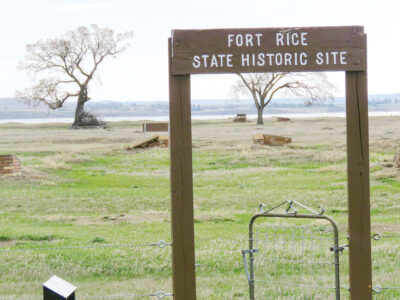
One of the side stories connected with Fort Rice involves two lone trees that stand on the edge of what would have been the parade ground at Fort Rice. I sat in the shade of those trees many times when I visited the site to gather information for my story.
A visitor to the modern Fort Rice State Historic Site is immediately struck by the starkness of the grounds. Rows of corner markers, ridges of earth and abundant prairie dog mounds are the predominant components of the site. In marked contrast are two lone trees on the east side of the former parade ground. Seemingly out of place on the otherwise windswept prairie, they attract attention because of their orderliness and placement.
In my research in the archives of the SHSND, I came across a photograph of the site taken circa 1871. The photograph is of a soldier standing tall with a military saber at his side. What was most interesting to me were the two small saplings on either side of the soldier.
On my next visit to the site, I took a copy of that photograph and compared the placement of the soldier with the buildings in the background. The buildings are long gone but the WPA corner markers are still there. To my amazement, the photograph lined up perfectly with the two lone trees.
Further research in the archives revealed that the post surgeon at the time, Dr. Washington Matthews, had written in his 1868 journal that "To day comdg. officer commences to plant trees (Elm) around the parade ground."
A much longer story ensued after more research and consultation with a city forester, a medical doctor and photo archivists. Long story short, I am convinced that the two lone trees still alive and well at Fort Rice are the fully grown trees shown as saplings in the 1871 photograph.
I have dubbed them "witness trees," living reminders of the deaths incurred by the post soldiers, post civilians and Native American warriors at and around the Fort Rice Military Post.
Doug Wurtz grew up near Ryder and graduated from Minot State University. His retirement activities include nature photography as well as serving as a Certified Interpretive Guide for the State Historical Society of North Dakota. He is past president of the North Dakota Archaeological Association. Doug and his wife, Linda, live in Bismarck.