Souris Basin Planning Council tools make resources, data more accessible
Resources, data become more accessible
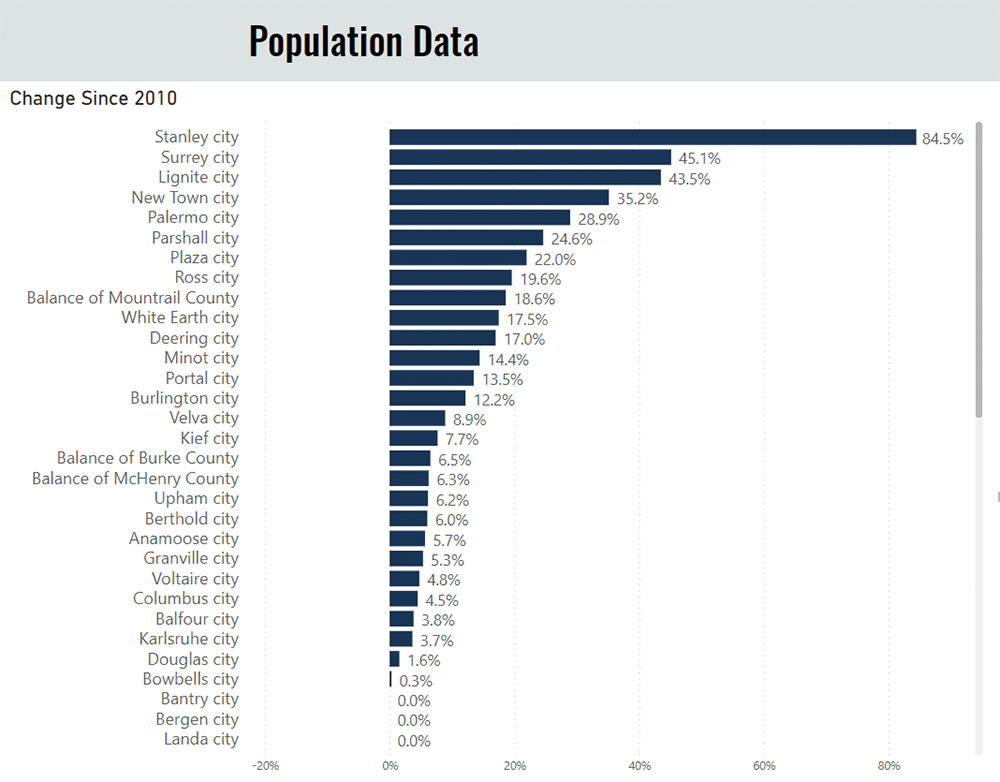
Submitted Photo Regional population changes are among data in a new online tool that Souris Basin Planning Council has made available to the public.
Burke County has the highest median household income in the Minot region at $77,000. Renville County has the highest percentage of remote workers at 8.7%, while Ward County has the region’s largest foreign born population at 4.7%. In Mountrail County, 53% of residents are younger than 35.
These are among population data that Souris Basin Planning Council has compiled for its seven-county Region 2 in an online, statistical tool being made available to the public.
The new data tool and an online resource service launched last September are early pieces of the council’s ongoing effort to create a resiliency strategy for the region.
Not just for businesses and organizations, the tools are for everyone, said Lyndsay Ulrickson, SBPC executive director in Minot.
Ulrickson said the population data tool was developed in response to queries that SBPC receives. There are federal websites that contain the data, but they can be confusing to navigate to find specific, local information.
“We really wanted a better data tool with graphs that are just so much easier for people to look at and understand. That’s what we’ve done here,” Ulrickson said.
The data shows population trends and the factors in those trends over the past 10 years in Bottineau, Burke, McHenry, Mountrail, Pierce, Renville and Ward counties. For instance, Mountrail County had the region’s highest birth rate in 2020 while Bottineau County was the only county to see positive net migration in that year.
The tool also provides population trends in city and rural areas, with the ability to compare different areas.
“We wanted to look at not just what is the population now, but what have some of those changes been,” Ulrickson said. “It shows all of those different changes so that people can make better decisions. If it’s nonprofits who are grant writing, they don’t have to go dig and pull up multiple sets of data. They can get a lot of that right here.”
Besides demographic information, the tool provides workforce data. It shows how occupational group numbers have changed in individual counties over time and makes national comparisons.
For instance, the data shows Ward County’s workforce is up 14% since 2001. Mountrail’s workforce went up 216% between 2001 and 2014 and remains up 110%.
Ulrickson said anyone needing guidance on using the tool can call the SBPC office. If someone is looking for information not on the website, SBPC would like to know that as well to help in determining new data to add to the site. The site will be continually updated as the latest data and information become available, Ulrickson said.
Praxis Group developed and is maintaining the data tool.
SBPC also continues to develop its online resource page, which is accessible as a link from SBPC’s website or directly at sourisbasinsource.com.
The searchable database provides information on where entrepreneurs or nonprofits can turn to find help within the region.
The website’s first phase was a resource section for new and experienced entrepreneurs.
“This is not the end all, be all of all of the resources, but it’s a start for entrepreneurs,” Ulrickson said. “Because we’ve been hearing for several years from new businesses and experienced business owners that there just is not one place to go and try to figure out what some of these resources are.”
Phase two involved the creation of nonprofit resources.
“Every nonprofit is always trying to offer more services with less all the time, and so we have 15 Capacity Building resources out here that could be helpful,” Ulrickson said. It includes a free library of document templates and expert blogs.
Phase three, which should be completed and available this spring, will feature community resources.
Resources are grouped into categories, such as arts and culture support, business financing, business start-up, nonprofit, workforce development and indigenous-owned, veteran-owned or women-owned businesses.
Because there may be resources that SBPC isn’t aware of, the website allows regional entities to submit their resource information for inclusion. Entities have the ability to go on the site and manage their listed information to keep it current or add descriptions, photos, videos or website and social media links.
SBPC has moved forward with its data tool and resource page while continuing to work with SRF Consulting and Praxis Group on its larger resiliency strategy. Ulrickson said a first draft of the strategy should be available in a month or two.
Local News
Time capsule, sculpture highlight pioneer reunion
Defendant in Spirit Lake shooting pleads guilty
A Fort Totten man has pleaded guilty to two separate counts of assault and voluntary manslaughter in U.S. District ...

Moen Family musicians return to Frozen Fingers Festival
Accommodating growth

Discovery well anniversary