City of Minot invests in employee training
City invests in employee training
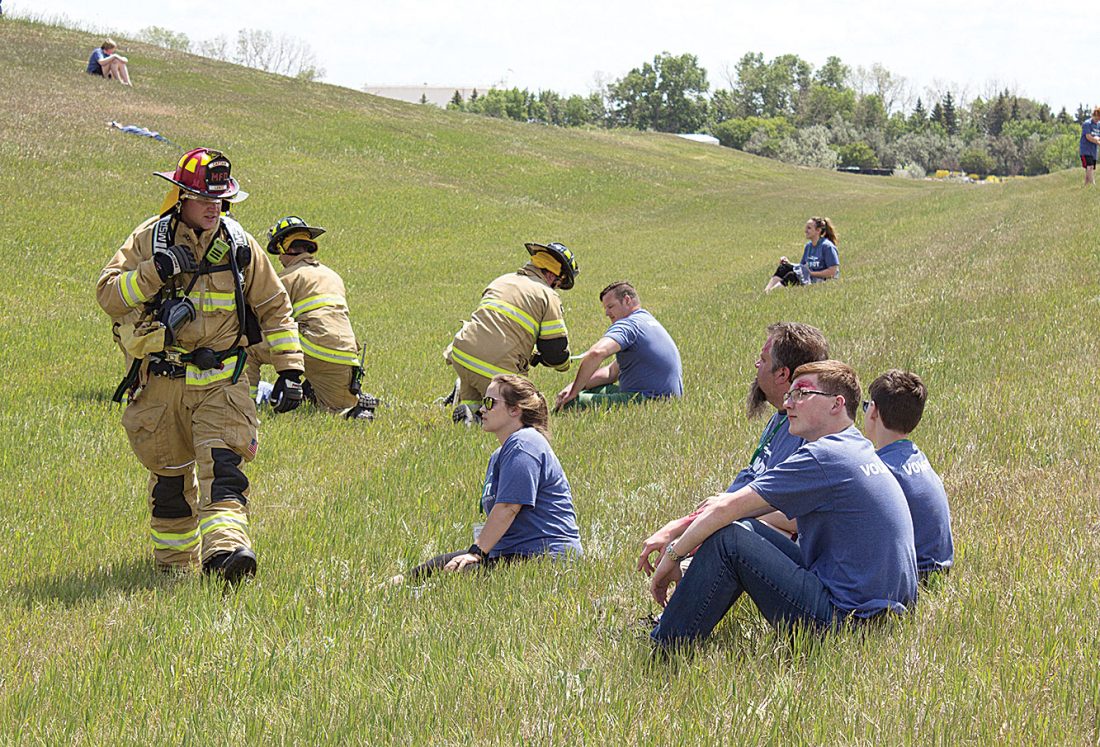
Submitted Photo Minot firefighters check the scene of a mock airplane crash, at which volunteer actors play the role of victims, during an emergency training exercise last June. The training exercise also involved the city’s police, public information office and airport personnel as well as other emergency responders.
When it comes to continuing education, the City of Minot invests thousands of dollars every year to ensure its employees stay ahead of the learning curve.
The city budget allocates money in every department to memberships in key industry associations and travel and fees for state and national conferences that employees attend.
“If you don’t invest in them, you stagnate. The organizational knowledge stagnates, and the community stagnates, and we have heard loud and clear our community doesn’t want that. They expect better services, higher quality staff members, and they expect better results from their government,” City Manager Tom Barry said.
In 2019, the City of Minot budgeted $231,514 for education and training, which includes conferences, webinars, literature and associated expenses. In some cases, training is necessary to fulfill professional development hours required for employees to maintain certifications critical to their jobs.
Some training has required travel. The city budgeted $206,636 in 2019 for travel, which includes travel to educational events or conferences but also to other activities, such as attending legislative sessions.
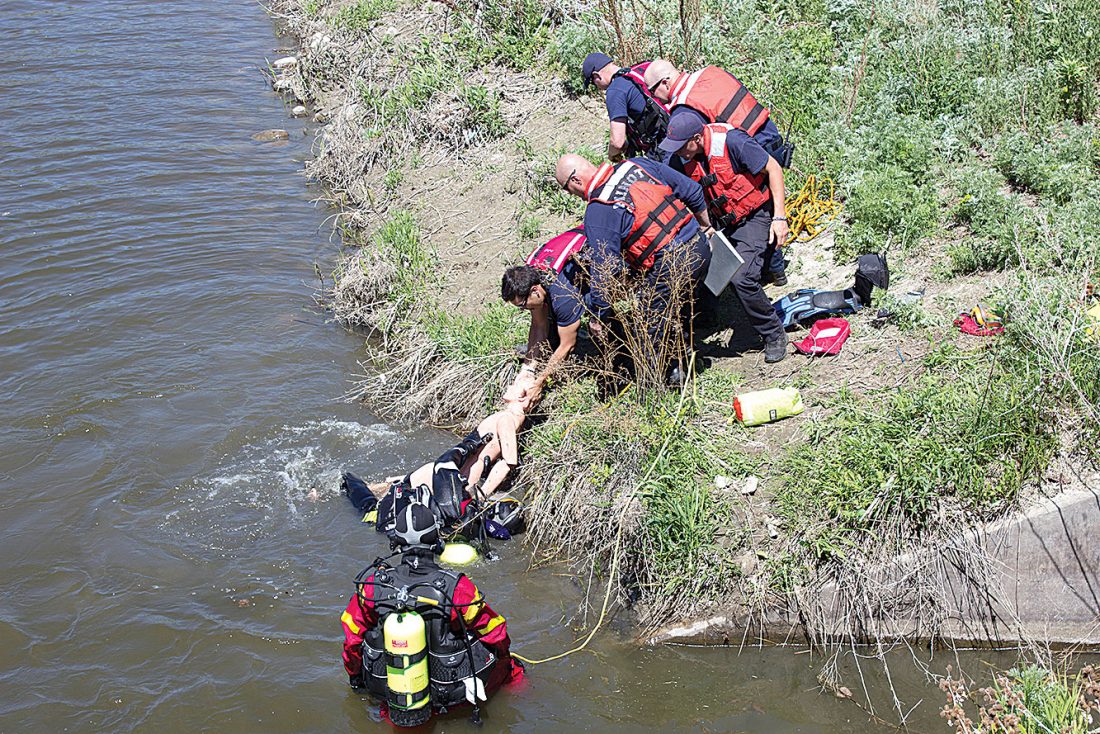
Submitted Photo The Minot Fire Department’s dive rescue team pulls a mannequin from the river during a training exercise.
This year, the city budgeted $241,286 for memberships in associations. For instance, the cost to join the North Dakota League of Cities was $27,250. Among other organizations for which the city budgeted memberships included the North Dakota Water Education, $3,000; Minot Area Chamber of Commerce, $1,150; and Western Dakota Energy Association, $400.
Barry said the City of Minot supports memberships for employees in associations that are well established in their industries, such as the International Association of Firefighters or American Public Works Association. Some employees or departments may be enrolled in more than one association to gain access to different benefits or be involved at state and national levels.
Memberships also open the door to attend certain conferences. Barry said he elected to join the International City/County Management Association because of its extensive annual conference and other resources available in areas such as policies and government trends.
The ICMA and National League of Cities both hold annual conferences that Barry considers particularly valuable because of their size and scope. He said he hopes to send department leaders to future events of those organizations because of the educational value, including opportunities to learn from other cities.
“We can see what they’re doing, learn from their mistakes, advance the things that they’ve been successful on and not have to stumble as much – waste time, waste energy, waste materials and dollars,” he said.
This year Barry was joined by Minot Fire Chief Kelli Kronschnabel at the ICMA conference, which drew nearly 5,500 attendees to Nashville in October. Barry said the conference attracts attendees who work in a variety of government management roles, including department and division managers. Kronschnabel attended because of conference sessions related to fire departments and because of her interest in advancing her career in government, Barry said.
Barry said his goal in sending staff to conferences is to expose them to new ways of thinking that open possibilities for themselves and for the city. It lets the City of Minot do succession planning because it can prepare employees to move up in an organization.
“The reality is we have to grow our teams,” he said. “Once you commit to growing your people from within, then the entire organization benefits.”
Mayor Shaun Sipma said the city council has viewed training as one measure to rein in employee turnover. Training that increases competency and keeps employees connected in their industries raises job satisfaction, he said.
City Council President Mark Jantzer said without employee exposure to their peers and industry trends at conferences, Minot becomes isolated and can miss out when it comes to good ideas.
“If we want our people to do the best possible job that they can for the city, we need to give them continued professional training opportunities,” he said.
Conferences are valuable for the bigger picture they provide, Barry said. Without that, he said, “We get tunnel vision. We have no clue on what’s working well out there.”
At the ICMA conference this year, Barry took in multiple sessions on recycling and visited one-on-one with a presenter to get information specific to Minot. He attended a session on non-cash employee benefits that can be used in recruitment and retention to gather information for Minot’s recruitment task force.
The conference offered information on technology systems. Minot is investing millions of dollars in technology upgrades, and having access to information about systems available and the experiences of other cities in using them can save Minot in both cost and mistakes, Barry said.
Barry took criticism from some in the community who raised concern over the expense of the conference and whether there were actual benefits to warrant that type of cost. The suggestion was made that training could be obtained more locally, particularly through online mediums.
Barry said Minot uses online training tools as well as conference attendance, but there’s a motivation factor associated with attending an event and being around people who are looking to improve their organizations.
“You share ideas,” he said. “It’s the side conversations. It’s meeting with the facilitators or networking with somebody who actually shared an experience that they had. There’s no way that you’re going to get those kinds of benefits from a webinar.”
However, conferences can be expensive because of the major cities in which they are held and the cost of getting there from Minot. The cost of the Nashville trip included $1,901 for hotel rooms for the four-day event. It included two $744 airline economy tickets on Delta as well as Barry’s $790 registration and Kronschnabel’s $200 membership and $490 registration. With per diem of about $293 each and taxi charges, the total bill was about $5,500.
Although Barry acknowledged the high cost, he said efforts were made to obtain the best deals on flights and hotel rooms. Despite the cost, he said, a number of cities, including Grand Forks, sent multiple people to the ICMA conference this year.
Josh Wolsky, Minot City Council member, said the amount of overall spending on associations, education and travel gives him pause and reason to study the spending more closely. However, he said, he has examined each department’s spending in those areas during the budget process and found the dollars appropriate.
“The per-department allocations have never felt out of line to me,” he said.
The council portion of the city budget includes $5,000 for travel, $5,000 for education and training and $31,800 for city association membership.
The city manager’s budget for six employees includes $6,200 for travel, $6,800 for education and training and $13,045 for associations.
The largest education budgets are for those departments with larger staffs and significant training requirements. The fire department’s 2019 budget includes $21,950 for travel, $47,020 for education and training and $156,795 for associations. The police department budget includes $40,000 for travel, $30,900 for education and training and $6,045 for associations.
Some other departments are:
— Airport, $21,210 for travel, $24,700 for education and training and $2,480 for associations.
— Human resources, $15,060 for travel, $21,000 for education and training and $2,205 for associations.
— Building inspection, $10,740 for travel, $8,297 for education and training and $2,460 for associations.
— Traffic division, $11,940 for travel, $5,000 for education and training and $4,927 for associations.
— Engineering, $9,860 for travel, $10,360 for education and training and $2,216 for associations.
—
-
- Submitted Photo Minot firefighters check the scene of a mock airplane crash, at which volunteer actors play the role of victims, during an emergency training exercise last June. The training exercise also involved the city’s police, public information office and airport personnel as well as other emergency responders.
-
- Submitted Photo The Minot Fire Department’s dive rescue team pulls a mannequin from the river during a training exercise.
Local News

Time capsule, sculpture highlight pioneer reunion
Defendant in Spirit Lake shooting pleads guilty
A Fort Totten man has pleaded guilty to two separate counts of assault and voluntary manslaughter in U.S. District ...

Moen Family musicians return to Frozen Fingers Festival
Accommodating growth

Discovery well anniversary