
Working on the highway
Push for more lanes on US 52 builds momentum
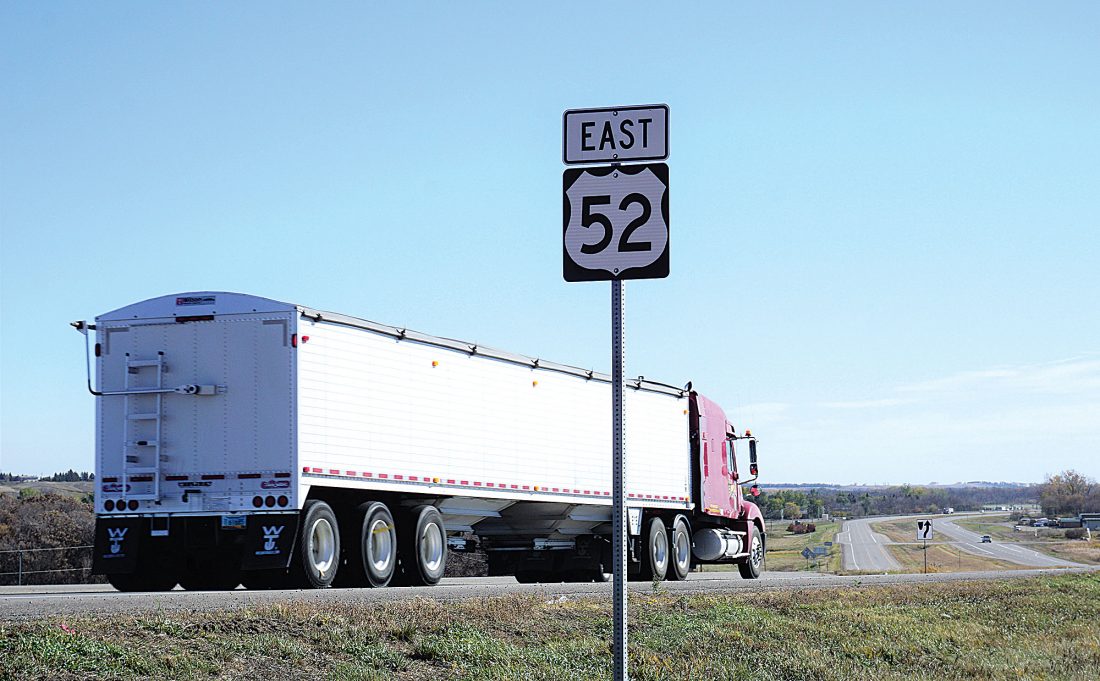
File photo A truck leaves Minot on U.S. Highway 52.
Years of campaigning for four-laning of U.S. Highway 52 by various city, county, legislative and economic development leaders never brought a major project to fruition. But as talk shifts to a Super 2 concept involving passing lanes, there’s signs a project could develop traction.
Steve Salwei, transportation programs director with the North Dakota Department of Transportation, said last month that passing lanes are being considered for a portion of the highway.
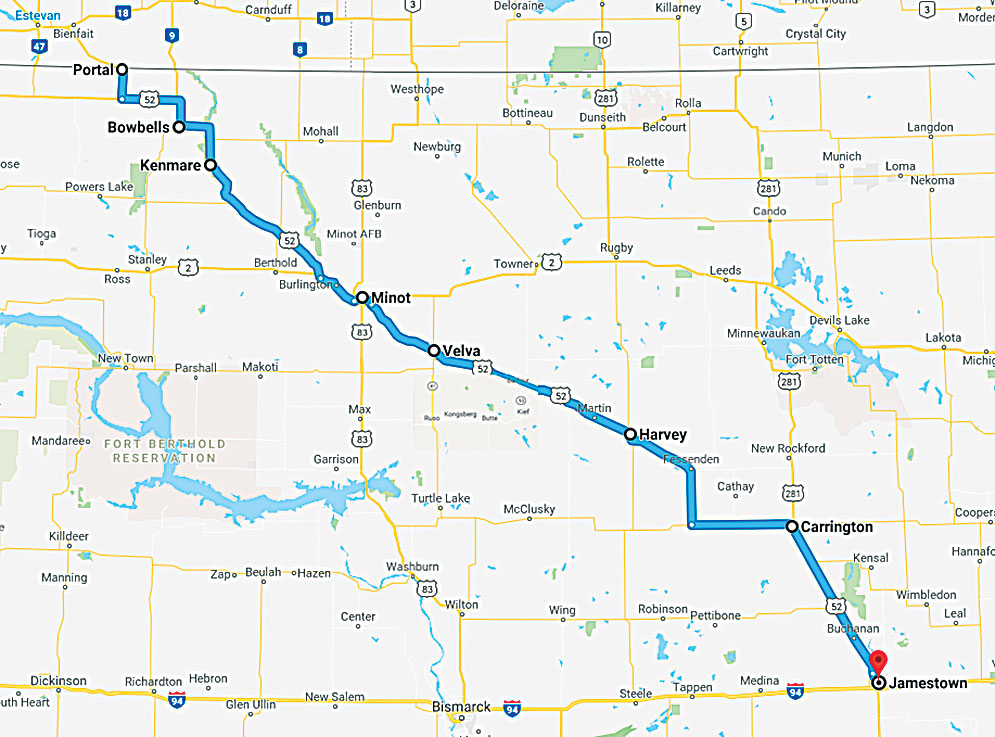
“We are currently developing a scoping report to add passing lanes on Highway 52 from the Canadian border down to U.S. 2. This is Step 1 in the process. The next step is to try and work it into a future STIP so we can identify funding for the project,” Salwei said.
STIP is the Statewide Transportation Improvement Program, which identifies the priority projects for the next four years. The state finalized the 2019-2022 STIP late last year.
A scoping report is a review that looks at existing conditions, proposed improvements and their key impacts, as well as possible costs. Depending on the findings of the report, U.S. 52 passing lanes could show up on the next 2020-2023 STIP or a future STIP. The priority of a project determines how quickly it might be programmed for funding and construction.
State Rep. Dan Ruby, R-Minot, said getting passing lanes on the state STIP is key because once on the list, U.S. 52 becomes eligible for appropriated highway funds as they become available, without a need to go looking for a funding source.
Ruby said the Legislature has resisted dictating transportation projects, preferring the Department of Transportation in cooperation with the Great Plains Transportation Institute develop those priorities.
“But I think more people would agree that it should be higher on the priority and get some attention, especially if we get more traffic,” he said of U.S. 52.
Ruby has attempted to draw legislative attention to the highway over the years. His most recent House bill regarding U.S. 52 in 2017 sought to encourage the highway department to consider a four-laning option whenever an environmental impact study is conducted for a major reconstruction project. That would have sped up the process should four-laning ever be pursued, he said. The bill did not pass.
Stephanie Hoffart, president of Minot Area Development Corp., said the extra lanes on U.S. 52 would be another advantage MADC could promote in building out its industrial park. Companies do consider transportation in selecting locations, she said.
“It surprises people,” she said of the existing highway. “People coming to the area don’t expect two lanes. They are used to seven, eight lanes.”
A two-lane road also is a disadvantage for Minot in competing with other major cities in the state, she added. Bismarck, Fargo and Grand Forks all sit at the intersection of two four-laned highways, while Minot just has U.S. Highway 2.
Hoffart and other development leaders look to what Saskatchewan is doing to improve its Provincial Highway 39, which connects with U.S. 52, as another reason to take action on this side of the border, and sooner rather than later.
“We have to make sure we are moving at the same speed,” Hoffart said. “There will be more traffic coming.”
This past summer, the Government of Saskatchewan announced construction of a series of 16 passing lanes and some short sections of twinning on Highways 6 and 39 between Regina and Estevan. Two sets of passing lanes (a set is one passing lane in each direction) were completed south of Regina this past fall at a cost of about $5.4 million in Canadian dollars, according to Doug Wakabayashi, communications and customer service director with the Ministry of Highways & Infrastructure. Remaining work is expected to be completed over the next five years.
A twinning project on Highway 39, east of Estevan, aimed at improving safety and efficiency for motorists and truckers, opened in 2018. This stretch of highway sees about 6,000 vehicles daily, according to a province news release.
Passing lanes improve safety by creating additional passing opportunities with an additional lane for a short stretch, typically one to one and a half miles. Passing lanes can result in a significant reduction in collisions and cost 85 per cent less, when compared to full twinning, the Saskatchewan ministry reported.
Wakabayashi said the ministry looks at several data sets in determining the priority of major investments such as is planned with Highways 6 and 39. Data includes safety-related information, including collision history and collision rates, and current and projected traffic volume, projected rates of population growth and measures of congestion.
A government release regarding the project noted, “Once complete, it will improve the flow of highway traffic, and reduce congestion and travel time. As a result, it will improve the movement of goods to market in Saskatchewan’s busiest trade corridor with the United States, supporting growth in mining, agriculture, and oil and gas production.”
Estevan Mayor Roy Ludwig said the trade corridor running through Saskatchewan and North Dakota would benefit immensely from improvements on the U.S. side to match the Canadian highway projects. Estevan sits along the Highway 39 route about 24 miles northwest of Portal. Initially, the province committed to twinning the 150 miles from Regina to Portal, but that’s been reduced to passing lanes between Regina and Estevan, Ludwig said.
“Which is not as much as we would have liked, but it’s an acceptable fallback for now, so it’s encouraging to hear on the U.S. side they are looking at that as well. That will help the truck traffic become more efficient over time,” Ludwig said. “We have $2 billion a day that goes back and forth between the U.S. and Canada borders. We want to foster that growth and free trade. We think that’s a positive thing between our two countries. I believe we have a great relationship between the two countries. We want to see that improved, and we want to see the free trade increased because that’s beneficial to both countries.”
North Dakota traffic counts from 2017 showed 1,140 vehicles coming and going at the border, including 575 trucks. The combination of increasing traffic and increasing technology needs resulted in the opening of a new port of entry complex in Portal in 2012.
Burke County Commissioner Allan Ryberg, Bowbells, said it had been reported last spring that about 300 trucks a day are coming across the border onto U.S. 52. In addition, there’s heavy local truck traffic from agriculture and the oil industry, he said.
The state has performed maintenance on the highway from Portal to Brooks Ranch near Burlington.
“The pavement surface is a lot better but it still needs passing lanes,” Ryberg said. He noted people continue to pass unsafely because of the lack of adequate safe zones. However, he also acknowledged potential difficulties in constructing passing lanes because of Canadian Pacific rail lines and electrical highline wires that run alongside the roadway.
Jamie Livingston, a Kenmare city council member who has been involved in economic development efforts, said highway safety is a priority.
“Our concerns are that we feel that traffic on 52 from Portal to Minot is going to pick up when Canada puts in their Super 2 system and four-laning a lot of their roads from Regina to Portal. We feel that traffic, especially semi-truck traffic, is going to increase,” he said.
Kenmare’s economy would benefit from increased traffic so rather than discourage it, Livingston said, he’d like to see safety improved and traffic encouraged. He said issues exist due to subtle hills and the amount of machinery being moved. Kenmare is an agricultural machinery hub.
“We have heard from those industries, telling us that they feel this is a dangerous highway,” Livingston said.
“It’s a hazardous road. It’s very difficult to pass,” said Brad Haugeberg, manager of CHS-SunPrairie, an ag company in Minot. “For safety purposes in today’s world, if there were passing lanes, that would be huge for that roadway.”
Improvements have been made between Minot and Velva, where a section of four-laning exists southeast of Minot, but more improvements are needed, said Randy Hauck, general manager for Verendrye Electric Cooperative, Velva. Two areas where two-mile passing lanes would be useful are before the hill between Velva and Sawyer and between Sawyer and Logan, he said.
“There’s major industry along that road,” Hauck said. “We are always going to have big trucks going down the highway so let’s make them flow better. A passing lane concept would have some merit. Obviously, four-laning would be better, but if that’s not possible, probably passing lanes is the answer.”
Known for its heavy truck traffic, U.S. 52 could conceivably attract more motorists if more favorable driving conditions could be established. Passing lanes might draw motorists who now avoid the highway for safety reasons or because passing is so difficult. That could benefit towns along the highway, Hauck said.
“If the road is good, people will drive that road. If it’s not good, they will avoid that route,” he said.
The peak U.S. 52 traffic is between Minot and Velva, with as many as 3,765 vehicles a day, including 880 trucks, in a 2017 count. That’s up more than 400 vehicles a day from 10 years earlier, according to transportation department figures. Vehicles on the road are notably higher in most places along U.S. 52, with a particular increase in trucks, traffic counts show.
Although the state is looking at passing lanes only north of Minot, Ward County Highway Engineer Dana Larsen sees a need for passing lanes south of Minot too.
“The counties definitely need to work together with the DOT to come up with a study and a plan to improve all of the Highway 52 corridor, particularly between the Canadian border and Voltaire,” Ward County Highway Engineer Dana Larsen said. “Between Minot and Voltaire could probably justify being a four-lane.”
Larsen said the section from Minot to Voltaire carries traffic as heavy as other four-laned federal highways in the state, such as U.S. Highway 83 south of Minot and many parts of U.S. 2.
Improvements from Bell School, where current four-laning ends, to Voltaire would have the most impact and safety and efficiency, he said. About 15 years ago, the state improved Highway 52 from Brooks Junction near Burlington to the north by widening the roadway and flattening the inslopes. Those same improvements weren’t made south of Bell School, where the highway continues to be narrow despite carrying much heavier traffic, he said. Guard rails compound the obstacles for motorists, and damaged guard rails are a common occurrence, he said.
Communities farther down the line also would like to see Highway 52 improvements.
Paul Gunderson, economic development director in Harvey, said Highway 52 is the dominant route through the community, making an impact both for commerce and for the local economy. Some of the surge in truck traffic has been locally generated by three agriculture equipment companies and other local businesses that truck in supplies.
“We watch an enormous amount of truck traffic go through,” Gunderson said. “What we see is a real significant need for pull-over lanes to get around trucks.”
Carrington Mayor Tom Erdmann said his community would like four-laning from Carrington to Buchanan, where existing four-lane begins and continues into Jamestown. He also would like to see turn lanes, at the very least, from Carrington to the junction with N.D. Highway 200, which is 24 miles to the west.
Erdmann said the state has acquired right of way to expand to four lanes south of Carrington, but cost has been prohibitive to do the work. Even passing lanes would help, he said. It’s not uncommon to see a string of vehicles hemmed in behind a semi-truck coming into Carrington, he said.
The construction of a roundabout at the intersection with Highway 200 in Carrington has helped alleviate bottlenecks there, he said. The state widened Highway 52 by four feet on each side two years ago and this summer widened Highway 200. Erdmann said the widening was necessary as the local elevator and pasta plant have put more trucks on the road.
Ron Hall, chairman of Central North American Trade Corridor Association, said a project on U.S. 52 is important not only for commerce but as a demonstration of the safety and quality of life issues that can be addressed through infrastructure.
“If you don’t have the infrastructure, you are not going to get anything else. It forecloses opportunities,” said Hall, of New Town and Fort Collins, Colorado.
He said more research is needed on the cost-to-benefit ratio of public infrastructure improvements to understand what this would mean to North Dakota. It’s a trade and tourism matter as well as one of jobs, he said. A safe and efficient transportation system encourages business and encourages people to choose to live in communities, he added.
“We are really interested in verifying that these investments are important and needed and that they pay off,” Hall said. “Right now, we are cheerleading and trying to connect players.”
He said the association is in dialogue with political leaders about the corridor and is working on the communication side to educate the public.
-
- File photo A truck leaves Minot on U.S. Highway 52.
Local News
International Music Camp, Army band performances set
DUNSEITH – The 70th season of the International Music Camp began Sunday, June 14, with its first session for ...

Siblings stir nostalgia with story telling

Amur tiger cubs conservation milestone for Minot zoo
Minot Baptist Church to hold VBS
Minot Baptist Church will conduct Vacation Bible School from June 22-26. The theme is “Emerald Crossing An ...
ND launches BRIDGE project to manage student information
The North Dakota Department of Public Instruction (NDDPI) has announced the statewide rollout of the BRIDGE Project ...
ND offers funding for mobile breast cancer screenings
BISMARCK – To help more women access lifesaving breast cancer screenings closer to home, North Dakota Health and ...