Runoff concerns rise
NWS flood outlook cause for concern in Souris Basin
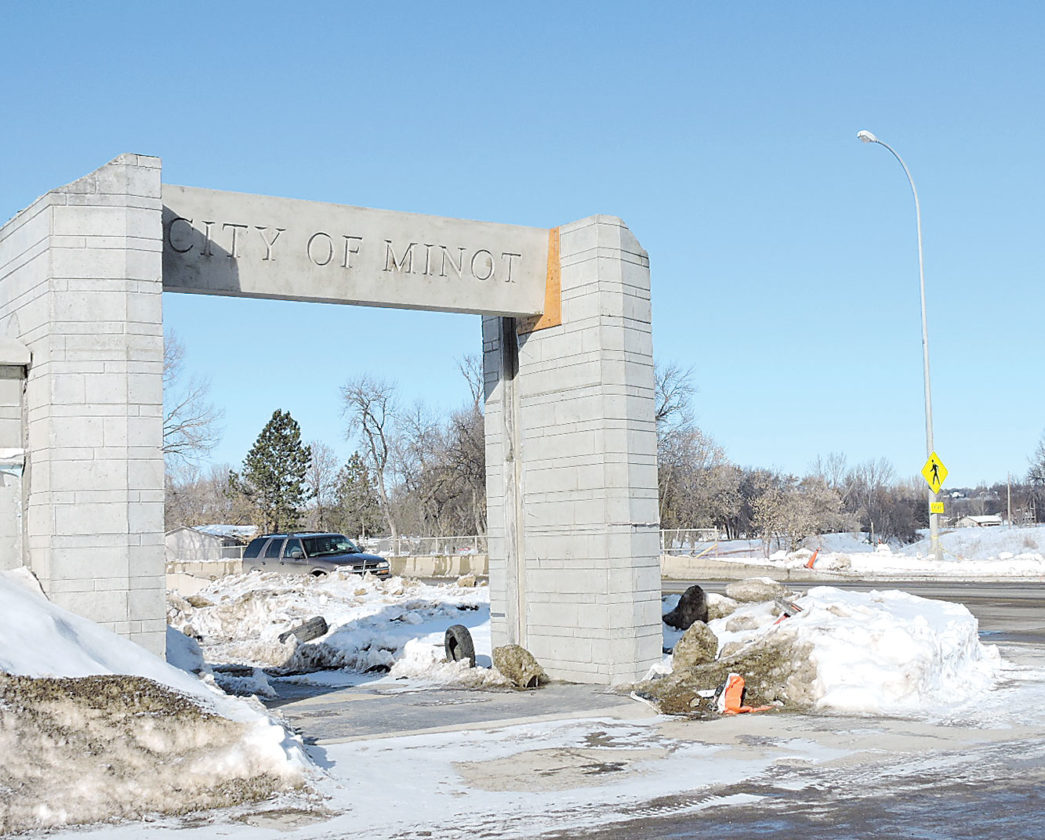
Kim Fundingsland/MDN A vehicle crosses the Souris River near Minot’s water treatment plant where a floodwall was recently completed. The National Weather Service warns that the current snowpack contains enough water to place spring flooding risk above normal.
The National Weather Service issued a Flood Potential Outlook for the Souris River Basin Friday. Among the conclusions is that there is already enough snow on the ground to place the risk of spring flooding well above normal levels, particularly downstream of Minot.
The outlook states, “all forecast sites in the Souris River Basin of North Dakota are well above normal for flood risk.”
It should be noted that the outlook has been issued far in advance of the snowmelt season and that significant changes are possible in the weeks ahead. More snow or rain could increase the flood risk while a continuation of recent weather would likely alleviate any high water concerns. Nevertheless, says Allen Schlag, NWS hydrologist in Bismarck, the amount of snow currently on the ground, and the water it contains, is significant.
“The numbers are relatively high for this early part of the season. I can’t imagine anyone warmly embracing this outlook,” said Schlag.
Schlag added that he’s seen higher numbers at this stage of the season in past years and, he estimated, half the time they decreased before the next Flood Potential Outlook was issued.
It is the lower reaches of the Souris River that have the greatest potential for flooding according to the outlook. At this time river levels are expected to remain well below the problematic stage for Minot. Minor flood stage at the Broadway Bridge is 1,551 feet. The outlook projects a 50 percent chance of the Souris rising to 1,550.2, a level that should flow through the city without any additional raising of city levees.
“By and large there should be no major problems for the city of Minot,” said Schlag.
Possible problem areas are low lying areas between Bakers Bridge and Burlington and points much farther downstream.
“Right now the melt would primarily be a rural area problem,” said Schlag. “The heaviest snowpack is downstream of Minot. There could be some pretty high water at Velva, Towner, Bantry and into Westhope.”
According to the outlook, snowcover through the Souris River drainage is not evenly distributed with “1.5 to 3 inches of water equivalent found in the areas upstream of Alameda and Rafferty reservoirs in Saskatchewan. Near the border however, the amount of water in the snowpack increases to 4 inches. Downstream of Minot the snow water equivalent is 4.5 to 5 inches.
“The Wintering River is draining some of the highest water content in the state with five and one half to six inches of water on the ground,” remarked Schlag.
The Wintering River joins the Souris near Karlsruhe. Another major tributary of the Souris, the often dry Willow Creek, is also situated in some of the heaviest snow cover in the state. Willow Creek flows into the Souris on the J. Clark Salyer National Wildlife Refuge near Upham and adds to flows heading north toward Westhope.
A major influence in the amount of snowmelt that runs off into various watersheds is the status of the ground. Snowmelt tends to rush toward a drainage over frozen ground but a great deal of snowmelt can seep into ground that is free of heavy frost. A favorable snowmelt season, one without a rapid rise in temperature over a period of several days, could also alleviate runoff concerns.
“A fair number of rapid melts in history have produced major flooding,” said Schlag. “Timing is going to be crucial along the Souris. Rain this year would produce a lot of heartaches.”
The Des Lacs River, often referred to as a “wild card” to the runoff season because of its history of sudden rises, is getting plenty of scrutiny from the NWS. However, the latest data concludes the Des Lacs will remain below minor flood stage of 1,651 feet. Right now the Des Lacs is given a 95 percent chance of reaching 1,646 feet.
“It all depends on how fast it comes off,” concluded Schlag.
Friday’s outlook reveals an early possibility of what could occur as a result of this year’s snowmelt runoff. The next outlook, which will be issued Feb. 16, is considered of even greater importance as the runoff season approaches for the Souris River Basin.
The NWS in Grand Forks, in conjunction with the North Central River Forecast Center in Chanhassen, Minnesota, issued their latest Spring Flood Outlook Friday for eastern North Dakota. Most notable was the the NWS stated, “The threat for significant, impactful, snowmelt flooding is very high for the Devils Lake Basin.”
According to the NWS, a high winter snowpack has primed the state for near record runoff into Devils Lake. Projections are that Devils Lake and Stump Lake could rise up to 4 feet more than current levels. Snow water equivalent in the snowpack over the Devils Lake drainage ranges from 3.5 to 4.5 inches.
At this time the Red River is expected to remain within its channel and not cause any major problems with the exception of northeast North Dakota where Oslo, Drayton and Pembina could be threatened with high water. Other river locations placed at risk of major flooding are the Park River at Grafton and the Pembina River at Neche.
Local News

Time capsule, sculpture highlight pioneer reunion
Defendant in Spirit Lake shooting pleads guilty
A Fort Totten man has pleaded guilty to two separate counts of assault and voluntary manslaughter in U.S. District ...

Moen Family musicians return to Frozen Fingers Festival
Accommodating growth

Discovery well anniversary