
America at 250: Age of innovation still influences nation
Trending
The way we build things, the way we travel, the way we protect ourselves, the way we are able to save and extend lives and the way we explore could not have happened without the efforts of some of the great American innovators of the 20th century.
From Henry Ford, who helped to make Detroit and the United States the center of the automobile business, to groundbreaking work in medicine that has transformed our lives to the courage of the men and women who were willing to travel into space, American ideas have truly changed the world.
When Ford, for example, created the first moving assembly line in 1913 in the Detroit suburb of Dearborn, Michigan, he not only changed the way automobiles were manufactured -- he set the stage for the mass production that would help supply America’s troops through two world wars and fuel the country’s booming economy.
“The assembly line process revolutionized the manufacture of cars themselves, allowing them to be made in much greater quantities in a shorter period of time,” said Matt Anderson, curator of transportation at the Henry Ford Museum of American Innovation in Dearborn. “But the bigger impact is because of the process, the price of an automobile fell so dramatically that really anyone, even within the working class, was able to afford a car, and it transformed the automobile from what had been a plaything for the wealthy to a tool for everyday life, which, for better or worse, it remains today.”
In 1908, for example, the price of a Model T was $850, which is the equivalent of about $31,000 today. By 1914, the price had dropped to $490 and in 1924 it was around $300. While it once took workers 12 hours to produce a completed car, Ford would be able to eventually turn out an automobile every 24 seconds.
Even though the assembly line made production of Ford’s cars more efficient, it did come with its own set of issues.
“One of the first problems with it is they realized the workers tended to resent the system or just not care for it because, prior to that, they had been very skilled craftspeople who were doing highly complex work,” Anderson said. “The whole point of the moving assembly line was to take all of the skill out of the work, so a person is just tightening a nut or inserting a screw.
“So, workers began calling in sick and absenteeism was a problem. They would just outright quit,” he continued. “Ford determined that the best way to retain his workers was to just pay them more. So, he more or less doubled the wage from $2.30 a day to $5 a day in 1914, which had the sort of happy side effect for Ford of allowing his workers to now be able to purchase the product they were making. You couldn’t say that Ford created the whole middle class, but certainly that wage increase was a bedrock reason for the growth of the middle class in the 20th century.”
Another drawback at the time is that Ford’s process required the Model T to remain static. There were no major design changes in that automobile through the end of its production in 1927. That was an issue, Anderson said, because Americans were moving beyond price and wanted additional features in their cars -- more horsepower, more comfort and more room.
And that allowed General Motors and Chrysler to step in and increase their sales.
It all led to Ford revamping the process to make it more flexible and to allow for design changes.
That ability to produce things in great quantity made the process valuable during World Wars I and II, Anderson said. It allowed the production of everything from mess kits to helmets, from Jeeps to armored cars -- even the famous B-24 bombers that Ford built at its Willow Run facility.
Having the ability to see gains in productivity while reducing costs, the moving assembly line was quickly adopted by other industries.
“All of this played into the great economic boom times of the 1920s, when people had easy credit,” Anderson said. “They could buy appliances, they could buy radios and other sorts of home entertainment devices that had been luxuries a few years before. All of those things were being built using assembly lines. By the end of the decade, airplanes were being built using mass production techniques, by the Ford Motor Co. in some cases.
“All of that played together in the great boom of the 1920s, which didn’t last, of course, because of the crash of 1929 and the Depression that followed,” he added.
While Ford and other business owners of the time were bringing about massive change in the country, others were looking to transform the way we take care of ourselves.
“There was a recognition by the University of Pittsburgh Medical Center as early as the 1920s and 1930s that medicine was a potential new industry for the city of Pittsburgh,” said Anne Madarasz, chief historian at the Senator John Heinz History Center in Pittsburgh. “So, really, the regional economy was transformed by medical innovation.”
Some of that would come through the work of Drs. Jonas Salk and Thomas Starzl.
Salk’s development of the polio vaccine would lead to the eradication of the disease that had frightened parents across many generations, while Starzl’s pioneering work with liver transplants has improved the lives of thousands.
“We can’t begin to imagine the fear that people felt, especially in the 1950s,” Madarasz said. “From the beginning of the March of Dimes, there’s this national effort to eradicate polio in the sense of not knowing what caused this and not knowing how to stop it. The vulnerability that people felt -- especially for children -- is hard to imagine,” she added.
Salk and his team developed a way to use a dead virus in the vaccine, which helped the body to build immunity to the disease.
“When you look at Salk and the way his research was handled, it wasn’t just Salk,” Madarasz added. “It was a team of people, and the population of the whole city of Pittsburgh that were willing to step forward as the testers of the vaccine. They were the polio pioneers, and that work allowed us to see the eradication of polio in our lifetime.”
Starzl, meanwhile, performed the first human liver transplant in 1961 at the University of Colorado. After arriving at the University of Pittsburgh in 1981, his work with immunosuppressive drug therapies helped make liver transplants mainstream lifesaving procedures.
“It’s a procedure that has impacted medicine in a variety of disciplines,” Madarasz added. “Starzl was just not an incredibly talented person. He was a true visionary, a mentor and a teacher. Still today, he is one of the most published researchers in medical history.”
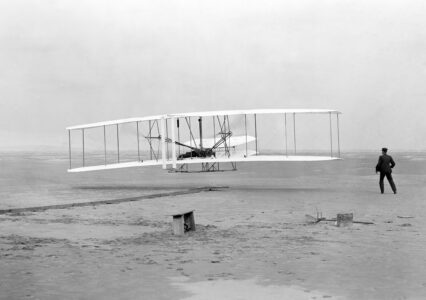
Orville and Wilbur Wright invented, built and flew the first motorized airplane, not in their home state, but on the sand in Kitty Hawk, N.C. Eddie Rickenbacker, a Columbus, Ohio, native, recorded 26 aerial victories during World War I, the most of any pilot in that war, and received the Medal of Honor.
“Ohio has a rich aviation history,” said Logan P. Rex, curator and communications director of the Armstrong Air and Space Museum in Armstrong’s hometown.
Rex pointed to Neil Armstrong, the first to walk on the moon; John Glenn, the first to orbit the Earth; Jim Lovell, the command module pilot on Apollo 8 and commander of the Apollo 13 mission; and Suni Williams, who was the first person to run a marathon in space and was the first woman to fly on a flight test of an orbital spacecraft, the Boeing Starliner, as examples.
“That’s another thing about Armstrong,” he added. “People would say he was very quiet or reserved about being the first man to walk on the moon. It really wasn’t that -- it was the fact that he understood that the world did not come together to put Neil Armstrong on the moon. The world came together to put a person on the moon, and he just happened to be that person.”
Collaboration is critical to success in the space program going forward, he added.
“He thought, even with this museum, that having his name and solely his name on it was a disservice to the hundreds of thousands of people who did their job just as well as he did his. Anytime they talked about this mission, he wanted to emphasize the importance of this being a global effort that was an American effort,” Rex continued. “People had to come together, and it wasn’t just him. I think that’s really important looking forward, especially for the future missions -- that if we want to accomplish great things, we have to work together.”