
Friluftsliv: Western Meadowlark: Our endangered state bird
Trending
To loosely translate from Norwegian to English:
fri = free, lufts = air's, liv = life
The English equivalent= Outdoor Life
On Saturday, June 22, 1805, Meriwether Lewis recorded a journal entry near Great Falls, Montana, while proceeding west with William Clark and members of the Corps of Discovery.
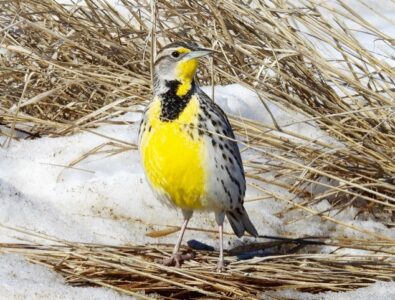
Lewis wrote, that day, of a bird with a song similar to one from his home state of Virginia. His was the first official description of that bird when he wrote: "...there is a kind of larke here that much resembles the bird called the oldfield lark with a yellow brest and a black spot on the croop; tho' this differs from ours in the form of the tail which is pointed, being formed of feathers of unequal length; the beak is somewhat longer and more curved and the note differs considerably; however in size, action, and colours there is no perceptable difference; or at least none that strikes my eye." (Moulton, Gary E., "The Journals of the Lewis & Clark Expedition, Volume 4," 1987, University 1 of Nebraska Press, page 325-326)
The bird that Lewis described that morning was the Western Meadowlark. The bird that he was comparing it to was the Eastern Meadowlark, the bird from his boyhood.
Lewis was correct in his observation that the tail feathers of the Western and Eastern Meadowlarks are slightly different. Their songs and beaks, however, are very similar. Neither of them, though, are actually larks. They belong to the genus "Sturnella." A true lark found in North Dakota is the Horned Lark.
The Western Meadowlark, Sturnella neglecta, is the state bird of not only North Dakota, but also Montana, Kansas, Nebraska, Oregon and Wyoming. The Eastern Meadowlark, Sturnella magna, doesn't have the designation of being a state bird.
The population of the Western Meadowlark, according to the American Bird Conservancy, is 90 million and decreasing due to the destruction of its nesting habitat, that of the prairies, pastures and abandoned fields. It is common, in my conversations with fellow North Dakotans, to lament the scarcity of our state bird. Many people have reported seeing few or no Western Meadowlarks in recent years.
One of my usual destinations for bird watching is the McKenzie Slough Wildlife Management Area fifteen miles east of Bismarck. I made a trip to McKenzie on Sunday morning, April 2, 2023, hoping to catch the spring migration of bald eagles. No eagles were to be seen but, much to my great delight, the Western Meadowlarks were in great abundance. I estimated there to be in excess of one hundred Western Meadowlarks that morning feeding in the roadside ditches. They are very skittish this time of year and hard to photograph, but the great number of them allowed me to capture a few images. An added bonus was the appearance of a few Horned Larks, the true member of the lark family.
Earlier in the Lewis and Clark expedition, Meriwether Lewis wrote: "As we passed on it seemed as if those seens of visionary inchantment would never have an end." (Ibid, p. 226)
He was describing the geology of the area they were passing through but I had the same feeling of "inchantment" that morning as I viewed our state bird in numbers that I thought not possible. In spite of spring snow storms, the birding season has begun in North Dakota. Get out to the prairies and potholes and see for yourself the wide variety of avian friends we have in our state.
Doug Wurtz grew up near Ryder and graduated from Minot State University. His retirement activities include nature photography as well as serving as a Certified Interpretive Guide for the State Historical Society of North Dakota. He is past president of the North Dakota Archaeological Association. Doug and his wife, Linda, live in Bismarck.