
Construction brings flood protection closer
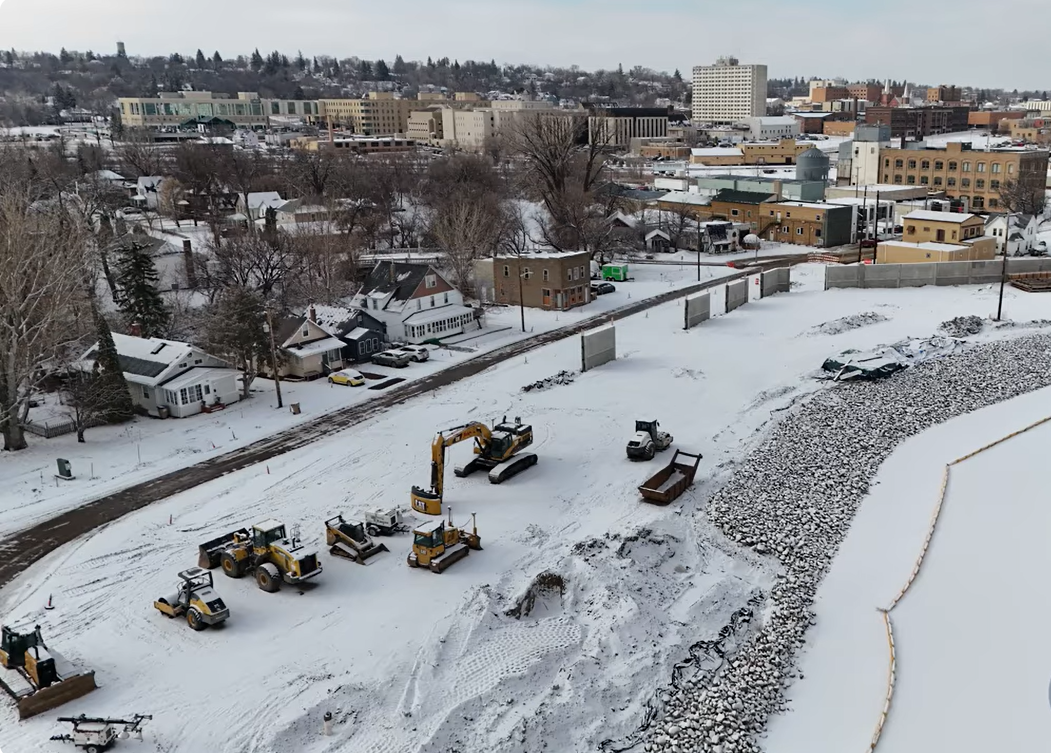
Submitted Photo Heavy equipment shown earlier this month awaits spring weather to continue work on segments of the flood protection project. Work in progress runs from Third Street East in downtown Minot through Roosevelt Park Zoo. Photo from Mouse River Plan.
Although removal from the federal flood plain remains some years away for many valley residents, design work and construction on the Mouse River Enhanced Flood Protection continue to move that day closer.
Ryan Ackerman, administrator for the Souris River Joint Board, provided an update on the project to the Ward County Commission Tuesday, March 17.
Ackerman said three phases of the flood project are in active construction:
– MI-5, which runs on north side of the BNSF railroad tracks from Third Street East to near the Xcel Energy substation, is substantially complete and will be wrapped up in the spring.
– MI-6, which starts at Third Street and continues east to Roosevelt Park near the pool, has started, and another portion will be bid in early summer that will start at Third Street and continue west toward Main Street. Ongoing negotiations with BNSF have been the critical factor in moving that western portion forward, Ackerman said, but agreements are close to being finalized.
– MI-7, within Roosevelt Park, is about nine months ahead of schedule due to good construction weather. Flood wall construction essentially finished late last fall. Finishing touches that remain include floodwall staining and landscape restoration.
Ackerman said this coming construction season will see a lot of activity within Roosevelt Park and Zoo. Several zoo exhibits that were demolished to make room for the flood wall will be reconstructed.
Regarding MI-4, the Maple Diversion, federal and local funding is lined up and state funds could come in the next legislative session, Ackerman said. The completion of the Maple Diversion is key to removing 60% of the city of Minot from the flood plain, which has implications for residents’ flood insurance requirements and bills.
“It’s going to take a long time to put that particular phase of the project together,” Ackerman said. “We’re estimating it’s probably going to be five construction seasons to make that happen. We do think that the potential exists to start construction of that at some point late this year. The initial phases that you’ll see under construction are going to be related to the railroad, in particular, relocating the CPKC Railroad onto a temporary alignment, called a shoofly, that would allow us to build the new railroad bridge, which is going to be on, basically, where the tracks sit today.”
On the heels of that work, it is anticipated the U.S. Army Corps of Engineers will issue several contracts to complete the river closure structures associated with the diversion, he said.
Maple Diversion will require sequencing, so work on the river closure structures won’t begin until after the railroad work, he added. Construction of the large diversion ditch would then follow.
In response to commission questions about fast-tracking removal of properties from the flood plain once the 60% milestone is achieved, Ackerman said the process with the Federal Emergency Management Agency must follow certain steps.
He said FEMA has provided a conditional letter of map revision, based on the intent with the flood protection plan.
“However, to give an actual map change that has impacts to our residents from an insurance perspective, that will not happen until after construction is complete and after the system is, basically, fully certified,” Ackerman said. He estimated construction completion in 2032, with map revisions possibly in 2033.
Maple Division is estimated at about $100 million, of which $60.5 million is promised from the federal government. The remainder typically would be split with the state taking on 65% and Minot’s sales tax 35%.
Ackerman said the state Legislature adjusted its approach to large water projects, making its Water Topics Overview Committee the appropriations gatekeeper. That committee will begin taking a look at water projects in the state in the next couple of weeks, he said.
In another significant move, the SRJB in January adopted an update to its master plan.
“This was basically a relook at the entire plan in an attempt to come up with a more efficient plan – try to save some money on the capital side of things. So, we were able to identify probably in excess of $100 million in capital cost savings, and the board adopted those changes,” Ackerman said. “With those changes, we approached the Department of Water Resources and the State Water Commission with our updated plan, and that coincided also with our funding request. The Legislature appropriated $81 million in the last legislative session for flood control activities in the Mouse River Basin, and the State Water Commission then allocated those funds to the joint board in its February meeting. So, those contracts are now in place.”
Of the $81 million, about $15 million is allocated for property acquisitions within Minot. The remainder will go to acquisition and construction outside of Minot, as well as project design, Ackerman said.
Starting this spring, additional phases within Ward County will advance to the design stage. These areas include Brooks Addition, Robinwood, Country Club Acres, Kings Court, Apple Grove, Chaparelle and East Side Estates, the city of Sawyer and decommissioning of the Talbott’s levee.
Ackerman said properties will need to be acquired for these subdivisions between Minot and Burlington and on Minot’s east side. The properties needed for the project will be verified in the plan design.
A public meeting on a proposed bridge replacement in Velva also is scheduled for Thursday, March 19, at 6:30 p.m. in Velva City Hall.
Ackerman said constructing a bridge at a higher elevation will alleviate a river bottleneck. He said plans are to build the bridge one lane at a time to allow emergency vehicles and other essential traffic to continue using it during construction.
As far as other flood project phases in Minot, MI-8 is at about 90% design completion, Ackerman said. Construction on MI-8 and MI-9 on Minot’s east side is expected within the next couple of years, he said, noting that funding still must be obtained.
Local News
American Indian College Fund honors scholars
DENVER — The American Indian College Fund held a ceremony on Sunday, March 15, in Bismarck. to honor the 2025-26 ...

Fuel for force
NDSU Extension to offer spring gardening webinars
Spring is just around the corner, and North Dakota State University Extension looks to help prepare gardeners for ...
Construction brings flood protection closer
Council proposes to restrict alcohol permits
Adjustments were made in the City of Minot’s alcohol ordinance draft and plans for a temporary animal pound at ...
Suicide prevention workshop equips faith communities
INSPIRITUS Community Health Foundation has teamed up with the N.D. Chapter of American Foundation for Suicide ...