
City, county councils discuss library, zoning concerns
Committee to look at library duplication
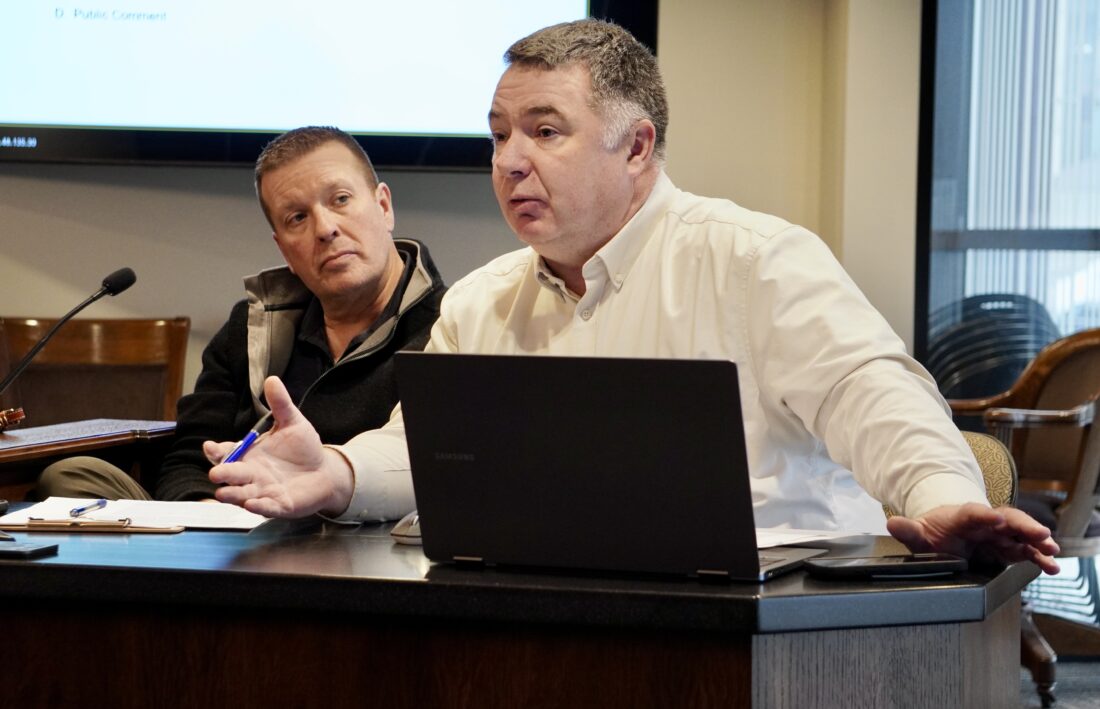
Jill Schramm/MDN Minot City Council member Mike Blessum speaks at the council’s joint meeting with the Ward County Commission in commission chambers Tuesday, Jan. 6, as council member Rob Fuller listens at left.
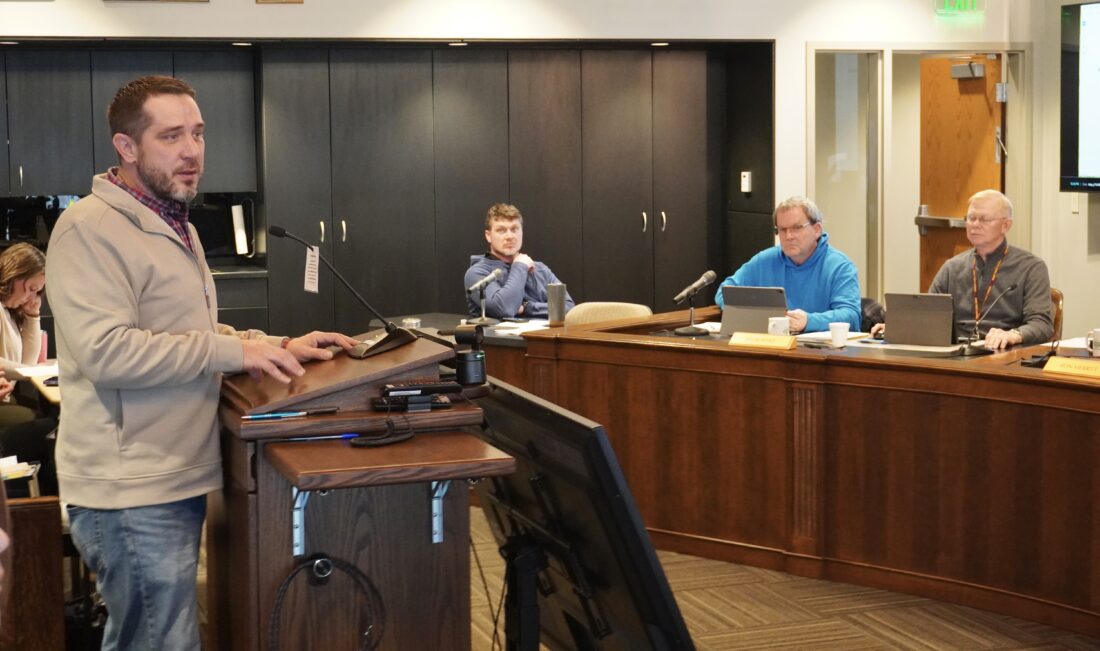
Jill Schramm/MDN Minot Principal Planner Doug Diedrichsen talks about extraterritorial zoning with Minot City Council and Ward County Commission members Tuesday, Jan. 6. From left are city council members Paul Pitner and Scott Samuelson.
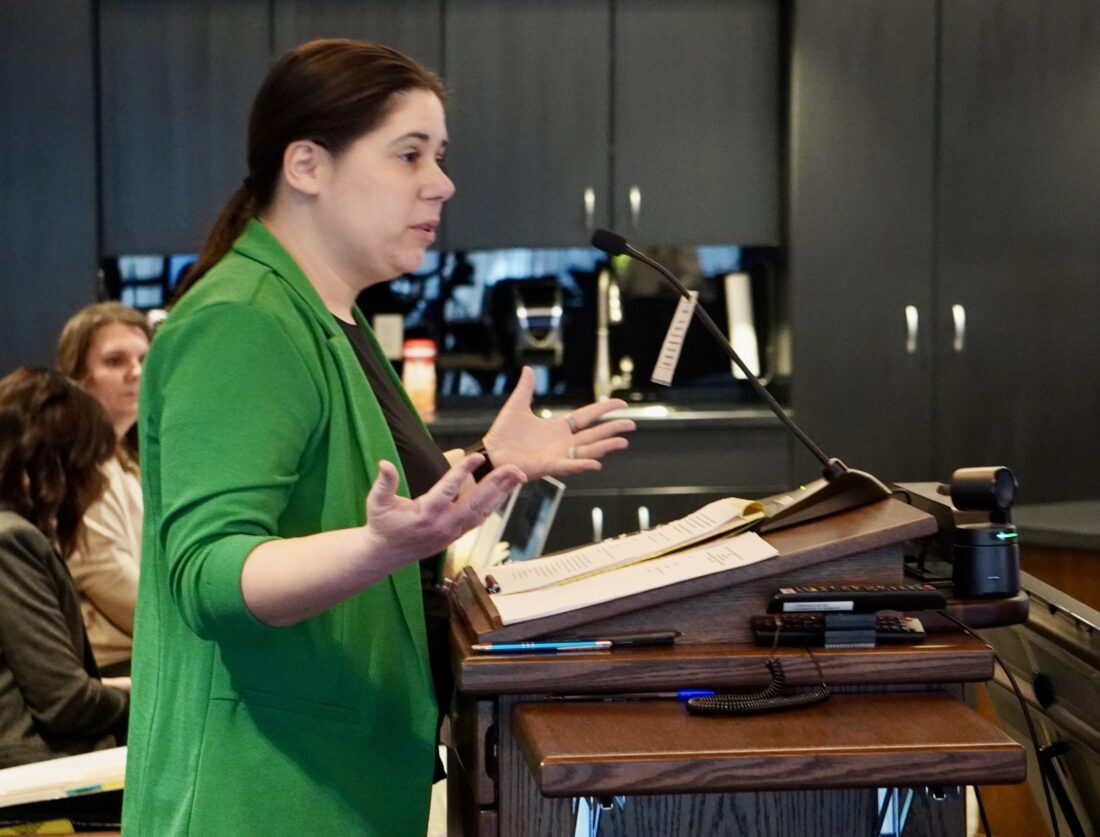
Jill Schramm/MDN Ward County Library Director Kerrianne Boetcher addresses a joint meeting of the Minot City Council and Ward County Commission Tuesday, Jan. 6.
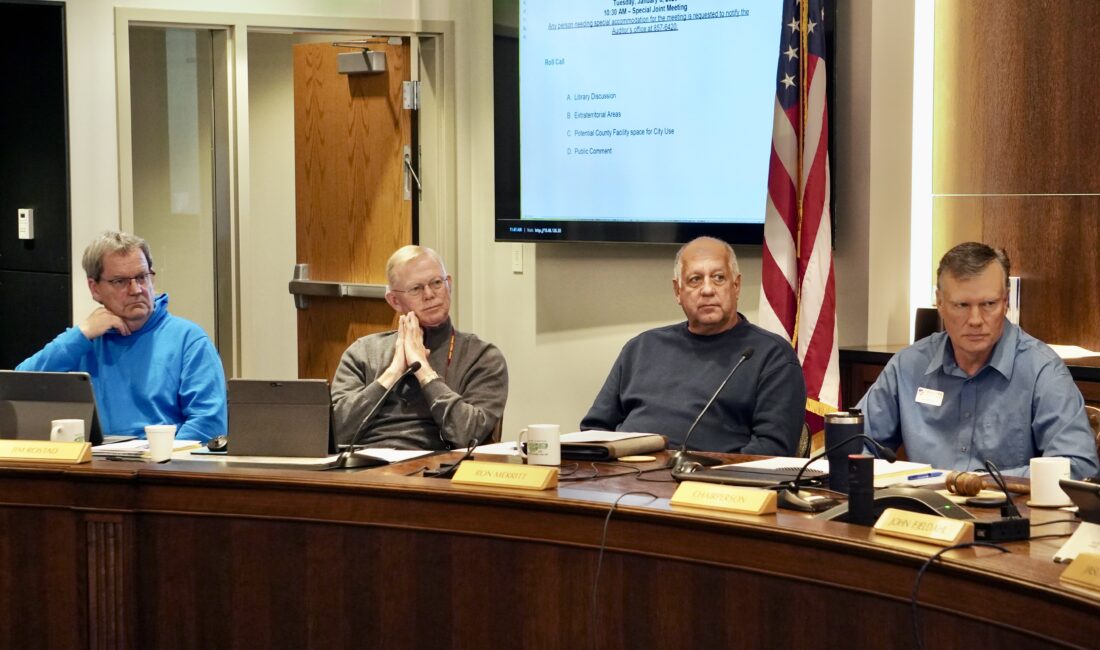
Jill Schramm/MDN Minot City Council member Scott Samuelson, left, Ward County Commissioner Jim Rostad, council member Mike Hayes and commissioner Ron Merritt listen to discussion at a joint city and county meeting Tuesday, Jan. 6, in county commission chambers.
Jill Schramm/MDN Minot City Council member Mike Blessum speaks at the council’s joint meeting with the Ward County Commission in commission chambers Tuesday, Jan. 6, as council member Rob Fuller listens at left.
Jill Schramm/MDN Minot Principal Planner Doug Diedrichsen talks about extraterritorial zoning with Minot City Council and Ward County Commission members Tuesday, Jan. 6. From left are city council members Paul Pitner and Scott Samuelson.
Jill Schramm/MDN Ward County Library Director Kerrianne Boetcher addresses a joint meeting of the Minot City Council and Ward County Commission Tuesday, Jan. 6.
Jill Schramm/MDN Minot City Council member Scott Samuelson, left, Ward County Commissioner Jim Rostad, council member Mike Hayes and commissioner Ron Merritt listen to discussion at a joint city and county meeting Tuesday, Jan. 6, in county commission chambers.
Trending
Ways to reduce library duplication again will be studied in Minot.
During a joint meeting Tuesday, Jan. 6, the Ward County Commission and Minot City Council agreed to form a committee to take another look at consolidation within their individual libraries. Additionally, the county commission narrowly rejected a proposed committee to study zoning in Minot's two-mile extraterritorial zone, although the city will be taking a closer look at a couple of concerns raised by the county.
On the library topic, Ward County Library Director Kerrianne Boetcher recalled that library mergers have been discussed at least six times since 1998, most recently in 2018. She said the two libraries haven't recently talked about merging.
"There's not space in either building," she said of merging and co-locating. "We would definitely need a space needs analysis done to decide if it's even possible to merge. More than likely, it would require a new building or keeping both locations."
City council member Lisa Olson, who chaired the 2018 committee, suggested the city and county step back at this time.
"If the library boards want to initiate this discussion, I think that it should be in their court," she said.
However, council member Mike Blessum said the governing bodies that provide the funding have a place in the discussion.
"We are the stewards of the people's tax funds. If we come to a conclusion that it's the right approach to combine and make this work in a better, more cost effective way, I believe that is our role," he said.
"I would like us to, at least, look at this one more time," county commissioner Ron Merritt added, noting he has had residents ask him about the duplication. "At the end of the discussion, if it makes sense to just leave it alone, let's leave it alone. I don't have an agenda one way or another, but it came up enough times that I owe it to the people that asked the question to give them an answer."
The council members and commissioners each voted separately with their boards to form a committee of two council members, two commissioners, a member of each library board and an at-large member selected by the mayor and commission chairman. Only Lisa Olson voted in dissent. The committee must return with a final report within six months, allowing time for a November ballot measure for a merger if that is the committee's recommendation.
Extraterritorial zone gets scrutiny
On the topic of the extraterritorial zone, Commission Chairman John Fjeldahl noted his concerns over city and county discrepancies in zoning and permit fees and right of way acquisition policies.. Fjeldahl said the county is looking to purchase right of way from some residents for a County Road 17 widening project, while other residents in the area who previously platted their properties with the city had been required to donate their right of way for future projects.
He also said he has concerns about governance without representation in the extraterritorial zone and "people feeling alienated by a government they can't elect."
Other concerns raised at the meeting related to the existence of exterritorial designations in areas the city is unlikely to grow into in the foreseeable future and the dilemma created with the need for county enforcement of city zoning in extraterritorial areas.
Doug Diedrichsen, Minot's principal planner, pointed out the extraterritorial zone is exempt from much of the city's zoning ordinance but there are some rules the city imposes for future planning as the city grows into those areas. The Minot Planning Commission, which largely makes recommendations to the council, includes three residents of the extraterritorial zone, appointed by the county commission.
Diedrichsen noted the 2-mile extraterritorial area around the city isn't adjusted whenever annexations occur because the process is so staff intensive. That creates differences around the city on where those exterritorial boundaries lie.
Diedrichsen said boundary changes generally are made when updating comprehensive plans, which occurs about every 10 years. The city's current comprehensive plan was adopted in 2021.
"If I were to make a recommendation, I would say let's do this during our next comprehensive plan rewrite, when we have budgeted to bring in the consultants that do those types of things, and they collect the data. They do proper public outreach," he said. "They have software and ways of getting the hard numbers that could actually show us where our growth patterns are."
Council member Paul Pitner moved to direct city staff to produce a city zoning fee schedule for the extraterritorial area that aligns with county fees for council consideration. He also proposed staff bring an action plan on right of way policy so the council can consider whether to require donation or make purchases. The council voted unanimously to accept both motions.
However, Blessum pushed for policymakers to get more involved, proposing a study committee of the county and city.
"We need to look at this because we need to get this right for people," Blessum said. "If we want policy to be driven, it must be driven by this group, not by city staff."
There also was interest in having the study committee discuss potential creation of a separate planning commission for the extraterritorial zone, which would entail a new board, comprehensive plan and zoning ordinances.
Lisa Olson said the city should address issues with the fees and right of way policy to see if this resolves issues before looking at more changes.
"I just think forming committee after committee after committee is not useful for people's time and efficiency," she said.
Pitner unsuccessfully sought to table the committee motion. The council then voted unanimously to establish a committee with an April 30 deadline to finish its work.
However, county commissioners Miranda Schuler and Jim Rostad agreed with Olson regarding waiting on the council's action on fees and right of way policy.
"We're putting too much in play here, and we just need to get some time to marinate, work through the motions that have been put through. It doesn't mean that we can't do this in the future, but I feel like we're just doing something to do something," Schuler said.
Merritt said there are issues other than fees and right of way that should be reviewed, such as whether 2-mile jurisdiction is needed around the entire city. Fjeldahl also advocated for a committee that would continue to give the county a voice in the extraterritorial discussion.
The county rejected the committee proposal 2-3, with Schuler, Rostad and Jason Olson voting against. The commission's decision not to participate in a committee negated the city's approval.
Pitner moved the council direct staff to make recommendations by April 30 on boundary adjustments in the extraterritorial area, which council members approved.
Pitner added the council is open to meeting with commissioners at any time if issues related to the extraterritorial zone arise.
"If there's concerns, I think we have another one of these meetings, and we deal with those issues case by case," he said. "I just want you to know the city is open to listening to concerns and acting on those."
City use of county space
Also at the joint meeting, council members and commissioners discussed potential space in the county administration building for municipal court. The two entities had discussions previously that fizzled when projected rent came up.
The decision was made to revive the conversation, particularly since the Human Service Zone has vacated space on the fourth floor that now could be considered. City staff were directed to engage in discussions with county staff and connect with the county's Realtor to develop options to bring to the boards.
"As far as the price, I'm more than willing to hear an offer and see what we can do," Rostad said, noting Minot accounts for 68% of Ward County's population. "These are our people - the vast majority- and so we want to provide a service."