
SBPC seeks to keep momentum going
Trending
Souris Basin Planning Council takes an all-encompassing view when it looks at delivering programs over its seven-county region.
SBPC Executive Director Briselda Hernandez said the approach with all programs is to ensure they are accessible and benefit the entire region.
"It's important for us to also look at 'How are we impacting the region? How are we impacting the surrounding community?' So we've been very grateful that the City of Minot through the MAGIC Fund has supported our regionwide programs, such as the Business Accelerator Fund," Hernandez said.
She added the Minot Area Chamber EDC has encouraged SBPC to promote its entrepreneurial Start Up Minot program to the rural communities to benefit small business start-ups.
Minot knows firsthand the benefits that rural communities provide, she said.
"And on the other side, with our rural communities, I think there's also a greater appreciation of what Minot does and can do for their communities," she said. "It really comes from both ends - that appreciation, acknowledgement. We as a regional council are using that momentum to not only continue and expand the programs that we have but also create new ones to help fill in the gaps that exist in our region."
SBPC offers two key initiatives - business financing and a Community Builder program that works with nonprofit and public organizations.
SBPC launched Community Builder in 2019 and it since has been adopted by the state's seven other regional councils. The COVID-19 pandemic slowed efforts, but SBPC's program since inception has provided 38 host sites with AmeriCorps members, who have logged 31,520 hours on projects for local organizations.
"We're helping build the capacity of these organizations that are essential to our region," Hernandez said. "It isn't to have them have an AmeriCorps member forever. It's really to build sustainability, get them to a point where they no longer have a need for AmeriCorps resources."
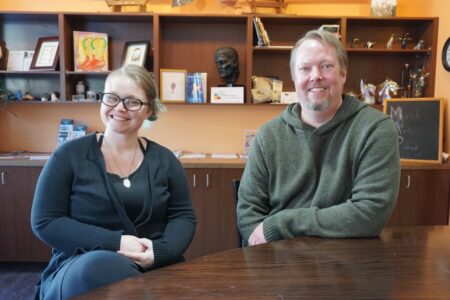
Justin Anderson, executive director for Minot Area Council of the Arts, said he watched the organization and its programming grow during his 3-½ years as the only staff person, but it grew beyond his ability to continue to manage. It became essential to bring in more staff or lose some programming.
The Community Builder program made hiring feasible.
"The great part about the program is that it allows a small nonprofit like us to take on an additional staff member without having the full expense," Anderson said. MACA pays a portion of the AmeriCorps costs to SBPC, which handles the payroll paperwork.
"It gave us that flexibility and freedom to, essentially, give it a shot," Anderson said.
Chandell Lattin had a 12-year career in medical billing and practice administration but was ready for a change when she saw MACA's opening for an AmeriCorps member.
"I wanted to do something I was passionate about," said Lattin, an artist and writer who joined MACA's staff through AmeriCorps in May 2022.
"Also, I've moved around a lot, and community is really important to me," Lattin said. "It's really given me an opportunity to really jump into the community, get to know people and to feel like I'm involved in things that are happening."
Lattin and Anderson said the AmeriCorps position developed into a role neither of them expected, but the result has been positive. Anderson said he and Lattin have been able to work together as a team, enabling programming not only to continue but keep pace with additional activity, such as the increasing rental use of the Carnegie Center.
"I can't imagine going back to just me at this point," Anderson said. "It's done exactly what we wanted it to do, which was give us the opportunity to find out what it looks like to have another staff person involved with the organization and then allow us to see that this is something that is going to be useful. Not only that but, at this point, necessary."
MACA is looking ahead to prepare to eventually take on the full cost of the staff position.
"We have to have the donations and grants in order to keep that going. We'll get there eventually because we've seen what it does to have somebody else here to help," Anderson said. "There's no turning back at this point."
The other side of SBPC's mission is business financing that centers on small businesses.
A grant from the U.S. Economic Development Administration had allowed for the creation of a revolving loan fund for the region. MAGIC Fund support for the newer Business Accelerator Fund enables the region to have a source of matching funds for the state PACE program.
"There is a gap in financing that's available to our small businesses, specifically in our rural communities," Hernandez said. "As a regional council, we take that responsibility to provide that key financing that's needed for these small businesses."
SBPC works with local development corporations to fill in gaps left by local programs.
"We value partnerships. We want that collaboration with everything that we do," Hernandez said. "With small business financing, specifically, we try to tap into the different resources that exist, whether it's a local resource, regional or state resource, to just give them the best option for their small business."
Minot, because it is the largest community in the region, still accounts for 82% of the business funding, or 27 of the 33 businesses aided through SBPC between 2019 and 2022. Nearly 500 jobs were created or retained by businesses that received financing, according to SBPC.
Hernandez noted the statistics don't include the technical assistance provided to businesses by SBPC, which is particularly utilized in rural areas that don't have the same kind of resources as exist in Minot.
SBPC also provides economic data dashboards on its website that any organization or stakeholder can access for decision-making, writing grants or developing programs. It also has a regional resource directory on its website.
Looking ahead, SBPC wants to increase its outreach to the business community and its lending capacity to assist them, Hernandez said.
"We're always striving to improve economic or regional economic progress. And for this year, we're focusing on trying to accomplish that through technical assistance and strategic planning," she said.
Last year, SBPC worked with New Town to write a strategic plan and it is working with Mountrail County Job Development Authority to update its strategic plan. SBPC administers a grant and loan program that it helped Mountrail County JDA develop and launch in 2021.
"We want to continue that and expand upon that. If their new strategic plan highlights a greater need, we want to work with them to see if we can help meet that need or connect them to the right entities or resources to fulfill their goals," Hernandez said.
In addition to strengthening its own internal capacity, having experienced a recent leadership change when Hernandez became director, SBPC is undergoing its own strategic planning process this year. It will be holding community meetings in each county. Hernandez said the process will continue over the next few years.
A final goal is to improve regional connectivity and build consensus, she said.
"There has been such a great momentum in understanding and valuing the concept of approaching issues or needs as a region versus as individual communities. We want to continue that momentum," she said.