First Response Air brings lifesaving care to rural ND
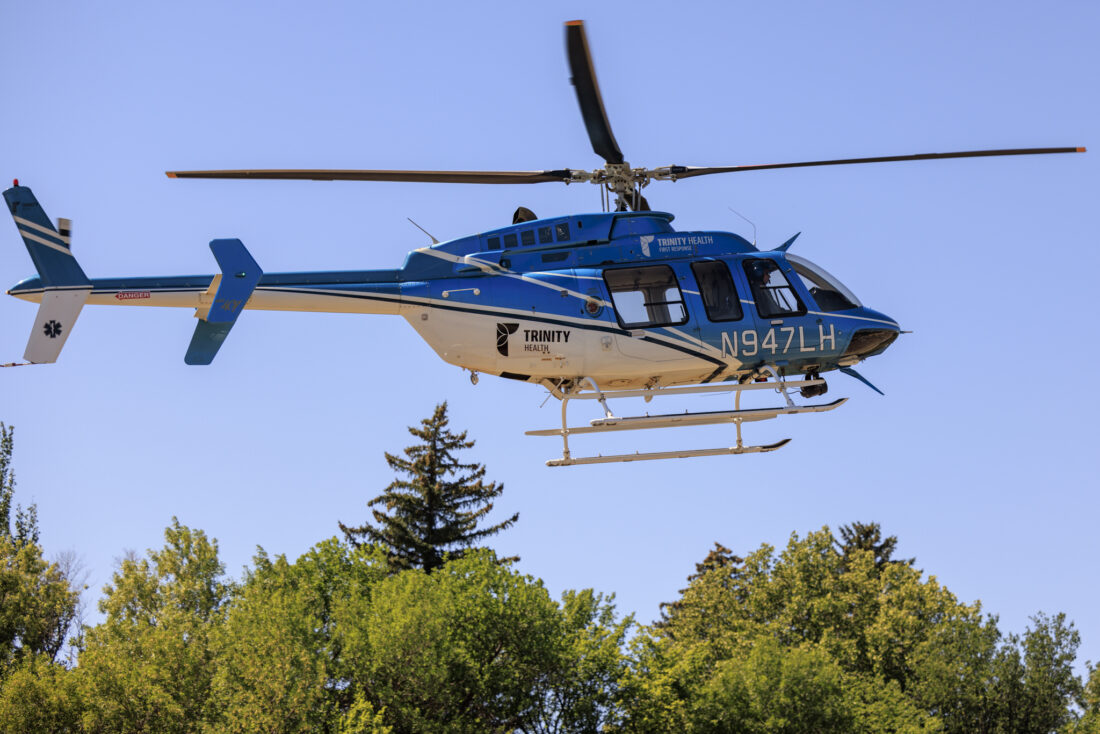
Submitted Photo First Response Air is a common sight, flying hundreds of lifesaving missions and maintaining a spotless safety record.
It’s been 30 years since North Dakota residents first witnessed a two-toned helicopter flying overhead, its distinctive hum droning in the distance. Since then, First Response Air, formerly NorthStar Criticair, has become a common sight, flying hundreds of lifesaving missions while maintaining a spotless safety record.
First Response Air was established in 1992 as an extension of Trinity Health’s critical care program. It provides rapid delivery of lifesaving care to patients within a 150-mile radius, which covers a vast rural stretch of northwest and central North Dakota. It then transports them back to Trinity Health Hospital in Minot.
“Our primary duty is to stabilize, package and transport patients to definitive care,” said flight paramedic Michael Melby, who recently flew his 400th mission with the air ambulance as part of an EMS career spanning 26 years, 10 with First Response Air. “Where we really shine is taking care of STEMI, stroke and trauma patients – anything that is time sensitive.”
Trinity’s acute care hospital is the region’s only level II trauma center and the sole provider of definitive treatment for STEMI heart attacks and stroke. The ability of a rotary-wing aircraft to transport patients within a preferred and timely treatment window makes First Response effective.
Regarding STEMI heart events, Melby states, “We’re equipped with12-lead EKG so we can capture and transmit the readout to the emergency physicians back at Trinity. That allows us to bypass the ER,” he explained. “The ward secretary registers the patient; a STEMI alert is called, and the patient goes directly to the Cath lab for reperfusion. It’s a very cool process.”
Similar processes allow patients to receive care for stroke and other time-sensitive conditions as well as trauma resulting from accidents or disasters.
Flight teams consist of a paramedic, critical care nurse and pilot, who maintain contact with hospital-based providers during the mission, depending on the type of emergency – adult/pediatric, high-risk neonate or high-risk labor/delivery. Medical director Jeffrey Verhey, MD, a critical care and pulmonary specialist, oversees such clinical aspects as stocking medications. Dedicated crews and equipment enable the craft to be airborne within 15 minutes of receiving a call.
When not flying a mission, crew members circulate in the ER, ICU or elsewhere in the hospital. Melby recalls one of those days when a patient came to the ER.
“He was a younger gentleman with a son. He came in with a STEMI and went into ventricular fibrillation (a life-threatening arrhythmia). We knew he was in trouble,” he said.
It took multiple defibrillation attempts, but finally they were able to convert his heart to a normal rhythm and get him to the Cath lab for intervention.
“I saw him a couple of days later,” Melby continues. “He was on the elevator. He didn’t know who I was, but I heard him say to his son, ‘Let’s go home.’ I thought – this is why we do this stuff.”
Some patients require specialized care outside the region, so in 2015 Trinity Health added a fixed-wing plane to its emergency transport fleet. First Response fixed wing can transport patients with specific needs to specialized hospitals within the continental United States. For example, patients can be flown to the burn center in St. Paul, Mayo Clinic in Rochester or a rehabilitation center in Denver.
Last year, in a move to integrate its ground and air ambulance services, Trinity consolidated emergency transport under a single umbrella – Trinity Health First Response. The new department combines rotary and fixed wing air ambulance services with Trinity’s ground ambulance, EMS education and First Call dispatch. The move has facilitated a more collaborative approach to prehospital emergency care, according to Melby.
“Working with the ground team is great,” he said. “Ground ambulance services are the heartbeat of our whole industry. When we’re on scene for an extrication, First Response Air will take the patient who’s most critical and Ground will take those less acute or call another flight service if needed. We have a good working relationship. All of us have the same goal; we’re trying to make people’s lives better.”
With the move to Trinity’s new Healthcare Campus and Medical District, both Air and Ground will be able to better serve patients. A dedicated ramp will guide ground ambulance vehicles into one of four enclosed ambulance bays equipped with heat and electronic doors. The helicopter will be able to land on the same level as the ER – no need to land on the hospital roof and traverse through the hospital to the emergency department.
“That alone will cut transfer time down to a minute or less,” said Amy Thomas, director of Trinity Health First Response. “It’ll be a game changer.”
Local News

Time capsule, sculpture highlight pioneer reunion
Defendant in Spirit Lake shooting pleads guilty
A Fort Totten man has pleaded guilty to two separate counts of assault and voluntary manslaughter in U.S. District ...

Moen Family musicians return to Frozen Fingers Festival

Accommodating growth

Discovery well anniversary