Council keeps CTE on schedule
City to use Hub City money to fill gap
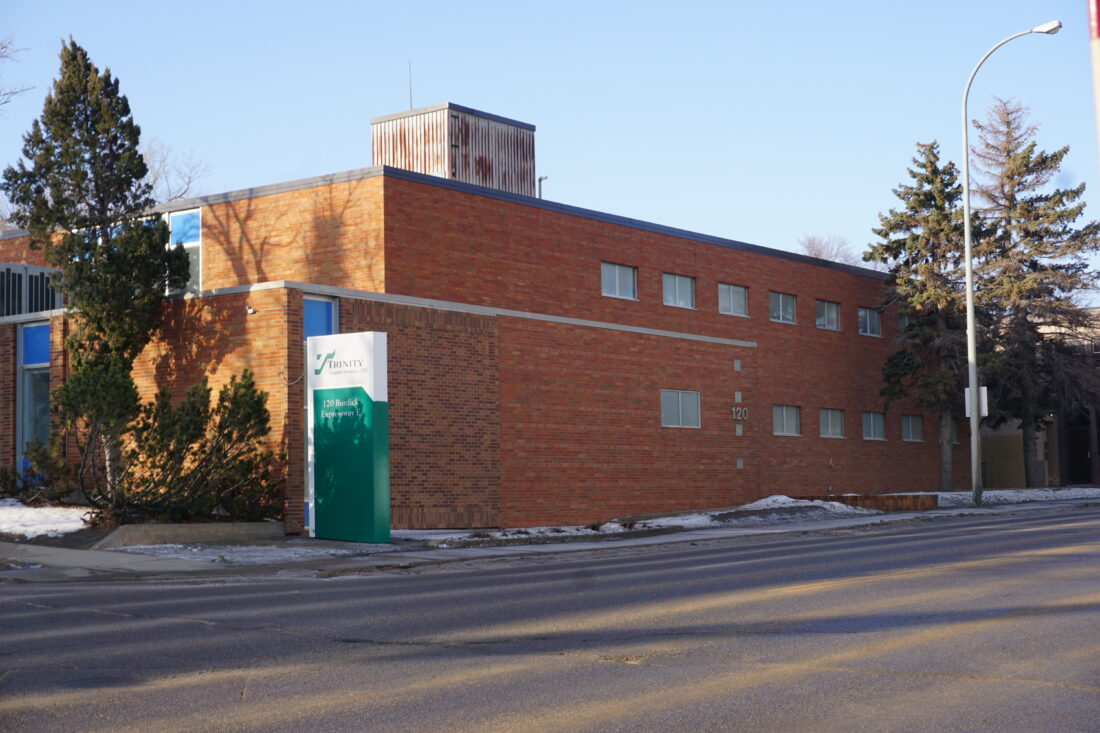
File Photo A downtown building on Burdick Expressway, purchased from Trinity Health, is scheduled for renovation into a career and technical education center.
Building renovation for Minot’s future career and technical education center will get started with the Minot City Council’s decision Monday to infuse the project with an additional $1.84 million.
The council voted to use a portion of the Hub City money it receives from the state as an oil-impacted community to fill a financing gap between construction bids and funds available.
The city previously had shifted its plans to just remodel the building’s first floor, postponing the second floor, but even with that change, bids came in beyond funds available. Council member Lisa Olson, who has been the city’s lead on the project, proposed an additional $1.84 million, which will accomplish remodeling of both floors and allow development of more programs more quickly. Failure to approve the funding would delay the project a year or more, she said.
“By using Hub City funding, we are allocating state funds to complete the project. The overage is not falling on the backs of our local taxpayers. Rather, it is using monies earned through energy sector businesses to address the need that we see in northwest North Dakota,” Olson said.
City Finance Director David Lakefield said the city has about $7.4 million on hand from Hub City funding, which typically is spent on infrastructure projects. However, only about $2 million is unallocated in the 2022 budget.
“We would have enough funding there to carry out this project,” Lakefield said. “We would anticipate additional collections before the end of the year as well.”
The CTE program was developed as one of the proposed projects submitted in competing for a National Disaster Resilience grant after the 2011 flood. Upon receiving the grant, the city worked with Minot State University and Dakota College at Bottineau on curriculum and operations.
“Though this process has been long, there always has been support for it. However, because the process has been lengthy, the costs have increased, just as all projects that we see come before us,” Olson said.
The council saw a need to get moving on the project because a dental assisting program is set to launch in August 2023, followed by a dental hygienist program.
Carmen Simone, DCB dean, told the council there will be 12 dental assisting students a year. There will be 10 hygienists a year, or 20 students total in the two-year program.
“This dental foray is really a heavy lift for us, and two programs that are very much needed in western North Dakota,” Simone said. Having a second floor available will allow the CTE to support additional workforce training, she added.
Olson pointed out that there are students already taking the prerequisites to enter the dental assisting program next August.
“We know that the word is out there and that the momentum is moving forward,” she said. “We firmly believe that as long as we can get that construction taken care of, we’ll be able to have students there.”
Total cost of the base bid and architect fees came to nearly $4.7 million, according to the city. The allocation of $3.4 million in NDR funds left a funding gap of $1.3 million just to convert the first floor into a CTE and offer one dentistry program.
Finishing the second floor was bid at $545,911. To do the entire internal remodel will cost more than $5.24 million, prompting the $1.84 million allocation from the Hub City fund.
Other options offered to the council by staff included directing DCB and MSU to find the extra funds; delay or kill the CTE project; use carryover sales tax funds that otherwise would go to major city projects or equipment replacement in future budgets; use MAGIC Fund dollars; or reallocate the $1 million in additional funding budgeted in 2023 for road infrastructure.
The city had spent $800,000 from the MAGIC Fund for the purchase of the CTE building from Trinity Health.
Local News

Time capsule, sculpture highlight pioneer reunion
Defendant in Spirit Lake shooting pleads guilty
A Fort Totten man has pleaded guilty to two separate counts of assault and voluntary manslaughter in U.S. District ...

Moen Family musicians return to Frozen Fingers Festival
Accommodating growth

Discovery well anniversary