Minot City Council debates garbage pickup schedule
Council debates once-a-week garbage pickup
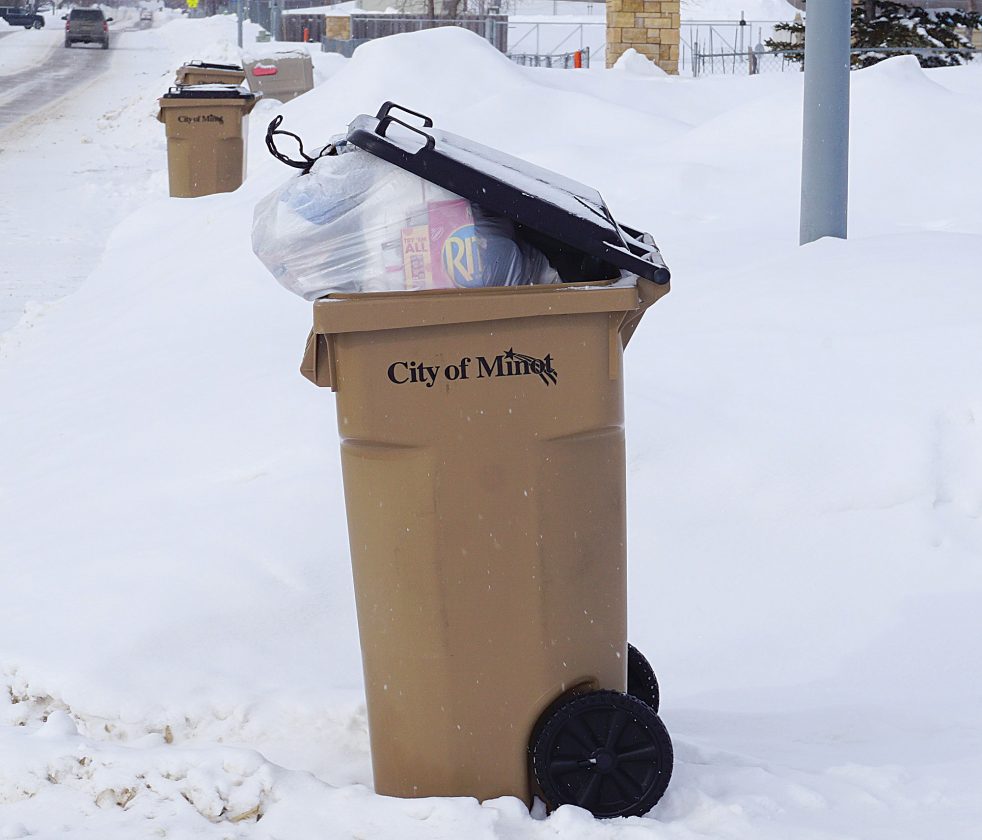
File Photo An over-filled trash cart sits on the curb in southeast Minot this winter. The Minot City Council is debating both recycling and a less frequent pick-up schedule.
Once-a-week garbage collection in Minot would save money, if residents are willing to accept the reduction in service, according to a report delivered to the Minot City Council Monday.
The report created by the Minot Public Works Department at the request of the council found savings of $217,000 to $310,000 a year, depending on the amount of sanitation equipment deployed. The savings to a household would vary from $1.42 to $2.04 a month, or a 9 to 12 percent reduction in collection fees. The current monthly fee of $14.72 to $17.72, depending on container size, covers services other than twice weekly pickup, such as compost sites, hazardous waste collection and clean-up events.
“Before we make an ultimate determination on one or two days service, I would like us to consider some type of recycling program or better collaboration with KALIX – where that is considered maybe before we move house and home into a full-on curbside recycling program,” said council member Shannon Straight, who suggested investigating a drop-off recycling point at the landfill.
Kalyn Dewitt Vadell of Minot, who spoke about recycling last month, again asked the council to continue talking about recycling.
She asked the council to determine the household cost of a curbside program but also asked for a look at the associated savings in landfill operation.
“North Dakota emits 55 million tons of carbon dioxide annually, which contributes to the climate change that directly affects Minot and the surrounding areas,” she said. “We can stand by and and pretend that we’re not contributing to climate change. But we can’t expect other people and other cities to take care of the problem when we are personally contributing to it.”
Based on the amount of trash produced in Minot, she added, “We could save about 90,000 tons of carbon dioxide by recycling.”
Dustin Evanoff of Minot also advocated for recycling.
“Of course, it can cost a little money but you’ve got to think of our future as well,” he said. “It’s a little bit of money on the water bill, but at least give the people the option to have that.”‘
Regarding fewer pickup days, council member Josh Wolsky noted fewer containers are set out later in the week as compared to Mondays and Tuesdays.
“I look at that, and I question whether we are as fully optimized as we can be. It seems like we are driving by a lot of potentially empty cans,” he said. “Are we over-servicing?”
Council member Lisa Olson said those who want twice a week pickup feel they are in the majority.
“They feel that that’s what they’re paying for. They are used to that service. They want to keep that service,” she said.
“There’s a lot more discussion that needs to take place because it certainly coincides with whether or not recycling is part of this conversation,” Mayor Shaun Sipma said. He promised more discussion in coming months.
–
Minot hopes for more flood money
A Senate bill with money for Souris River flood control is about $35 million short of what’s needed to keep the construction project advancing on schedule, City Manager Tom Barry told the Minot City Council Monday.
SB 2020 provides about $65 million for the Mouse River Enhanced Flood Protection Project.
“We continue to work this bill, and it looks like maybe we’re inching our way north of this $65 million mark, but that we are going to fall far short of the $100 million mark,” Barry said. “There’s enormous pressure coming from Fargo for their flood control needs, and, of course, the Legislature’s having to figure out how they’re going to appropriate all that money for all of the needs across the state.”
The Legislature also defeated Senate Bill 2275, which would have provided loan money for projects such as flood control. Legislators did pass the Operation Prairie Dog bill, which will provide Minot with $4 million to $8 million a biennium for infrastructure projects.
However, Barry noted Minot’s five-year capital improvements plan totals $400 million.
“I can tell you we still have more needs than we have funding,” he said.
Legislative passage of a bill prohibiting cities from imposing a surcharge on building permit fees for residents in the two-mile extra-territorial area means the City of Minot will be reviewing its surcharge policy later this year.
Legislative impacts will be among the topics at the city’s first community town hall meeting, scheduled for May 8.
Barry said the city will be increasing its efforts toward community engagement. A community focus group will be formed to provide guidance into community engagement strategy development.
– Jill Schramm
Local News
County faces digital accessibility deadline
Ward County is working under a time crunch to comply with new federal rule regarding access to a government’s ...

Minot VFW Post donates Teddy bears
Suspect arrested in theft investigation
The Minot Police Department’s investigations into a stolen credit card and vehicle this week received a break on ...
Minot High adopts new secondary logo
Minot High School has officially adopted a new secondary logo amid an ongoing trademark dispute with the University ...
Victim of crash near Towner identified
TOWNER — The North Dakota Highway Patrol has identified the victim of a one-vehicle rollover near Towner Tuesday, ...